Roc Casagran: "I liked the teachers who talked about current events and dropped reflections"
The winner of the 2024 Sant Jordi Novel Award liked to read, write, and do mental calculation, which shows that learning does not need to be compartmentalized

-
CAT -
CAST
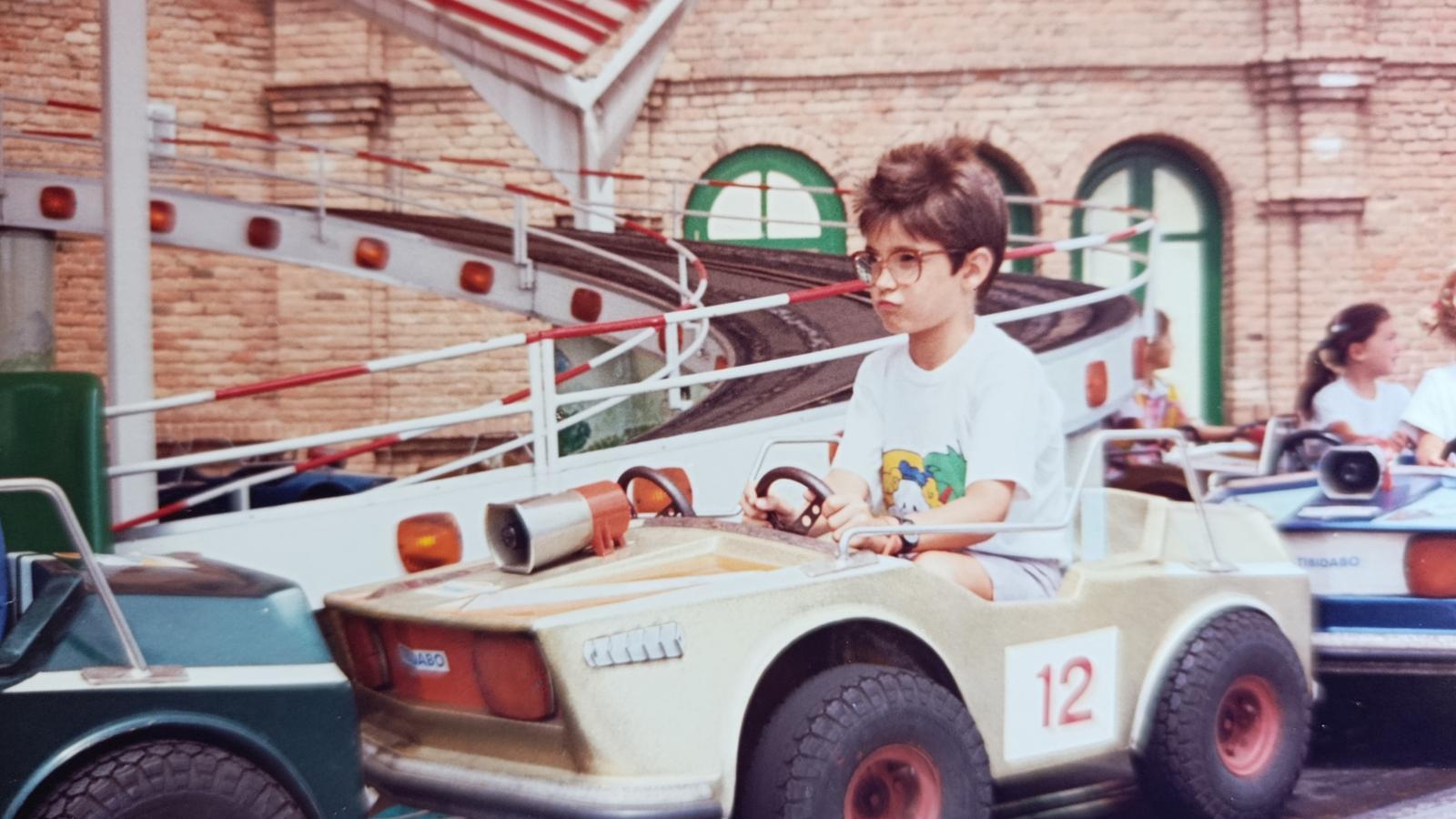
The writer and secondary school teacher Roc Casagran doesn't have many memories of primary school. He would summarize it as a few years in which he had a good time, played and enjoyed himself with friends, "which is what it was all about," he points out, and learned from his teachers: "I barely remember specific activities, except for mental calculation exercises, which I really liked. The important thing there was speed, they gave us 10 mental calculation problems and you had to answer quickly." It surprises him to remember precisely that, considering that he later leaned towards literature. "You know that adults tend to compartmentalize learning, but I like and liked reading and writing and also calculation; it's not incompatible," he assures. Until the first year of primary school he was enrolled at the Escola Nostra Llar in Sabadell. His parents have spoken to him several times about the teachers he had, wonderful professionals with whom he began the process of learning to read and write. "It's a shame I don't remember them, because I learned a lot from them," he comments. Then he went to Joanot Alisanda School, a school with a huge playground compared to the previous one, and which he took advantage of to play football: "I always stayed for lunch; this meant having more time to play and do our own thing. Playing, sweating, and having a good time." What he remembers most from this stage is when he discovered Paco Ibáñez and poetry in general. "It must have been in third or fourth grade, in Spanish class, when they played a song by Paco Ibáñez, and I loved it," he admits. Just as he is unable to name any teacher who marked him from primary school, from secondary school, at the Institut Pau Vila, also public and also from Sabadell, he already has more memories. Here he has more present the classes of the language teachers in general, and more specifically those of Antoni Dalmases, who is also a writer: "He was one of those who not only spoke to you about language and literature. I really liked the teachers who dedicated time to other topics that were not strictly the subject, they spoke about current events and dropped reflections," he comments. At the time, it seemed to him that perhaps they were not very relevant, but, even so, he was interested in the less academic "content" and especially that they treated him not as a small child, but as an almost adult. Another of the teachers who went beyond the content was the writer and Latin teacher, Antoni Pladevall, with whom they spoke about current events and politics.

He is convinced that, now as a teacher, even if unconsciously, he tries to emulate the teachers he liked. He believes that most worked with the trial-and-error formula: “I like to teach the subject and try to link it to daily life and our society. This sometimes involves straying a bit from the syllabus and listening to the students,” he explains. And he combines all this with demandingness. After years of experience, he has come to the conclusion that adolescents value teachers who are fair, even if they are demanding: “This is the memory I have as a student and what I try to do as a teacher.” Besides learning at school, the summer camp was an important source of learning. “This is where you were in contact with nature and you learned quickly and on your own, without the parents' cushion. It was another way of growing up, freer,” he explains. He is unable to remember the name of any of the counselors, but he champions education through leisure. In fact, when he was older he was a counselor at summer camps and some camping trips. Besides the "esplai", I did other activities. I had attended carpentry and DIY workshops, where I learned some knowledge that I claim to have completely forgotten. What I do have a very good memory of is the sports extracurriculars I did, football and table tennis. I started playing football when I was already in high school: “I got to know a quite different world; it was a kind of parallel universe that had nothing to do with the "esplai" environment. A reflection of the diverse society we live in, and the evidence that everywhere we can learn things”, he concludes.
