The EU and NATO accuse Russia of a "new escalation" in attacks against Europe: "It's the new normal"
Brussels considers the drone attacks on Leipzig airport as "state-sponsored terrorism"
-
CAT -
CAST
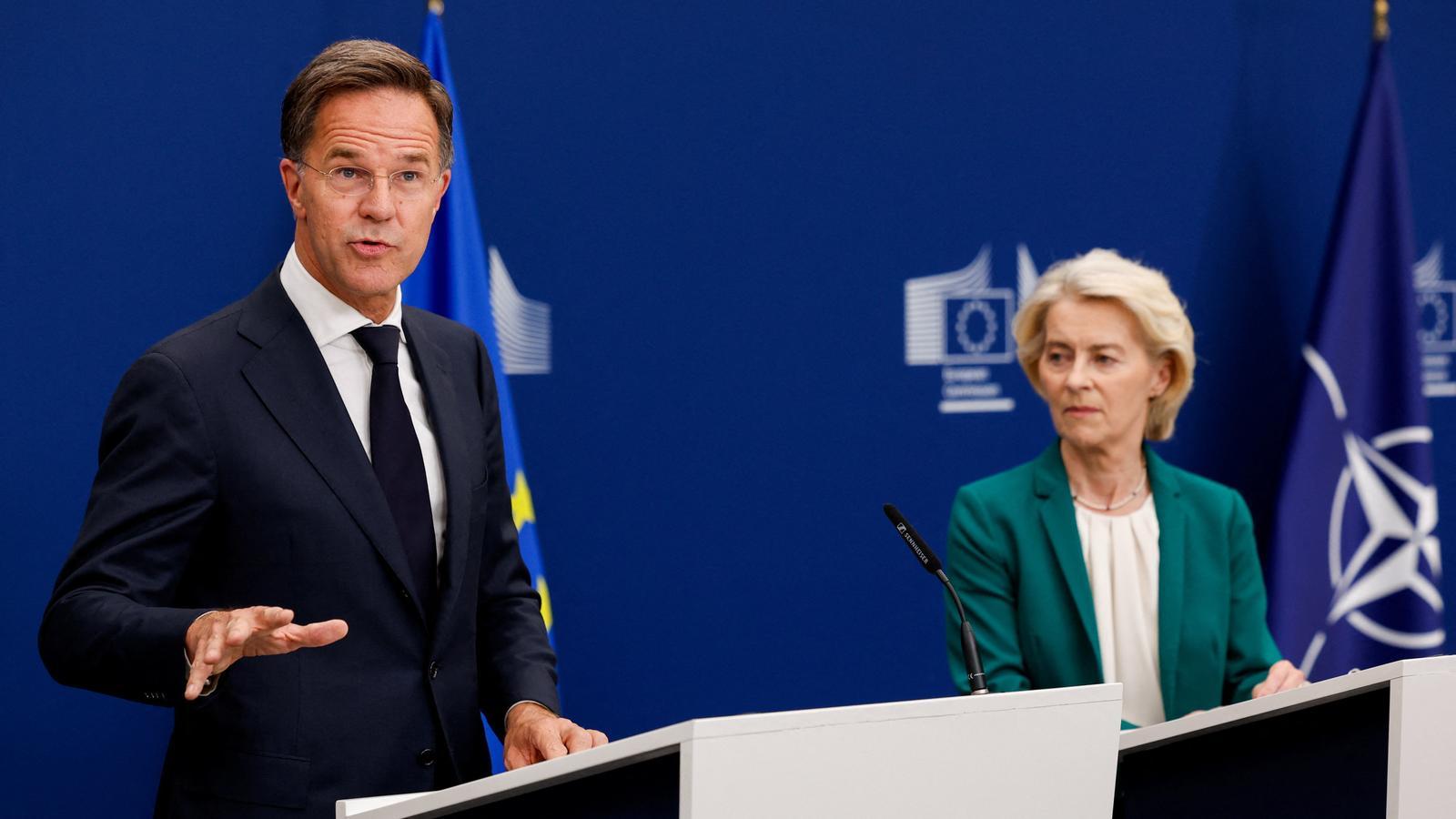
BarcelonaThe drone attack at the beginning of August on the German airport of Leipzig has put the European Union and NATO on alert, who view with concern how incursions with military aircraft into European territory are becoming increasingly frequent. The day after German authorities held Russian intelligence services responsible for the Leipzig incident, this Wednesday the President of the European Commission, Ursula von der Leyen, and the Secretary General of the Atlantic Alliance, Mark Rutte, met urgently in Brussels, and they have pledged to increase pressure on Moscow.
"It was an attack with military material, carried out by Russian agents on European Union territory," said Von der Leyen, referring to the incident in Leipzig, which she considered a "new escalation on European soil." On August 4, German airport workers found a drone loaded with explosives and a detonator at the facilities, an important logistics center for civilian and NATO cargo in eastern Germany that is also a base for several Ukrainian cargo planes. On that day, a collision of a second drone against a DHL cargo plane was also reported, and ten days later a third aircraft and more explosives were found, as reported last week by German media.
"Europe and NATO will not just maintain pressure on Russia. We will also increase it and we will not stop," assured the president of the Community executive. Von der Leyen stated that this incident "is part of a broader pattern of increasingly dangerous incidents" and lamented that "Europeans are facing the harsh reality that this is the new normal."
She cited recurrent incursions into European airspace, drones paralyzing airports, and interference with critical infrastructure, and argued that Europeans must "take a step forward," which means "being prepared to respond to Russia's recklessness more quickly and effectively."
Rutte also warned that Russia has become "increasingly reckless" and considered that the arms industry needs to "take a step forward" with new factories or production lines, but that it is also necessary to "facilitate cooperation" between companies in the sector, both within Europe and throughout the Alliance, which includes the powerful industry of the United States. Furthermore, he assured that support for Ukraine will not stop due to Russian attacks: "If Russia thinks that the threat will divide us, or if it thinks it will dissuade us from supporting Ukraine, it is mistaken," he said.
"State-sponsored terrorism" by the Russian state
The head of the European Union's foreign policy, Kaja Kallas, has said that the Leipzig attacks have "all the hallmarks of state-sponsored terrorism" and has also promised to respond "with determination." She said this during an informal meeting of Foreign Ministers in Ireland, where she stated that the EU is working to increase sanctions against Russia.
Kallas said there is "broad support" among ministers to move forward with a ban on EU entry visas for former Russian combatants and to impose tougher visa restrictions for Russian tourists. She also said that several states – including Spain – have once again raised the idea of using frozen Russian assets to fund Ukraine and that discussions on this matter will continue.
However, Belgium's Foreign Minister, Maxime Prevot, insisted that his country's position has not changed and it continues to be against this measure due to the legal doubts it raises among the authorities of the country holding the vast majority of the Russian assets that are intended to be used. "I have made sure to reiterate Belgium's position, which has remained unchanged for a year. The reasons for our opposition have not magically disappeared in the meantime," he said. And he argued that "using these assets through a process equivalent to confiscation would entail very significant risks."
Following the conclusions of the German authorities regarding the authorship of the Leipzig attack, the EU and several EU member states have summoned officials from Russian embassies, and Germany has announced that it will close its consulate in Bonn and terminate its agreement with the Russian House cultural center in Berlin. For its part, the Russian Foreign Ministry has summoned the German chargé d'affaires in Russia to reject what it has described as Germany's "totally fabricated" accusations against Russia. The change in tone from Berlin, the engine of the EU but one of its historically softest partners with Moscow, anticipates a paradigm shift in Europe.
