Brussels wants to decide the conditions of the 'Breturn'
The new geopolitical context pushes London to seek a rapprochement, but the EU warns that it will not accept "a la carte" agreements
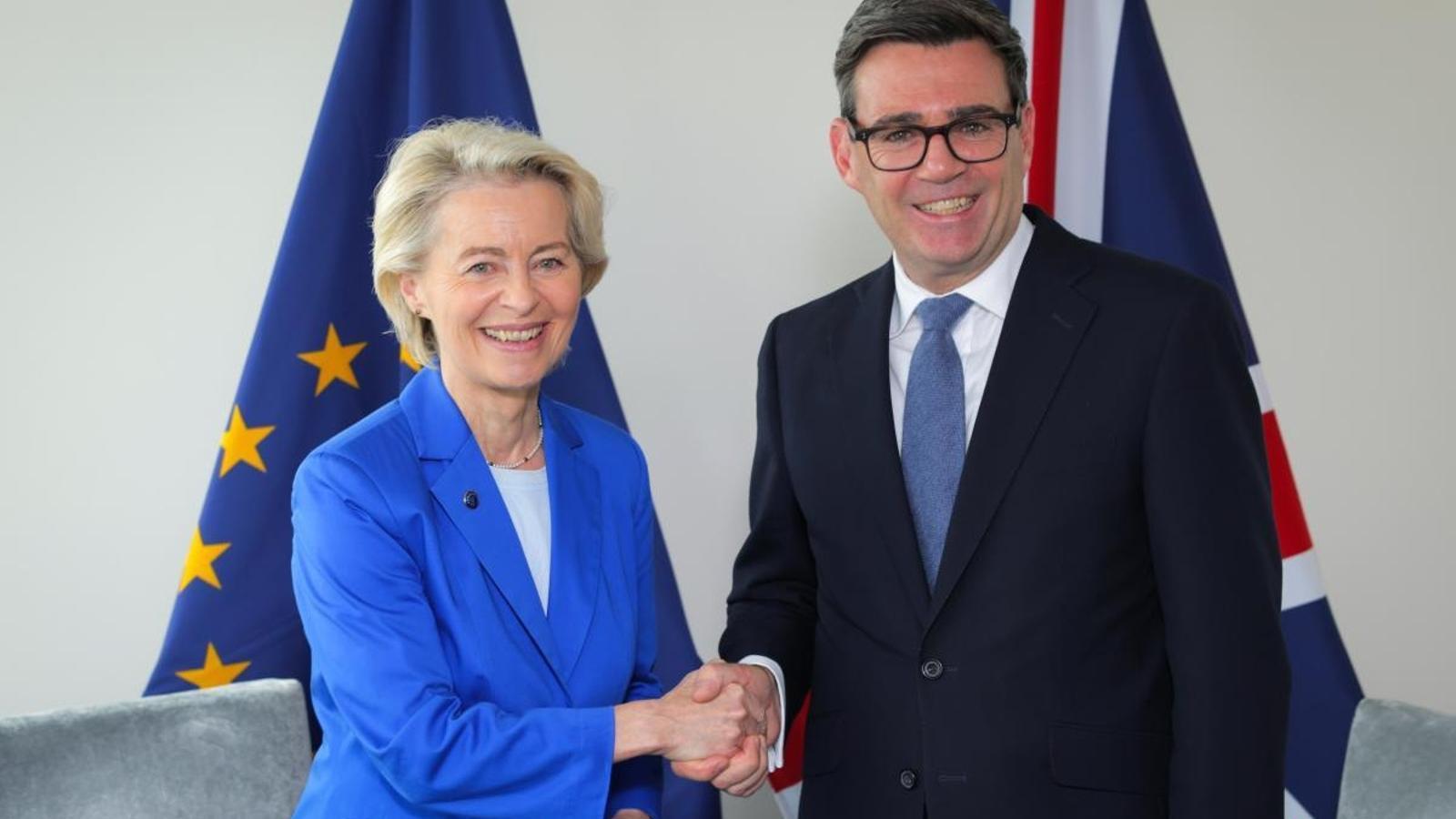

BrusselsWhen the British voted in 2016 to separate from the European Union, the decision fell like a bucket of cold water on every capital. A net contributor to the bloc was leaving, one of its great economic and military powers and one of its most influential members. A decade later, the British Prime Minister, Andy Burnham, has opened the door to the possibility that the United Kingdom might turn back. But would the European Union want to accept them?
In these ten years, on both sides of the English Channel, it has been noted that the expectations that had fueled the separation have not been met. Neither has the United Kingdom experienced the economic boost that Brexit supporters promised – in fact, its economy is in deep recession – nor has Brussels fared so badly without London. The circumstances, therefore, are very different from those that led to the rupture. If at that time it was the United Kingdom that forced its partners to negotiate the terms of the separation, now, in a turbulent geopolitical context marked by the Russian threat, the unpredictability of the United States, and Chinese competition, it is the EU that has the opportunity to decide the terms of a possible Breturn, the concept that has begun to be used to refer to London's approach to Brussels. And it is the United Kingdom, reluctant to be left out in the geopolitical and commercial cold, that has incentives to join.
London and Brussels are experiencing a new honeymoon since Burnham's arrival at Downing Street; Ursula von der Leyen's rapport had not been this good with any of the four predecessors with whom she has overlapped since becoming president of the community executive. Both leaders will have the opportunity to display this complicity on November 20, at a summit that will be organized in the community capital to stage this approach.
The rapprochement between the EU and the United Kingdom began in September, during a meeting on the sidelines of the United Nations General Assembly in New York. As reported then by the Financial Times, the British premier shared with Von der Leyen the concern that British companies might be excluded from made in Europe, the bloc's new industrial policy to combat Chinese competition by favoring EU companies in subsidies and public contracts.
That conversation caught the community leaders by surprise. But, since then, all the leaders who have spoken out about a possible Breturn have received the proposal with open arms. "Welcome back", reacted the French president, Emmanuel Macron, in English at the end of September, after Burnham raised the possibility of rejoining the bloc. "It is very good news, both for his country and for Europeans," he stressed. In a similar vein, the Spanish prime minister, Pedro Sánchez, the Danish prime minister, Mette Frederiksen, and the president of the European Parliament, Roberta Metsola, have expressed themselves, to cite a few examples.
That the European Union has many reasons to want to get London back is a consensus. On an international scale, it is not only a great military and nuclear power, but also a state with a seat on the UN Security Council. In the economic sphere, it is one of the world's great financial centers. But what is the price that Brussels would be willing to pay?
The trap of "à la carte selection"
At this moment, the most plausible scenario is that the United Kingdom seeks to "join the customs union or the single market without being a full member of the EU," explains Michael Emerson, an associate researcher at the think tank CEPS, to ARA, highlighting that these options are the most sensible in economic terms. However, entering the single market would clash head-on with one of the great battlegrounds of British domestic policy: immigration. This framework requires accepting the indivisibility of the four fundamental freedoms of the bloc – circulation of goods, services, capital, and people – a fact that would force London to give up exclusive border control for EU citizens.
That is why European states warn that they will not allow the British neighbor's accession to sacrifice the integrity of the common market. Taking into account the United Kingdom's historical trajectory within the bloc – marked by constant exceptions such as remaining on the sidelines of the euro and the Schengen area – diplomatic sources indicate to this newspaper that they will not tolerate "cherry-picking." "Either the customs union or both things," they state.
A warning that Emerson also shares: "The idea of trying to join only the parts of the single market that are most favorable for the United Kingdom is an illusion, as it would most likely be rejected by the EU," he warns. Thus, the researcher believes that any reopening of accession talks would lead to difficult negotiations in which Brussels would demand renouncing old privileges and exceptions –opt-outs or the British rebate –, which would cool London's enthusiasm for re-entry.
Meanwhile, the rapprochement is making headway through sectoral agreements. Regarding industrial urgencies, France and Germany have already indicated that they would accept including the United Kingdom in the made in Europe legislation, provided that the Burnham government aligns with the EU's tariff position against Chinese electric vehicles. Also on the summit's table are three other folders where a consensus could be reached more immediately: an agreement to eliminate health checks and bureaucracy in food exports, the United Kingdom's re-incorporation into the Erasmus mobility program – with the uncertainty of who will cover university fees – and a coupling in defense matters to strengthen cooperation in key folders such as military aid to Ukraine.
