Andy Burnham lashes out against Brexit: “We have lost more than we have gained from it”
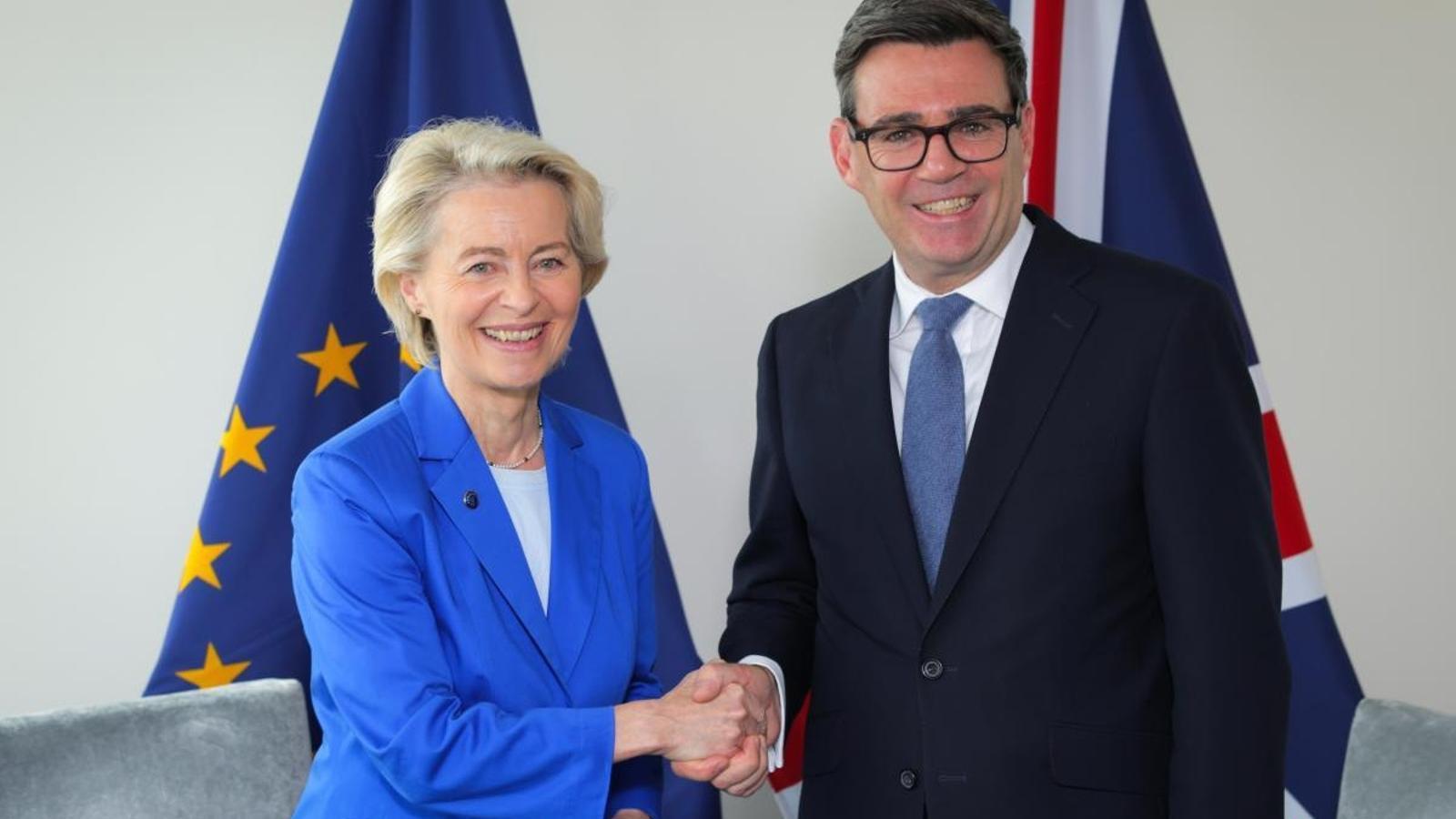
The British prime minister will sign a new agreement with the EU on Friday in Brussels to eliminate trade barriers and facilitate youth mobility
-
CAT -
CAST
LondonJust as the king was naked and nobody told him, Brexit has been a failure and few voices in British politics have dared to raise their voices to say so explicitly. But Andy Burnham has it firmly in his sights and takes every opportunity to remind the British of the serious mistake it was to leave the European Union, just over a decade ago.
And this Monday night he will insist on it at one of the most solemn and formal events of the British institutional calendar, the so-called banquet of the Lord Mayor of the City – the financial district –, where traditionally the prime minister gives a speech on foreign policy.
And apart from the obligatory mentions of Iran and Ukraine, two centers of global destabilization, with four days left until the summit between the United Kingdom and the European Union, in which London intends to establish a renewed relationship with the Twenty-seven, the premier will not mince his words, according to the advanced fragments of the speech: “An unnecessarily hard Brexit has created barriers for businesses and the promise to regain control” of the borders has not been kept. Burnham says about Brexit: “It is like the tale of the emperor’s new clothes: nobody dares to speak an obvious truth. Well, I say things as I see them. And, frankly, the emperor is naked”. In other words: “The Brexit we have been given has not worked. We have lost more than we have gained from it”, he says.
To try to recover part of what has been lost, Andy Burnham will arrive in Brussels on Friday with some very clear intentions. To establish a series of sectoral agreements, without currently proposing a return to the single market or the customs union. This new condition would only be adopted after a general election, in which the Labour Party had presented an ad hoc proposal within its manifesto, and even the possibility of a new referendum to rejoin the European Union.
For now, however, the priority is to eliminate barriers to agri-food trade with a sanitary and phytosanitary agreement that would allow for the reduction to zero of veterinary checks, inspections and red tape, which have made British exports more expensive, especially those of small producers. London also wants to harmonize its CO₂ emissions trading system with the community one to facilitate trade and avoid additional costs for companies.
Another of the objectives is to establish a youth mobility program that allows British and EU citizens between 18 and 30 years old to live temporarily, for up to four years, in the other territory, whether to study, work or travel. The number of participants is still a subject of negotiation. Some leaks suggest it could be around 80,000 places. The British government calculates that all the agreements together could contribute 12 billion pounds to the economy in the long term, 0.4% of GDP, of which about 5 billion would correspond to the agri-food sector. A good part of the benefits, however, would come from bureaucratic savings for exporters. In any case, there are no guarantees that this will translate into a decrease in food prices.
An example of waste
The trade-off that Burnham has to accept is that the United Kingdom will have to align with European rules in the areas covered by the agreements, without having a vote in the drafting of these rules. London does demand, however, to be able to participate in technical discussions and have a voice in the decisions it will have to implement, especially regarding food matters. The government argues that it is preferable to have influence in the deliberations than to remain completely on the sidelines. But the formula highlights the limits of the new status and what was lost with Brexit: the United Kingdom will recover the practical advantages of the relationship with the community market without recovering the decision-making capacity it had as a member of the EU.
The new agri-food agreements between London and Brussels will highlight one of the many absurdities of Brexit: the uselessness and waste of public resources allocated to the infrastructure built to enable customs controls, which have now fallen into disuse and are condemned to demolition. In Portsmouth, the second-largest port on the English Channel, an enormous inspection complex was built, with 17 cold rooms and freezers, laboratories, and 14 loading docks, prepared to inspect 80 trucks per day. The facilities were intended to carry out sanitary and phytosanitary controls on goods arriving from the European Union before entering the United Kingdom.
But last year, Keir Starmer's government ended up suspending the inspections due to bureaucratic complications and the problems they caused. The 23 million pounds invested in the project have thus remained as little more than a testament to irrationality. The government contributed 17 million and the Portsmouth City Council 6, which is now claiming them back, because it is an accumulated debt of money that could have been used for social service bills. All of this is an eloquent example of the profligacy of Brexit that Andy Burnham wants to curb. Friday's summit is a first step. But the "Britorn" (the return of the British to the EU) is, for the moment, a chimera.
