The ultraconservative wave strikes Lula, who loses the first round against Bolsonaro's son
Flávio Bolsonaro gets 2.2 million more votes than the veteran leader and has everything in his favor to reach the Palácio do Planalto in the second round on the 25th.

-
CAT -
CAST
Sao PauloThe Brazilian president, Luiz Inácio Lula da Silva (80 years old, Workers' Party, PT), the most influential leader of the left in Latin America in modernity, has suffered this Sunday an electoral defeat that augurs a sad political end for him. A minor figure of low standing, the firstborn of the Bolsonaro clan, Senator Flávio Bolsonaro (45 years old, Liberal Party, PL), has obtained a somewhat unexpected triumph in the first round of the presidential elections.
The far-right candidate, handpicked by his father, former President Jair Bolsonaro—who is serving a 27-year prison sentence for an attempted coup—has obtained 47.03% of valid votes, compared to 45.16% for Lula da Silva, representing a gap of 2.2 million votes. 56,104,049 for the Bolsonarista candidate and 53,876,219 for the PT leader.
Eroded and unable to transform the work of government into electoral capital, Lula has hit a ceiling at the polls. Unlike what happened in 2022, this time the PT has been unable or did not know how to broaden its base. Back then, the candidate for re-election, Jair Bolsonaro, aroused great rejection among centre and centre-right sectors due to the catastrophic management of the pandemic, which cost 716,000 lives. The left, with negotiating skill, championed a broad front candidacy and the defense of democracy.
This is a personal defeat for Lula da Silva, who since the 2002 presidential elections, which brought him to power for the first time, had accumulated five consecutive victories at the polls. He now sees his legacy at stake, because a definitive triumph of Bolsonarism could represent a regime change in the country. The veteran leader is still the hope of the continental left to stop the unstoppable advance of the far-right in Latin America, successfully sponsored from Washington by Donald Trump and his Secretary of State, Marco Rubio, who has a special obsession with the region due to his Cuban family origins.
“The end of the PT”
Bolsonaro's son has been favored by the concentration of tactical voting –the other far-right candidates dehydrated in the final stretch and only had 4.70% of support– and by the hidden shame vote, imperceptible in the polls.
The scenario that emerged from the first round is entirely positive for Bolsonarism, which still has room for electoral growth ahead of the appointment on Sunday the 25th. Furthermore, electoral history since the Brazilian redemocratization indicates that the winner of the first round has confirmed their triumph in the second round.
The firstborn of the Bolsonaro clan, whose rise was already pointed to by polls in the days leading up to the elections, has brought together all the anti-PT and anti-Lula sentiment that permeates a polarized country and that large media conglomerates have been fueling for decades. Recently, moreover, with the help of the far-right bot ecosystem that spreads fake news and social media algorithms.
“I am very happy with the results, we were very close to winning definitively in the first round. The word of the day is change. Brazil wants a change, this is the interpretation I make of what has happened. It is the end of the PT era, the change in the country is already decreed”, said, euphoric, Flávio Bolsonaro in a clumsy and simplistic speech like the ones his father used to give.
Nothing takes its toll on him
No scandal, neither the recent ones nor the baggage of alleged corruption cases, has affected the electoral performance of Senator Flávio Bolsonaro, whose main government point is the amnesty for his father and all those sentenced and imprisoned by the Supreme Court for an attempted coup d'état. "His past is dark," Lula da Silva pointed out early this morning.
In this electoral campaign he has been accused of having participated in orgies with prostitutes, of which there is photographic material from one of his associates, and to which the television propaganda of Lula's candidacy has made reference.

The winner of the first round is involved in the Master Bank case, an entity liquidated by the Brazilian Central Bank and considered the most significant financial scandal in the country's history, with a hole of 7.8 billion euros (47 billion reais), which had to be covered by the Credit Guarantee Fund. Bolsonaro's son negotiated with the bank's president, Daniel Vorcaro, who is in preventive detention, contributions worth 24 million dollars – of which the Federal Police has some recordings – for the project to make a biopic of the far-right former president, which according to the investigations opened at the Supreme Court could actually be a mechanism to embezzle public funds.
The far right sweeps the Senate
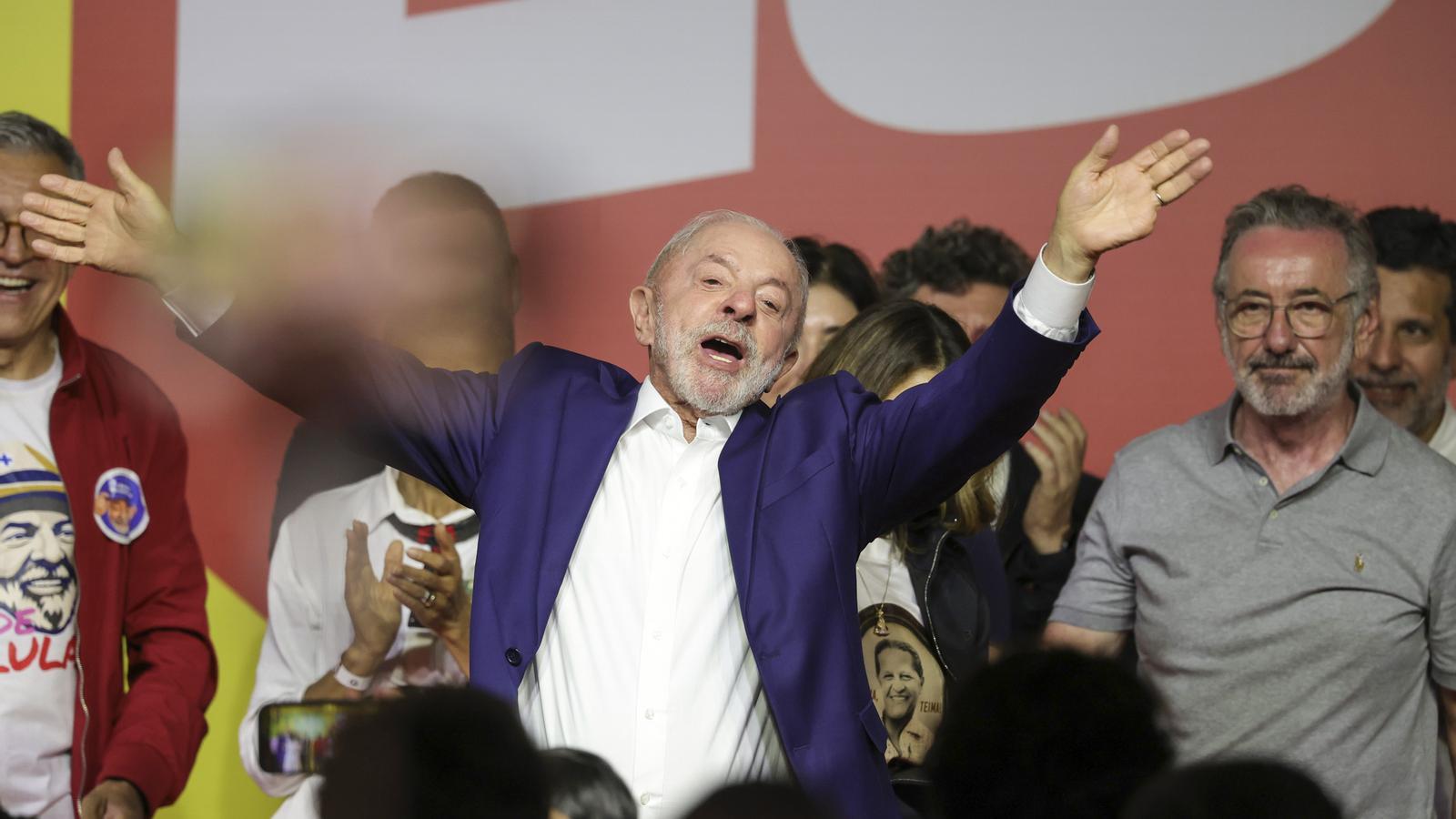
Lula's defeat is not isolated, but rather framed within the expansion of the far-right in the legislative power and in the states and regional Parliaments. The ideological situation is very negative for the still-president, and during the scrutiny, pessimism has taken hold of the most progressive electorate. Even so, the veteran leader, in his first public appearance, wanted to inject encouragement.
“I confess that I was convinced that I would win the elections in the first round; the results are unexpected. However, the game is just beginning. We are in overtime and we will convince the Brazilian people of the importance of continuing with the project of technological and scientific development, the exploitation of rare earths and critical minerals, and we will show how the growth of the new industry in Brazil will be,” he pointed out from São Paulo. “I am very good at head-or-tail games. In the face-to-face. Now we will see what projects the country has,” he said.
With a consolidated polarization, the big winner of yesterday's day is Jair Bolsonaro. In one of the last rallies before being imprisoned, he expressed that the priority for these elections was to strengthen himself in the legislative power. “If you give me 50% of the Congress and the Senate, I will change the destiny of Brazil. It does not matter where I am, whether here or in the hereafter, whoever assumes this leadership will command more than the president of the Republic”, he said. The goal of the far-right, in a message that had taken hold among its electorate, was to strengthen itself in the Senate to be able to promote impeachments of the Supreme Court judges and change their political color. In the spotlight is Alexandre Morães, also involved in the Banco Master affair and who led the entire trial of Bolsonaro's imprisonment.
This Sunday, when two-thirds of the upper house were being renewed, the Liberal Party obtained 19 new seats and became the main caucus, with 28 senators. And the Bolsonaro family has emerged greatly strengthened: Michelle Bolsonaro, the current wife of the former president, was elected senator for the Federal District in her first electoral participation, and one of the former president's sons, Carlos, was also elected for the state of Santa Catarina, even though he had never had any connection there because he had spent his entire career as a councilor at the Rio de Janeiro City Council. The youngest son of the clan, Jair Renan, elected federal deputy for Santa Catarina, will also be in Brasília, but in Congress.
