The past as an electoral weapon: what is lost if the memory law is repealed?
Thousands of exhumations, the resignification of Cuelgamuros or the audit of looted assets remain up in the air
-
CAT -
CAST
BarcelonaIn memory policies in Spain, everything moves very slowly, because for every step taken, a thousand and one obstacles must be overcome. Over the last four years, the state government has pressed the accelerator, but it is a bit late and many of the projects may remain a dead letter after the elections on November 29th. In their electoral manifestos, both the PP and Vox have made it clear that they will repeal the 2022 Democratic Memory Law.
What has happened in the autonomous communities governed by the right serves as a laboratory to anticipate what may happen on a national scale. In Extremadura, the Junta initiated the file to declare the Cross of the Fallen of Cáceres, a Francoist symbol, a Good of Cultural Interest and protect it. In Madrid, the headquarters of the Community of Madrid, at the Puerta del Sol, has a very dark past: that was where the General Directorate of Security was located, where the Francoist police tortured. The Spanish government wanted to place a plaque there to commemorate it, but Isabel Díaz Ayuso managed to have the National Court provisionally suspend its declaration as a Place of Memory and, furthermore, she withdrew teacher training courses on Francoism. It is not always necessary to repeal in order to halt: in Andalusia, research programs were left to die and the Junta disassociated itself from the large mass graves. Four or five years ago, the Andalusian government participated in the exhumations of the Pico Reja grave, in Seville, or those of the La Salud and San Rafael cemeteries, in Cordoba. Currently, however, it no longer participates, according to the Ministry of Territorial Policy and Memory, in the Monumento grave (2,700 victims), at the Soledad cemetery in Huelva (1,100 victims), or at the San Eufrasio cemetery in Jaén (1,800 victims).
More than 10,000 victims still to be exhumed
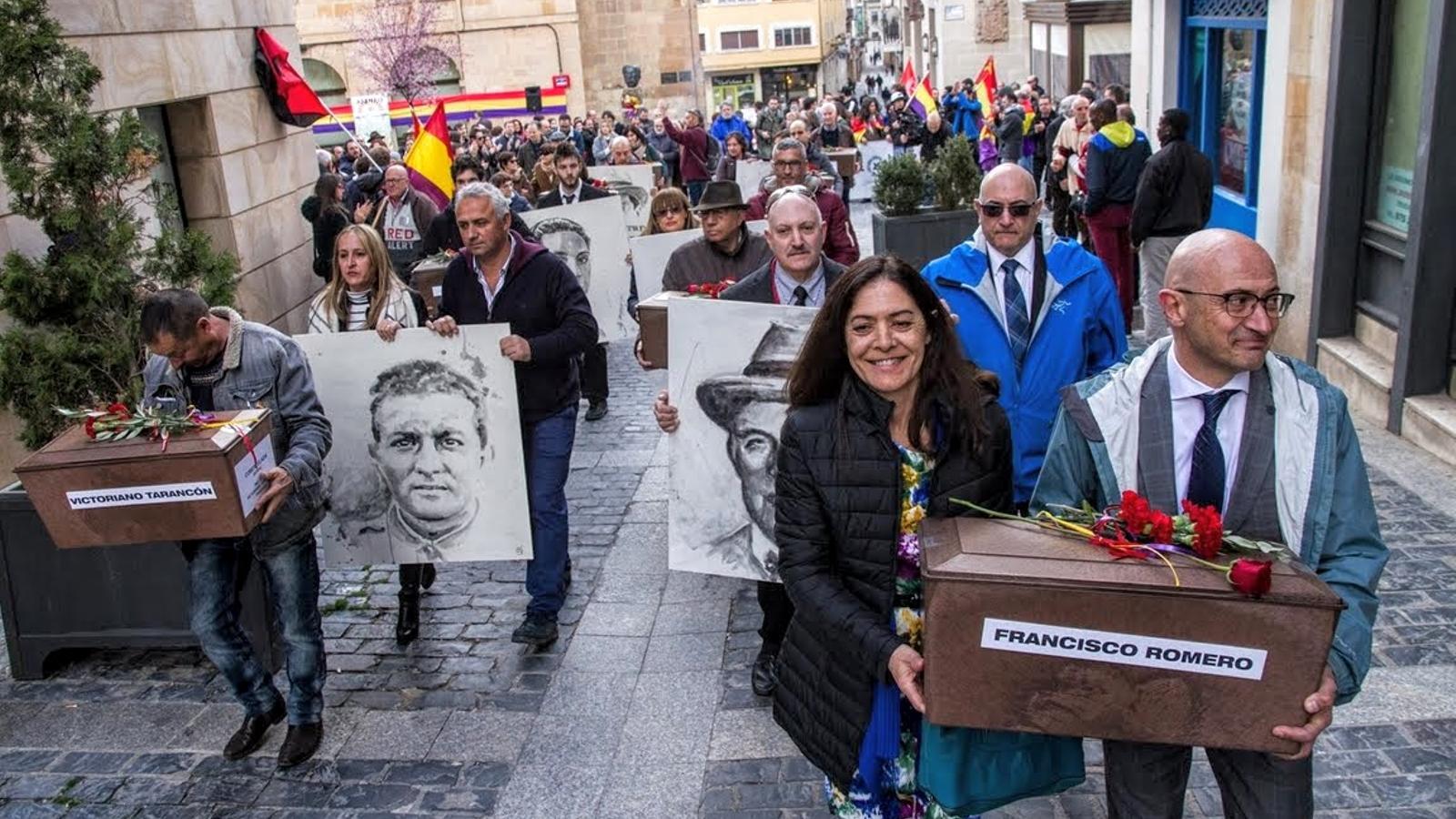
Although communities such as Catalonia have had their own memory and mass grave laws, in a large part of the State the historical burden had fallen, before 2022, on memorialist entities. "Now the State has taken the bull by the horns and is reaching where it could not reach before," states Miguel Ángel del Arco Blanco, professor of contemporary history at the University of Granada. This impulse has translated into a global annual budget of 13.9 million euros, recently increased for the program 50 years, Spain in freedom. The balance sheet leaves significant figures: 6,053 mass graves have been identified and more than 6,800 victims have been exhumed exclusively with state funding (a figure that exceeds 10,000 if those of other entities are added). Of these, only 400 have been identified. The minister Ángel Víctor Torres himself acknowledged that the process is halfway there: the forecast was to recover about 10,000 more over the next four years. Tens of thousands of men and women will never be found due to the complexity of the terrain or because their trace has disappeared forever.
After fifty years of democracy, the Ministry of Culture also urged the judicial extinction of the Francisco Franco National Foundation. For Jordi Guixé, historian and director of the European Observatory on Memories (EUROM), the law is, however, flawed with some shortcomings: "The text may be beautiful, but it lacks a power to execute". Guixé laments, among other things, that many declarations of Sites of Memory have remained a gesture with no associated budget or do not go beyond putting up a plaque, as is the case at the Via Laietana police station.
One of the most monumental vestiges of Francoism is the Valley of Cuelgamuros. The Spanish government announced last November that the winning project to resignify the mausoleum was The base and the cross and it had to allocate a budget of 30.5 million euros to it. There is already a basic architecture project, but no stone has been turned yet. After years of litigation, 27 victims have already been identified inside the crypts, and remains of people who were buried there without the permission or knowledge of their relatives continue to be exhumed.
Many people have been demanding for decades to be able to bury their relatives with dignity; it is estimated that anyone in the Spanish state is within 50 kilometers of a mass grave, but they encounter another obstacle: identifying the remains. On October 7th, the royal decree regulating the State DNA Bank was approved, but it will not come into force until April 2027. The Spanish government stresses, however, that it already has the Bonaparte software to integrate profiles.
Without an audit of confiscated assets
On the other hand, the 2022 law gave one year to audit the assets confiscated by the Franco regime and to inventory forced labor. Although studies have been commissioned from universities, such as the Rovira i Virgili, they remain pending tasks. Archival policy receives the harshest criticism from Del Arco: “The case of the Ministry of the Interior's archives cries out to heaven: there is no catalog or standardized opening, everything is done with an eyedropper, and that makes any investigation very difficult”. Finally, despite the creation of the Human Rights and Democratic Memory Chamber of the Public Prosecutor's Office, the courts continue to archive lawsuits against Francoist criminals by relying on the amnesty law and the statute of limitations for crimes. Del Arco considers this the “weakest” and most ambiguous part of the law. Guixé adds the lack of firmness on the streets: “In Berlin, if you take out a Nazi swastika, you are immediately sued. Here, a more explicit text regarding unconstitutional symbols is needed”.
If the polls give the majority to the right, the roadmap is quite explicit. In its electoral program, the PP commits to repealing the current regulation for a “law of concord”, which omits the condemnation of the coup d'état and the dictatorship and focuses on the legacy of the Transition. Despite promising to maintain exclusively “humanitarian” exhumations, questions are raised about the DNA Bank, the catalog of Francoist vestiges, or the future of the project at Cuelgamuros, and it opens the door to rewriting school curricula. Vox, directly, demands a total repeal.
Faced with this horizon, Del Arco warns that the dismantling will be easy and fast: “The rights of the victims of the Franco regime are not protected because they depend on the budget. They will act on that side: they won't even need to repeal the law, they will just have to stop putting money into it”. Without public investment, the exhumations of the 10,000 people who remain underground may come to a halt, letting silence win the game once again.
-
PSC: Consolidation of the democratic memory law
The Socialists propose developing the Exhumation Plan and the Census of Victims of the War and the Dictatorship, resigning the Valle de Cuelgamuros, expanding the network of Democratic Memory sites, and promoting the State DNA Bank.
-
Front Ampli: Closing of Francoist foundations
The coalition proposes a profound legal deployment of the democratic memory law, the closing of Francoist foundations, the approval of a law on stolen babies, and the reformulation of the official secrets law.
-
ERC: The transfer of the Laietana police station at the center
The Republicans make two legislative proposals (on the forced disappearance of minors and LGBTI+ memory and reparation), propose finalizing the audit of assets looted by the Franco regime, and demand the transfer of the National Police station on Via Laietana 43.
-
Junts: Via Laietana and heritage returns
Junts conditions memory on the denunciation of repression in Catalonia. They demand the transfer of the Via Laietana police station, the full return of the Salamanca Papers, and a new official secrets law, among others.
-
PP: Repeal of the democratic memory law
The Popular Party has committed to repealing the democratic memory law to replace it with a “law of concord.” They maintain the humanitarian nature of the tasks of searching for and identifying the missing and changes to the school curriculum.
-
Vox: Repeal of the democratic memory law
The far-right party proposes eliminating the democratic memory law because it aims to “impose an official truth.” Frontal rejection of any institutional intervention in the interpretation of history and protection of heritage and traditions.
