Linda Spilker: “When Voyager 1 arrives at one light-day, I will go outside, I will greet the night sky and I will say: Congratulations, Voyager! Good job!”
Scientific responsible for the NASA Voyager missions
-
CAT -
CAST
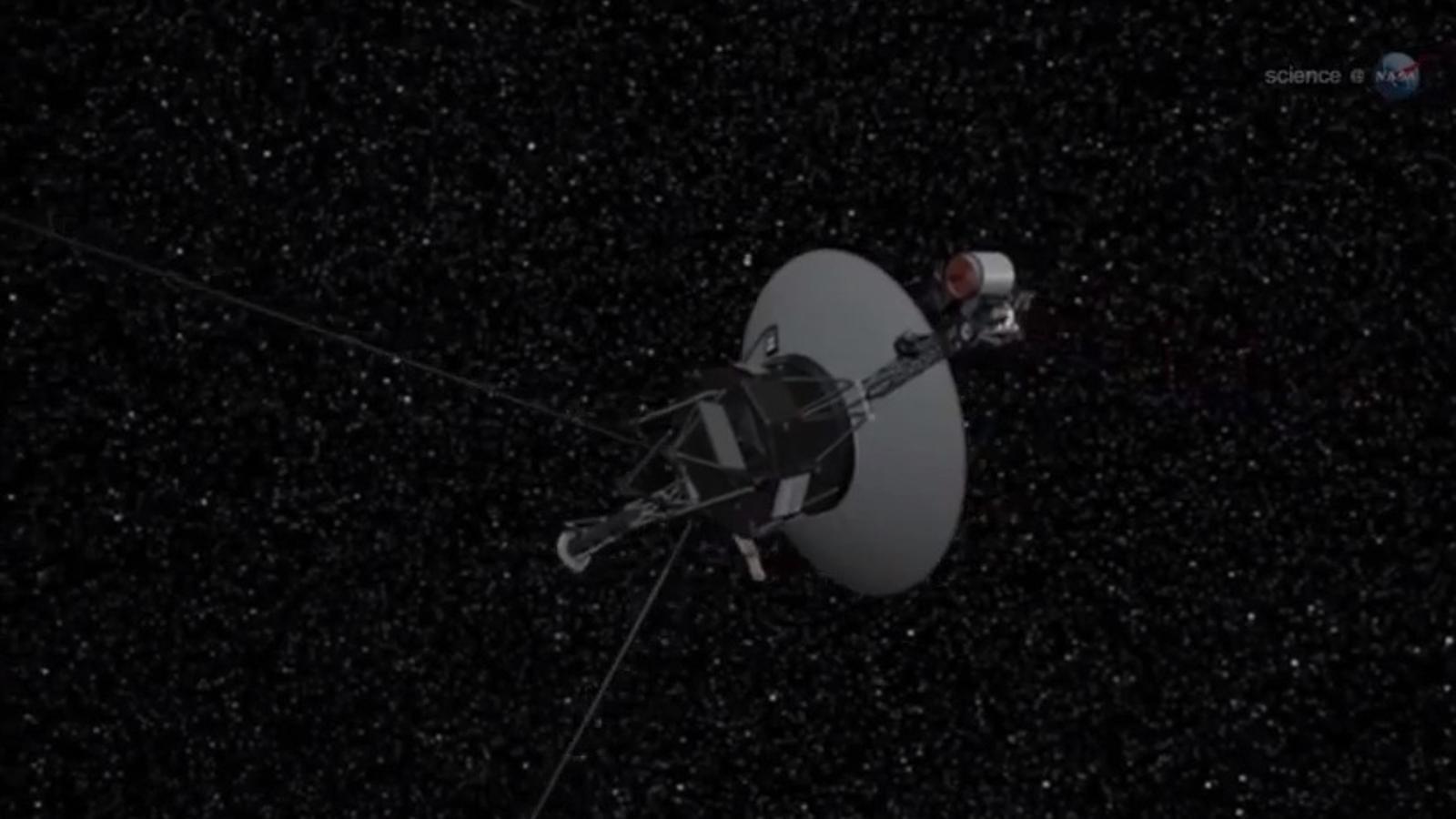
On November 18th at 11:16 a.m. (Catalan time) NASA's Voyager 1 space probe will reach an extraordinary milestone: it will be one light-day from Earth, that is, the distance that light can travel in 24 hours: 26 billion kilometers. Its creators, NASA, sent it into space on September 5, 1977, aboard a Titan 3E rocket with the mission of exploring Jupiter and Saturn, the giant planets of the solar system, taking advantage of a rare planetary alignment that occurs every two centuries. On board, it carried the Golden Record, a gold-plated copper disc that is a kind of message in a bottle thrown into space, intended for possible extraterrestrial civilizations.
Once that mission was completed, after a series of spectacular flybys, Voyager 1 began its journey into space beyond our solar system; in 2012, it crossed the heliopause and became the first human-made object to enter interstellar space. What was not foreseen at the time is that nearly half a century later, the craft would still be functioning and sending information.
Linda Spilker is the scientist responsible for NASA's Voyager missions. She first worked on these probes at the beginning of the program, in 1977, until 1990. Later, she was the principal investigator for the Cassini mission until she rejoined the Voyager 1 program in 2020; two years later, she assumed scientific responsibility for it.

Voyager 1 is traveling through interstellar space, beyond the boundaries of our solar system. If we could travel to where it is right now and look around, what would we see?
— We would be surrounded by absolute darkness, with stars that would shine like tiny luminous dots in the distance. Our Sun would be so far away that we would see it as a very bright star. Interstellar space is not an empty place. It is formed by hydrogen and helium, with small amounts of heavier atoms, such as carbon, oxygen, nitrogen, and calcium, which have been produced mainly in supernova explosions in the area. There are also high-energy particles, called cosmic rays, and small amounts of dust. The charged particles travel through interstellar space along magnetic field lines, which move like ocean currents. Naturally, most of these elements would be invisible to the naked eye, but we can detect them thanks to the instruments on Voyager 1.
On November 18th the probe will arrive at a distance of one light-day from Earth. How important is this moment?
— A light day is the distance that light can travel in 24 hours: 25.9 billion kilometers. This makes Voyager 1 the farthest human-made object in existence. The Moon, the closest object to Earth, is only 1.3 light-seconds away. The Sun is 8.3 light-minutes away. Neptune, the planet farthest from Earth, is 4.2 light-hours away. It is a milestone for humanity to have been able to build something that has traveled so far.

How will you celebrate this moment?
— In California, where I live, it will be a little past two in the morning when Voyager 1 reaches one light-day. I will go outside, greet the night sky, and say: "Congratulations, Voyager! Good job!"
Voyager 1 took off in September 1977, more than 49 years ago. Still today, NASA maintains a team dedicated to the two Voyager probes. What is this team like?
— Today it is a very small team, of about ten people, some of whom collaborate part-time while working on other projects. The youngest member of the team, our communications engineer, is 25 years old; his parents had not even been born when Voyager was launched. Other members were already working on the mission when it took off! Some have retired, but have returned to offer part of their time and contribute the knowledge they have about the mission. The oldest, who is an expert on the flight data system computer, has just turned 90 years old.
What data is the probe sending us today?
— Voyager 1 explores interstellar space and keeps its antenna always oriented towards Earth to communicate with it. This means it continuously sends data. The question is when we can have coverage from the antennas of NASA's Deep Space Network to receive them. The probe began its interplanetary mission in 1977 with ten instruments and one radio science experiment. When it transitioned to an interstellar mission in 1990, five were still functioning. However, since Voyager 1 loses four watts of power every year, we have had to shut down systems over time. Today, only two continue to function: the magnetometer and the plasma wave subsystem.
What do these instruments tell us about interstellar space?
— The probe sends continuous measurements of magnetic fields and plasma waves. From time to time, this data gives us surprises. At first, we expected the plasma electron density and the magnetic field intensity to decrease slowly as the probe moved away from the solar system. But we have discovered that this is not necessarily the case. In 2020, Voyager 1 detected an intense event, possibly originating from the Sun, which caused a sudden increase in both the magnetic field intensity and the plasma electron density. And these values have not gone down since then. This is one of the great wonders of space science: you collect data you did not expect to find according to current models and theories, and this forces you to adapt them and develop new ones.
Voyager 1 was initially designed for a four-year mission and is now approaching 50. What is the secret to its longevity?
— The evolution of technology has greatly facilitated operations. When I started working on the mission in 1977, we drew the observation calendars on a long sheet of tracing paper with rulers and pencils. Today, we can generate these calendars automatically with computers. By current standards, the probe's technology seems outdated; Voyager 1 is as big as a small car. The computer is the size of a briefcase and has less memory than the mobile phone you carry in your pocket. On the other hand, perhaps this old technology has contributed to its longevity.
In what sense?
— In space, equipment is constantly impacted by cosmic rays. If you have larger components, it is less likely that the impact of a single cosmic ray will damage a significant part of the equipment. If you were working with a single small computer chip that was damaged by a cosmic ray, you would lose a huge amount of information.
The Voyager probes have already traveled a long way. What have been the most outstanding moments of the mission for you, personally?
— I was there when the rocket carrying Voyager 2 lifted off from the launch pad to begin its journey. It was wonderful to be part of this adventure from the beginning. The timing of the mission was also perfect: only once every 176 years do the planets align in such a way that Jupiter, Saturn, Uranus, and Neptune can be flown over in a single trip. Voyager 2 was the first space probe, and until now the only one, to have visited four planets in a single mission. Another one of the most outstanding moments for me was the passage by the moons of Jupiter: they were the ones that gave us the biggest surprises.
Why?
— As for the moons, we did not have much information to compare them with and we assumed that they all resembled ours: ancient worlds, covered in craters. But when we arrived at the moons of Jupiter, we discovered that Ganymede showed signs of tectonic movements in the crust. Europa, bright white and covered in ice, had almost no craters. And, finally, on Io we saw active volcanoes that were in full eruption while we passed nearby. None of this fit our models about the moons. So we learned to expect the unexpected.
How did you follow all this at that moment?
— In the building where I worked, there were television screens in the cafeteria, in the meeting rooms, and everywhere. I had a list of the schedules for the different events: the approach to a certain moon of Saturn, the arrival of an image of the rings of Uranus... Sometimes I would bring my sleeping bag because some of the best things happened at night. Many of us slept under the desks and set our alarms to take a nap until it was time to wake up. When the images appeared on the screens, people would jump up and point at them: "What do you think this is? Can you believe it?". It was wonderful to be there and to experience it.
Before the Voyager missions, we only had a rough idea of what planets like Jupiter, Saturn, Uranus, and Neptune were like. For the first time, we were able to see these distant worlds with high resolution. How have these probes changed the way we imagine the universe?
— The Voyager program changed the way we see our solar system. Today, some of the iconic photographs taken by Voyager 1 and Voyager 2 are still shown in classrooms and textbooks. The Voyagers also laid the foundation for the missions that followed: they showed us the bright white surfaces of Europa and Enceladus, which were later explored by NASA's Galileo and Cassini missions. These missions discovered that both moons are covered by an ice crust beneath which lies an ocean of liquid water. This opened up new questions: could there be life in these oceans? Right now, the Europa Clipper mission is on its way to explore this possibility. Voyager answered many questions, but it also posed many other exciting ones.
The longevity of Voyager 1 is impressive, but the probe is not immortal. When will it stop communicating with Earth?
— We do not know. It could happen today or a few years from now. Like the human body, a space probe shows symptoms of aging as time passes: fuel lines become clogged and the plutonium-based power source slowly degrades. A day may come when we stop receiving the signal from Voyager 1. As always, we will try to see if we can get the spacecraft working again. But, if nothing makes that possible, we will have to accept that Voyager 1's exploration mission has ended and that another has begun: it will become a silent ambassador for humanity.
You are referring to the Golden Record carried by both Voyager probes: a gold-plated copper phonograph record containing greetings in 55 languages, images of Earth, and all kinds of music. Why did NASA decide to send it into space?
— The disc was conceived as a cosmic message in a bottle, with the idea that possible extraterrestrial civilizations could know that we exist. On the cover, there is a map showing the location of our solar system in the galaxy in relation to nearby pulsars. In about 40,000 years, Voyager 1 will pass relatively close to another star. Who knows, maybe someone out there will find our message and come to visit us.
Would you like that to happen? That extraterrestrials visit us or that we receive some signal from them?
— I have always wondered if there is life somewhere else in the universe. It would be a dream come true if an intelligent life form visited us or if we received some signal from them.
The Golden Record can last up to a billion years and could outlive humanity. What message would you like Voyager 1 to carry into the universe?
— For me, the message is simple: there was a civilization that had the intelligence and the technology necessary to build this probe and send it toward the stars. This fills me with immense pride.
