The keys to the war that is putting the world economy on the ropes
Iran maintains its attack capabilities intact while holding its own against the United States and Israel with the closure of the Strait of Hormuz

-
CAT -
CAST
BarcelonaThe war in Iran threatens to cause an economic meltdown even worse than that resulting from the 1973 oil crisis. This was the warning issued Monday by Fatih Birol, executive director of the International Energy Agency (IEA). Almost a month after the first US and Israeli attacks on Iran, we review the key events of a war that has already put the global economy on alert and could have significant geopolitical consequences.
The beginning of the conflict
The war began on February 28 with a joint Israeli-American attack against Iran. The attack was carried out in broad daylight, an anomaly in this type of operation. The reason? Israeli intelligence was able to determine the time and place where several high-ranking officials of the ayatollahs' regime were meeting, and The CIA confirmed that the then Supreme Leader, Ali Khamenei, was also in the same government complex..
The objective of the war
Before the attack, the United States and Iran had been negotiating for weeks regarding Tehran's weapons capabilities. Washington wanted a commitment from Iran not to develop nuclear weapons. However, although the country had enriched uranium to 60%, there is no conclusive evidence that the Iranian regime was building an atomic bomb. The talks also aimed to limit Iran's ballistic missile program. It seemed that the negotiations were going in the right direction.nine days before the attack The US issued an ultimatum in Tehran And the bridges were destroyed with the start of the bombing.
Before the microphones, and remembering the repression of the January protestsAt the start of the war, Donald Trump asserted that his objective was regime change. As the days passed, the US president sidelined this issue in his speeches, even claiming that regime change had already occurred "because the leaders are all different," despite the fact that they all belong to the apparatus of the previous regime. For Israel, both a weakening of the regime and a reduction in Iran's military capabilities as a result of the war represent a golden opportunity to achieve one of Benjamin Netanyahu's long-held goals: to establish himself as a hegemonic power in the region.
Iran's leadership, exterminated
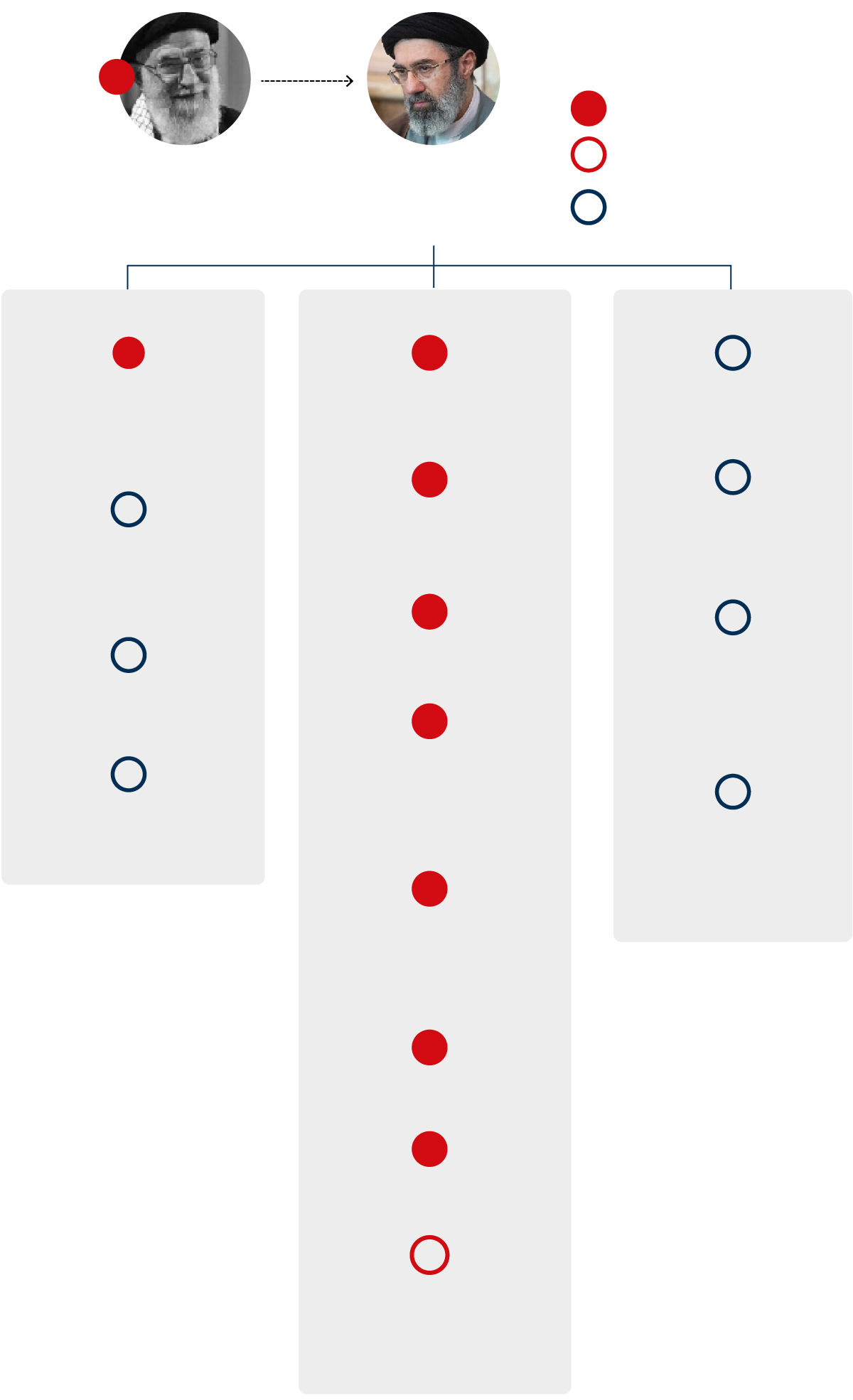
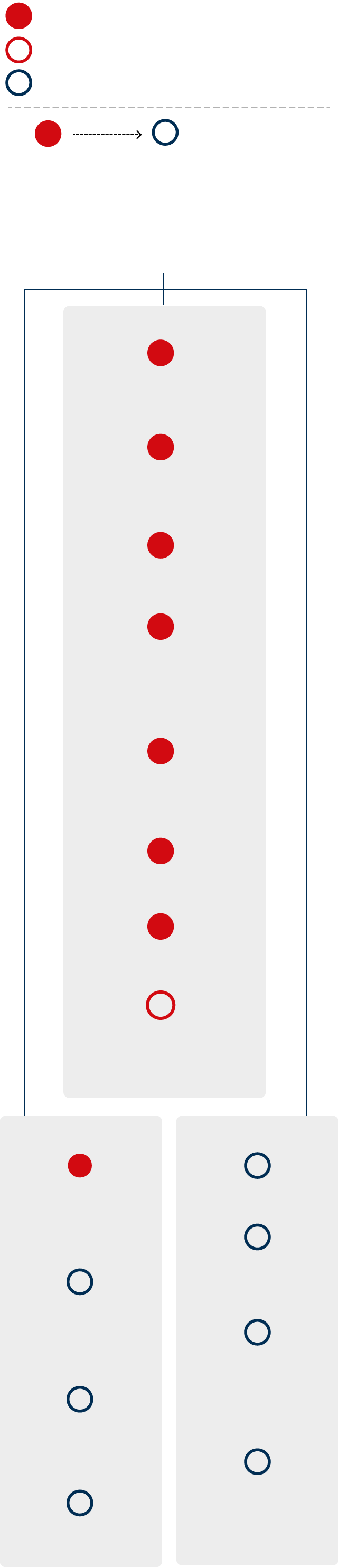
In the initial attacks, the United States and Israel killed several high-ranking Iranian officials, including the country's supreme leader. Also killed were the commander of the Revolutionary Guard, Mohammad Pakpour; the Minister of Defense, Aziz Nasirzadeh; and the Chief of Staff of the armed forces, Sayyid Abdolrahim Mousavi. After 27 days, only seven of the sixteen people who formed part of the Supreme Leader's inner circle remain alive. Meanwhile, Iran has elected Mukhta Khamenei, Ali Khamenei's son, as the new leader. Despite the regime's leadership being effectively decimated, the country is demonstrating a remarkable capacity for both resistance and attack.
Morts confirmats per l'Iran
Morts segons Israel
Ali Khamenei
Anterior líder suprem
Mojtaba Khamenei
Fill d'Ali Khamenei
i actual líder suprem
Membres destacats
del règim
ALTRES LÍDERS
DEFENSA
CERCLE PROPER
Masoud Pezeshkian
President
Ali Shamkhani
Cap del Consell de
Defensa Nacional
Ali Larijani
Secretari del Consell Suprem de Seguretat Nacional
Gholam-Hussein
Mohseni Eje’i
Cap del poder judicial
Mohammad Pakpour
Comandant en cap de la
Guàrdia Revolucionària
Mohammad Bagher Ghalibaf
Portaveu del Parlament
Aziz Nasirzadeh
Ministre de Defensa
Mohammad
Movahedi
Cap de l’Assemblea d’experts de l’Iran
Yahya Rahim Safavi
Assessor
Sayyid Abdolrahim Mousavi
Cap d'estat major de les forces armades
Ali Asghar Hejazi
Assessor
Hassan Khomeini
Net del fundador de la República Islàmica de l’Iran
Gholamreza Soleimani
Comandant de la força paramilitar Basij
Mohammad Shirazi
Cap de l’oficina militar
Salah Asadi
Cap de la intel·ligència
Hassan Jabal Amelian
Cap del programa avançat d’armes de l’Iran
Morts confirmats per l'Iran
Morts segons Israel
Membres destacats del règim
Ali
Khamenei
Anterior líder
suprem
Mojtaba
Khamenei
Fill d'Ali
Khamenei
i actual líder
suprem
DEFENSA
Ali Shamkhani
Cap del Consell de
Defensa Nacional
Mohammad Pakpour
Comandant en cap de la
Guàrdia Revolucionària
Aziz Nasirzadeh
Ministre de Defensa
Sayyid Abdolrahim Mousavi
Cap d'estat major de les forces armades
Gholamreza Soleimani
Comandant de la força paramilitar Basij
Mohammad Shirazi
Cap de l’oficina militar
Salah Asadi
Cap de la intel·ligència
Hassan Jabal Amelian
Cap del programa avançat d’armes de l’Iran
ALTRES LÍDERS
CERCLE PROPER
Masoud Pezeshkian
President
Ali Larijani
Secretari del Consell Suprem de Seguretat Nacional
Gholam-Hussein
Mohseni Eje’i
Cap del poder judicial
Mohammad Bagher Ghalibaf
Portaveu del Parlament
Mohammad
Movahedi
Cap de l’Assemblea d’experts de l’Iran
Yahya Rahim Safavi
Assessor
Hassan Khomeini
Net del fundador de la República Islàmica de l’Iran
Ali Asghar Hejazi
Assessor
Morts confirmats per l'Iran
Morts segons Israel
Membres destacats del règim
Ali
Khamenei
Anterior líder
suprem
Mojtaba
Khamenei
Fill d'Ali
Khamenei
i actual líder
suprem
DEFENSA
Ali Shamkhani
Cap del Consell de
Defensa Nacional
Mohammad Pakpour
Comandant en cap de la
Guàrdia Revolucionària
Aziz Nasirzadeh
Ministre de Defensa
Sayyid Abdolrahim Mousavi
Cap d'estat major de les forces armades
Gholamreza Soleimani
Comandant de la força paramilitar Basij
Mohammad Shirazi
Cap de l’oficina militar
Salah Asadi
Cap de la intel·ligència
Hassan Jabal Amelian
Cap del programa avançat d’armes de l’Iran
ALTRES LÍDERS
CERCLE PROPER
Masoud Pezeshkian
President
Ali Larijani
Secretari del Consell Suprem de Seguretat Nacional
Gholam-Hussein
Mohseni Eje’i
Cap del poder judicial
Mohammad Bagher Ghalibaf
Portaveu del Parlament
Mohammad
Movahedi
Cap de l’Assemblea d’experts de l’Iran
Yahya Rahim Safavi
Assessor
Hassan Khomeini
Net del fundador de la República Islàmica de l’Iran
Ali Asghar Hejazi
Assessor
Bombs in the Golf
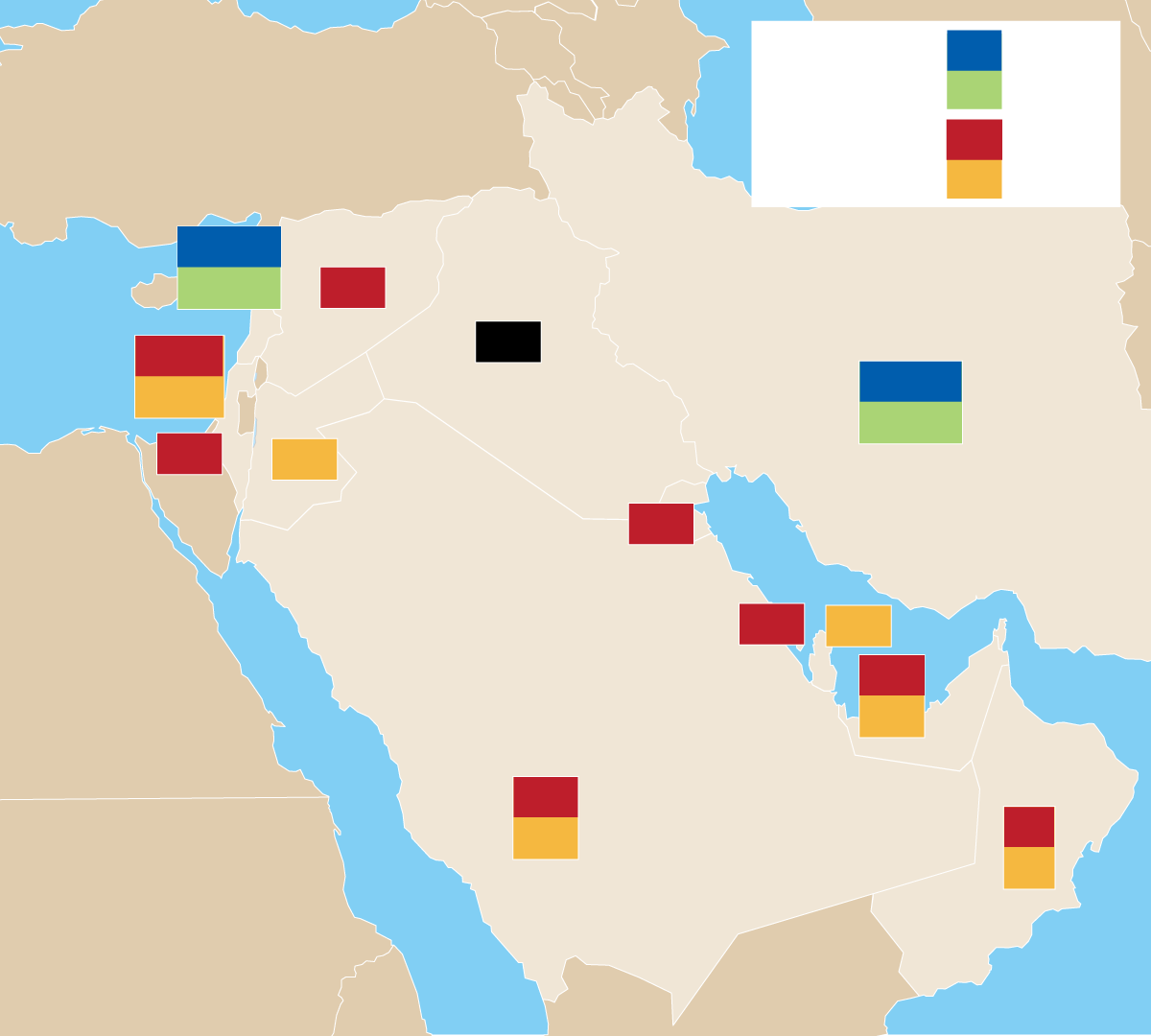
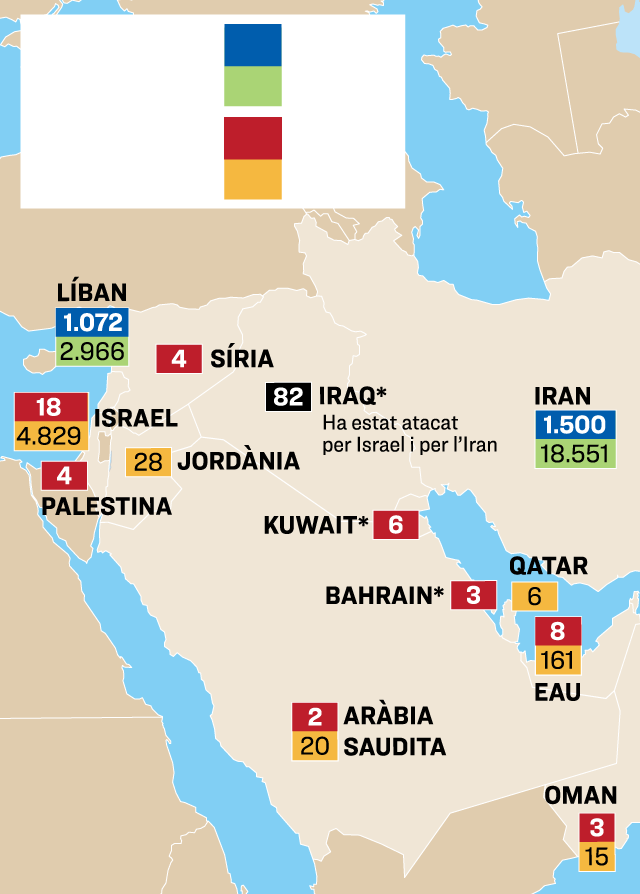
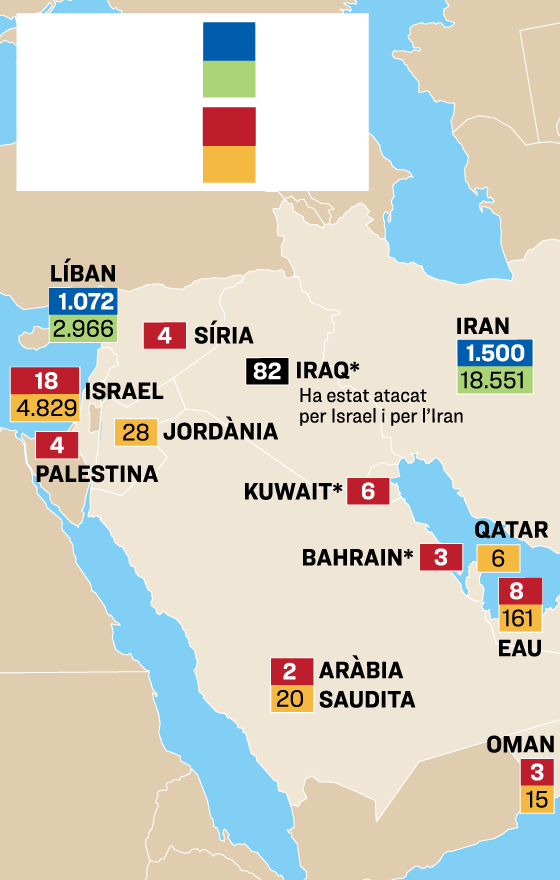
Meanwhile, Iran is bombing much of the Middle East. It is attacking US embassies and consulates, as well as US military bases in countries of the region that have aligned themselves with Washington in recent years. It is also launching missiles against oil infrastructure and near ports and airports. For their part, Israel and the United States are relentlessly bombing Iran.
The missile exchange has forced the closure of airspace and several airports on occasion, while the number of civilians killed in Iran in US and Israeli attacks exceeds 1,500, and in Lebanon it is now over 1,000. In Israel, Iranian missiles have killed 18 people, and in Iraq, 82 civilians have died in attacks by both sides.
Atacs d’Israel
i els EUA
Morts
Ferits
Atacs
de l’Iran
Morts
Ferits
LÍBAN
1.072
SÍRIA
4
2.966
82
IRAQ*
IRAN
18
ISRAEL
1.500
Ha estat atacat
per Israel i per l’Iran
4.829
18.551
4
JORDÀNIA
28
PALESTINA
6
KUWAIT*
3
6
BAHRAIN*
QATAR
8
EAU
161
OMAN
ARÀBIA
SAUDITA
2
3
20
15
*Nombre indeterminat de ferits
Atacs d’Israel
i els EUA
Morts
Ferits
Morts
Ferits
Atacs de l’Iran
*Nombre indeterminat de ferits
Atacs d’Israel
i els EUA
Morts
Ferits
Atacs
de l’Iran
Morts
Ferits
*Nombre indeterminat de ferits
Specifically, the attacks have also affected the eastern Mediterranean. In Cyprus, a drone struck near a UK military base during the first weekend of the war, while NATO intercepted three missiles heading towards Turkey. These attacks have prompted some European countries to mobilize warships and air defenses in the area, but Europe has distanced itself from the offensive by the United States and Israel
Israel's front against Lebanon
The war in Iran has reignited another conflict: the clashes between Hezbollah and Israel. Following the assassination of Iran's supreme leader, the Shiite militia, an ally of Iran, launched a wave of attacks against northern Israel. Tel Aviv's hostilities in Lebanon have been constant since the last armed confrontation in 2014. Now, under the pretext of this March's attack, Israel has launched a ground incursion into the south of the country with which it seeks to push Hezbollah away from the Israeli border, in an operation that has plunged Beirut under bombs and is reminiscent of the Israeli offensive on Gaza.
The closure of the Strait of Hormuz
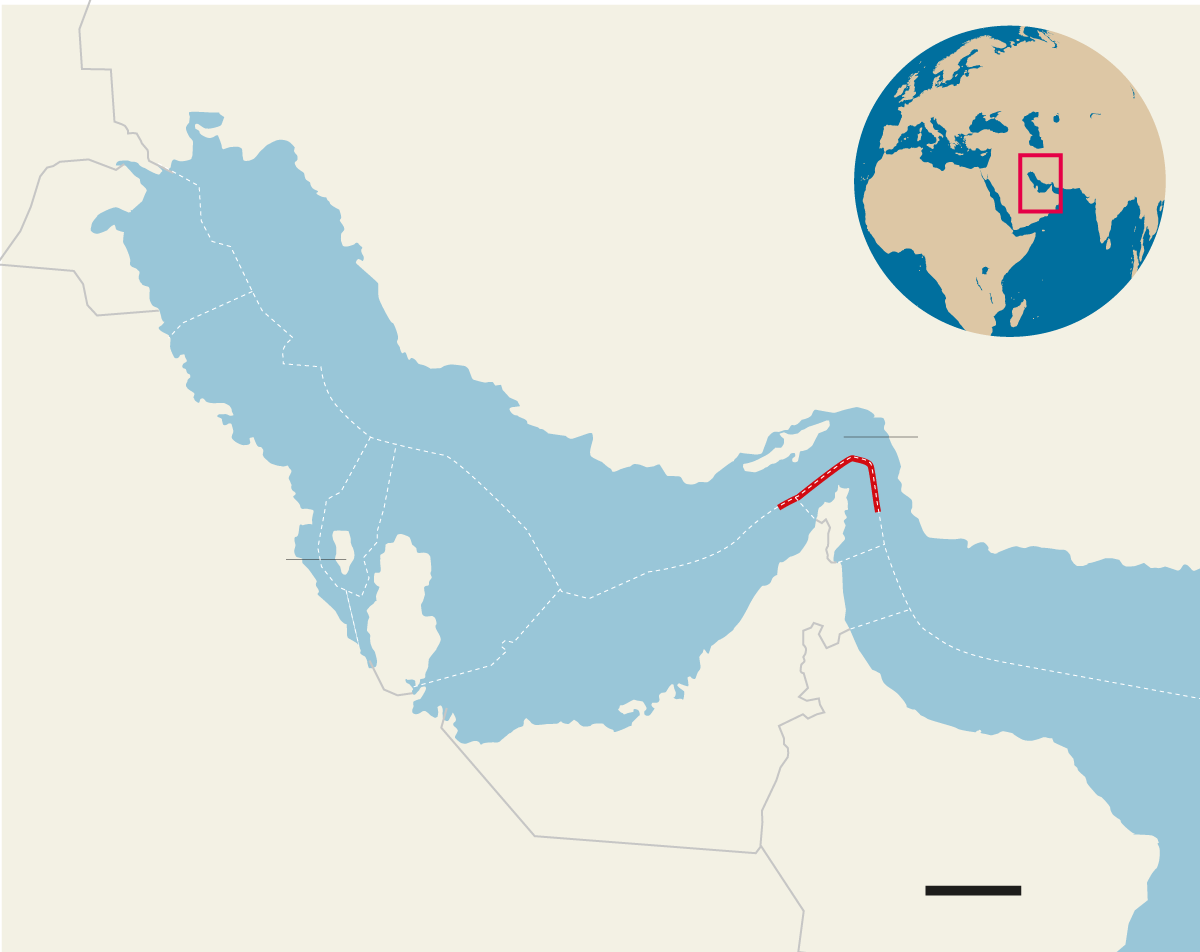
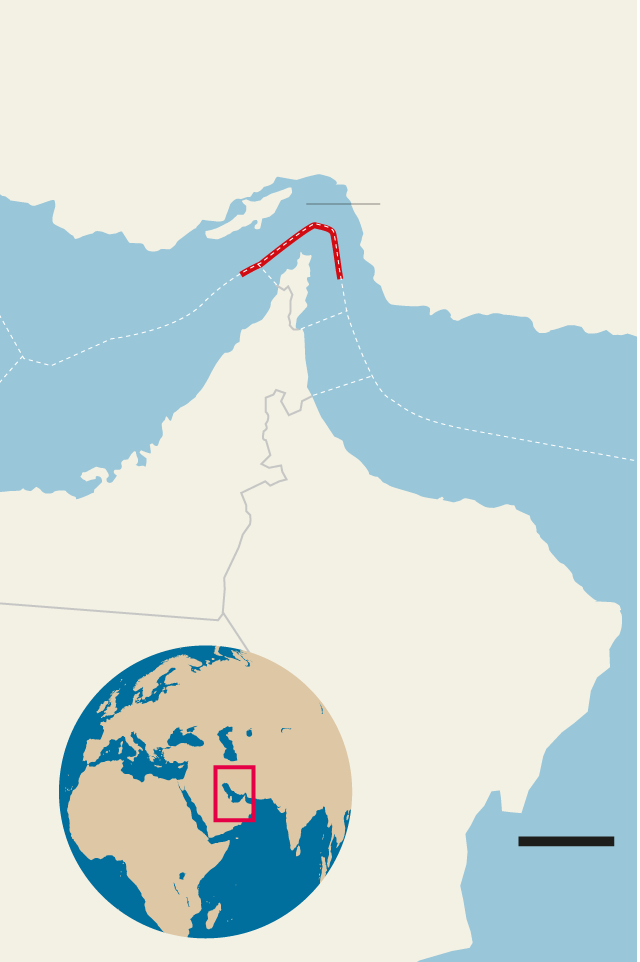
Among the consequences of the war, the one having the greatest global impact is undoubtedly the rise in oil and gas prices. The price of Brent crude has been hovering around $100 a barrel for days, whereas before the war it fluctuated around $70. According to the International Maritime Organization, 2,000 ships have been stranded for weeks in the Persian Gulf and the Gulf of Oman, on both sides of the Strait of Hormuz. Iran has threatened to attack ships linked to the United States and Israel, as well as those belonging to countries supporting the military operation. Before the outbreak of the conflict, 20% of the world's oil and gas trade passed through this strait.
IRAQ
KUWAIT
golf Pèrsic
IRAN
ESTRET D’ORMUZ
160 km de longitud
33 km d’amplada
BAHRAIN
QATAR
golf d’Oman
ARÀBIA SAUDITA
EMIRATS ÀRABS UNITS
OMAN
OMAN
100 km
ESTRET D’ORMUZ
160 km de longitud
33 km d’amplada
IRAN
golf d’Oman
EMIRATS
ÀRABS
UNITS
OMAN
OMAN
100 km
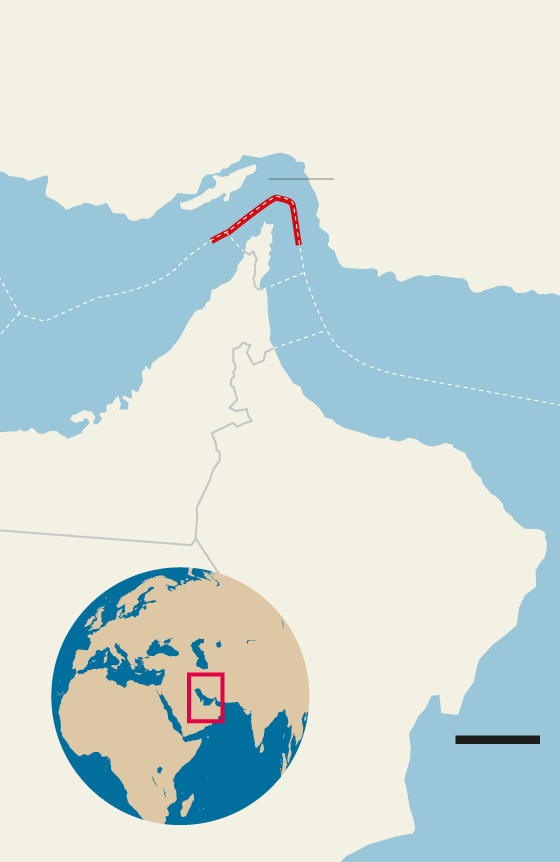
ESTRET D’ORMUZ
160 km de longitud
33 km d’amplada
IRAN
golf d’Oman
EMIRATS
ÀRABS
UNITS
OMAN
OMAN
100 km
In an attempt to prevent escalating prices, Trump makes calculated statements to reverse price increases at critical moments, causing an almost immediate effect on investor confidence. The US president has lifted restrictions on buying crude oil in MoscowThe sanctions imposed in the wake of the war in Ukraine as a way to pressure Russia have been suspended, and US attacks have been suspended until Friday, giving Iran time to reopen the Strait of Hormuz. Despite the announcement, the bombing continues, and Iran maintains its position of recent days: only ships from countries "not hostile" to Tehran are allowed to pass through the strait.
The rift between Trump and Netanyahu
As the weeks have passed, disagreements have emerged between the US and Israel regarding their approach to the war. On the fifteenth day of armed conflict, Washington attacked Kharg IslandLocated in the Persian Gulf, Kharg is the port from which Iran exports 90% of its oil. Tehran has repeatedly bombed oil refineries and strategic ports in the region. Just days after the attack on Kharg, Trump and Netanyahu attacked the world's largest gas field, South ParsIran threatened to destroy the region's energy infrastructure and attacked several refineries again. The White House denied any knowledge of the bombing in South Pars. Trump even went so far as to say, "[Netanyahu] sometimes does things I don't like," although he made it clear that they maintain a very good relationship.
The duration of the conflict
In a new episode of tensions between Washington and Tel Aviv, the United States has sent Iran a plan in recent hours to end the war. It is noteworthy that only the White House is making the proposal, despite the fact that the current conflict was jointly initiated by the United States and Israel. The sending of the document, which Iran has already rejectedThe week has arrived in which the deadline set by Trump to end the war will be met. At the start of the attacks, the White House asserted that the bombings could last for four weeks, that is, until this Saturday. But at a time when Iran maintains its attack capabilities virtually intact, it seems strange that it should have to come and negotiate the plan now being offered by the very instigators of the war.

