Ceuta seeks spaces against the clock to accommodate unaccompanied minors
The Spanish government raises to 1,342 the unaccompanied minors and warns of a change in profile, with more girls and younger ages

-
CAT -
CAST
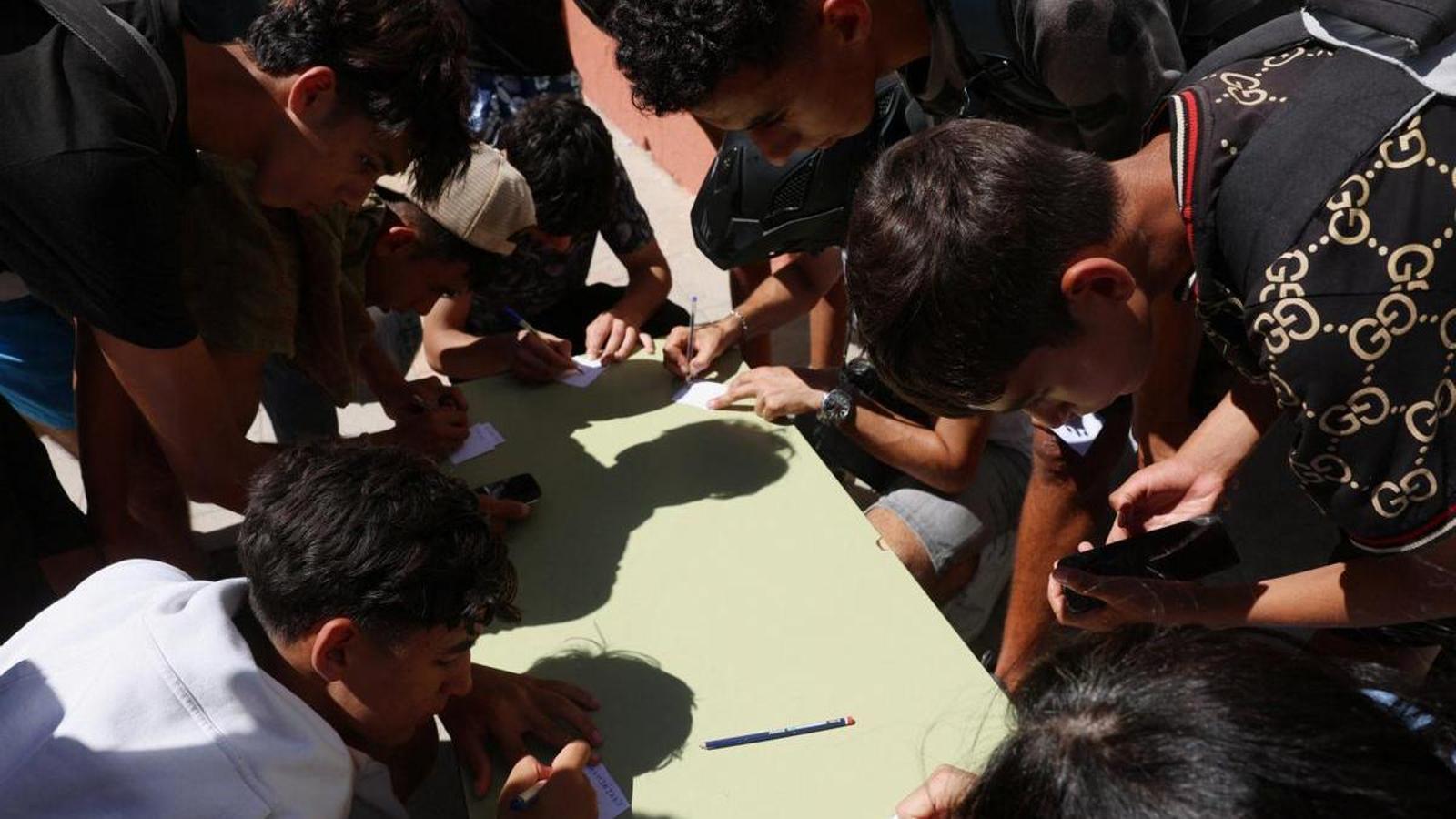
CeutaOfficials from the Superior Headquarters of the National Police in Ceuta have not yet arrived and there are already unaccompanied minors waiting in line to be registered. The overflow of children and adolescents at the door is repeated again this Friday and leads to moments of certain chaos and nervousness, an image that the authorities and the State's security forces want to avoid occurring in the center of the autonomous city, where the Headquarters is located. They seek to foster "normality." Members of the army are in charge of the situation, while ordering them to form a line. It is in this building where these boys and girls now place all their hopes: inside they will complete the first bureaucratic procedure that allows them to remain under the guardianship of the autonomous administration.
The Minister of Youth and Childhood, Sira Rego, assured this Friday from Ceuta that a total of 1,342 unaccompanied minors have been counted since the arrival of thousands of people in the autonomous city last Thursday. Most are boys, especially Moroccans, but this time there are also many girls compared to previous migratory crises. At the same time, the average age of the children has decreased. In fact, in the queue in front of the National Police, it has been decided to prioritize the entry of girls and minors under thirteen years of age due to their exposure to greater risks. In the case of girls, they may be exposed to situations of sexual violence. "We have started with the most vulnerable profiles, but all boys and girls will be attended to and protected," the minister stated.
Not all of them manage to register this Friday and they will have to return tomorrow. They will have to, one more night, sleep in the open. "The situation is complex," the minister acknowledged. Given the inability to continue expanding the existing reception centers, which were already very strained before the crisis, two public schools have been opened for the initial reception of these unaccompanied minors, and more spaces are already being sought. Sources close to this process admit that it is "very complicated." There are empty buildings in the city, but in deplorable conditions. For example, the old flour factory owned by the Ministry of Defense. For now, no tents have been deployed anywhere either.
But this official figure is high for many entities in the city. Even for the residents themselves, especially those from peripheral neighborhoods like El Príncipe or La Reina, where they have improvised a census collecting data on all of them. Although the Ministry of Childhood calls for caution, there is a consensus among organizations that over 2,000 unaccompanied minors will be exceeded. "The registration process continues and it is a constant trickle of identifications," the minister has acknowledged.
It is also feared that some may remain hidden or have not entered the city. They are wary of the police – because young people over eighteen are also wary of them, fearing immediate return – which is precisely where they should go. Therefore, entities in Ceuta are canvassing the city, as are the State's security forces and bodies. "Thanks to the alert from organizations, families, or people who are temporarily hosting them, we can find them, accompany them to the police station so they can be registered and enter the protection system," they explain from the Federación Sur Acoge of Ceuta.
Transfers to the Peninsula
But when the school year begins, the minister has assured that places like the two public schools will not be available. Therefore, these minors will have to have been relocated. This is where the autonomous communities come into play. A sectoral conference is planned for the end of August to begin with a binding and solidarity-based reception policy on the peninsula. That is, with the distribution among the territories. The ministry is confident that the procedure will be swift, even despite the reluctance, at least initially, of the PP, which governs most of the autonomous communities hand in hand with Vox. "I trust that it will not take more than two weeks [with the transfers] and with good judgment," states the president of FEPA, Ferran Rodríguez, in a telephone conversation with ARA. "The psychosocial impact of homelessness destroys children [...] Not only for the future, but it plunges them into dynamics that the vast majority do not know, such as committing crimes to eat," he warns.
The priority, as is usually the case in this process, will be the family reunification of minors in their country of origin with their parents. This will be done with "guarantees," the minister stressed. In the event that there were parents who, from Morocco, claimed their children and they did not want to return, she said that each case would have to be studied with specialized services. A specialized team from the Ministry of Childhood will be permanently transferred to Ceuta next week to help accelerate the procedures. These include social educators, psychologists, and pedagogues, among other profiles. "I believe that [it is an assessment] could be made from other communities. The entities [in Ceuta] cannot cope," adds Rodríguez. If this reunification cannot occur, unaccompanied minors will be placed under the guardianship of the public administration.
Once registered, in cases where the age of the young person is in doubt – that is, whether they are minors or not – age verification tests will be carried out to determine it. However, suspicions are growing that returns of minor children who entered Ceuta a week ago have occurred. Above all, after images captured by various journalists were made public showing a twelve-year-old boy who, in tears, asks members of the Spanish army not to return to Morocco. The scene took place at the gates of the Tarajal land border, and the intervention of various witnesses prevented the minor's return, explain sources who witnessed the scene to ARA.
The ombudsman speaks out
This Friday, the Ombudsman, Ángel Gabilondo, also spoke about the situation in Ceuta. "The geopolitical aspect and foreign policy must prioritize the dimension of this humanitarian emergency, and the significance of this border character for Spain and Europe must be recognized," he says in a statement. In the same statement, he argues that Ceuta alone "cannot be asked to accommodate so many minors, far from any possible calculation." The Ombudsman also called for listening to those affected, "to apply the law, which includes the help of interpreters and lawyers to determine their status and act accordingly.
