The fence that separated Gibraltar from La Línea de la Concepción since 1730 falls
The European Union and the United Kingdom formalize this Tuesday the agreement that integrates, 'de facto', the Rock into the Schengen area

-
CAT -
CAST
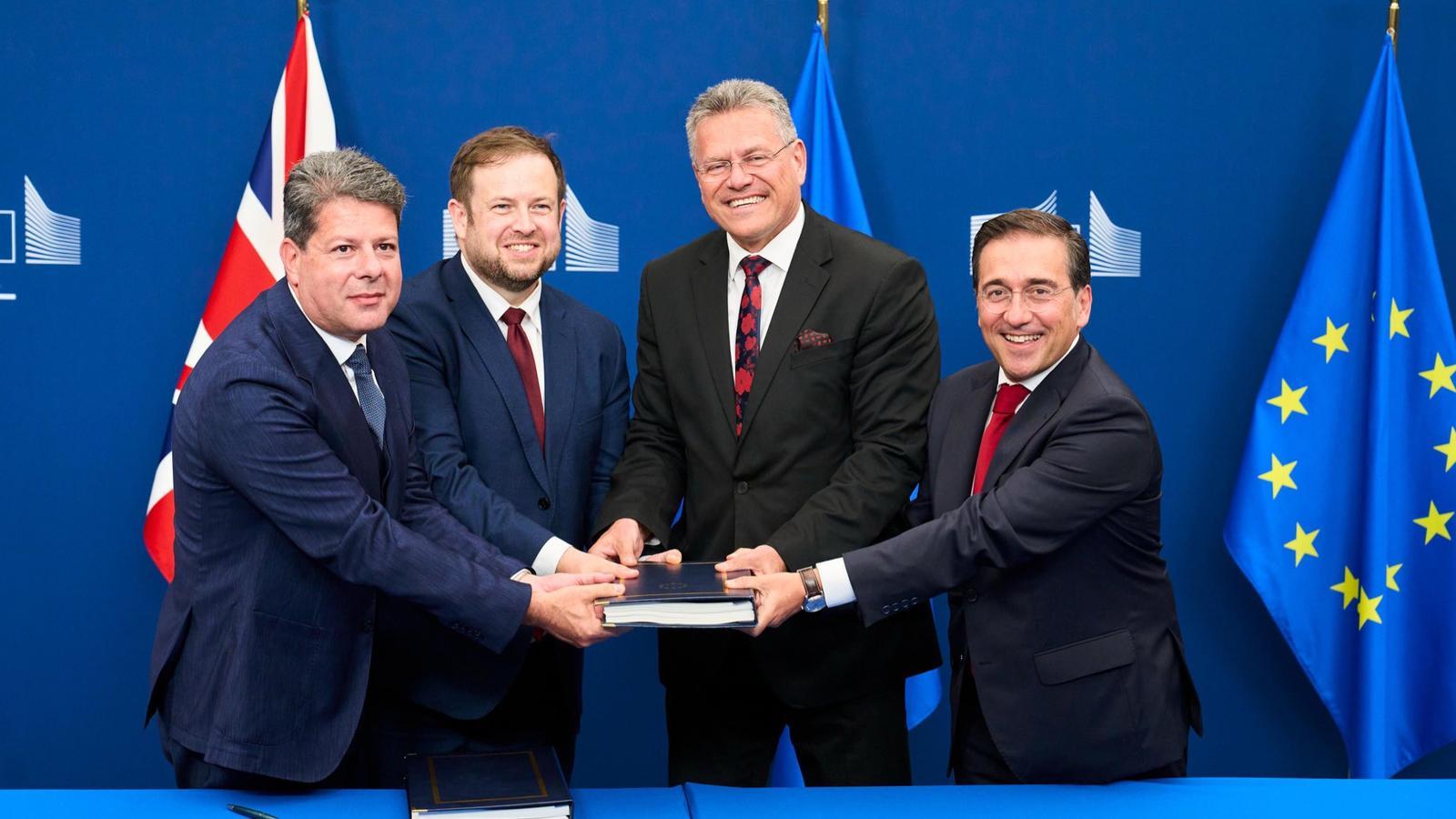
LondonIt has been days since the dismantling work of the Gibraltar fence began. The scar that separated the Rock from the Campo de Gibraltar will be erased from the maps – not from history – this Wednesday, when it enters in force the agreement reached a year and a bit ago the United Kingdom, the European Commission, the Spanish state and Gibraltar, and that definitively regulates the post-Brexit status of the territory. This Tuesday the EU and the United Kingdom formalized the signing of the agreement in Brussels and, the following day, the most symbolic aspect of the new status, a frank and barrier-free step, will already be clearly visible. The new framework for relations comes into provisional effect until the definitive ratification by the European Parliament and the House of Commons.
The president of the Spanish government, Pedro Sánchez, will attend what is undoubtedly a very significant moment in contemporary relations between London and Madrid. This is how it ends the trauma with which Gibraltar lived the Brexit –more than 95% of its population voted against it– and after five long years of negotiations between the parties, during which the always thorny issue of sovereignty has been set aside to allow the "Rock to be open to Spain", according to EU diplomatic sources.
Not even the Gibraltarians give up their britishness nor Spain to the aspiration that one day Gibraltar will be under its jurisdiction. The two parties maintain their sovereignty claims, therefore, and affirm that the agreement changes nothing in this regard. Diplomatic and legal goldsmithing. Madrid adopts a pragmatic approach. The economic benefit for the entire Campo de Gibraltar area is worth it, considers the government of Pedro Sánchez. The kick towards eternity, however, is evident and suits both. Furthermore, Madrid ends the anxiety that the 15,000 workers who enter the Rock every day could have. Now they will do so as if going for a walk: without bureaucracy. A situation that, since the official departure of the United Kingdom from the EU, in January 2020, had already been maintained as a test of goodwill during the negotiations.
Postponed indefinitely sine die the issue of sovereignty, the thorniest question of the agreement was who would control the borders. The chosen option is that at the port and airport – in practice, external borders of the Union – the Spanish police will be in charge, as the body responsible for monitoring entry into the Schengen area— and the British one too. People wishing to enter the Rock will have to pass two filters, therefore. In fact, Gibraltar is thus integrated into the aforementioned Schengen area. Goods circulating between Spain and Gibraltar will also not have to undergo any inspection.

The Chief Minister of Gibraltar, Fabian Picardo, has argued this Monday that the new legal framework between the United Kingdom and the European Union on the future of the border with Spain represents a "paradigm shift" for the territory and will allow the most negative effects of Brexit to be left behind. In an interview on the BBC Radio 4 program "Today,", Picardo also rejected criticism that the agreement implies handing over control of access to Gibraltar to Spain.
Paradigm shift
"We are on the verge of a situation that I hope will leave all this behind, not only with regard to Brexit, but also the problems we already had before Brexit. It is truly a paradigm shift," stressed the leader of the Gibraltar Socialist Labour Party. He also insisted that the pact is precisely the guarantee for the territory to remain under British sovereignty. "Brexit could have created enormous economic risks for Gibraltar that could have distanced it from the United Kingdom, and this protocol saves us from all that," he declared.
The fine print of the agreement allows us to deduce that, above flags, what matters is money. Because a key aspect for Spain was to end the financial opacity of the Rock towards the public treasury. In this sense, the financial clauses of the agreement oblige Gibraltar to provide Madrid with all tax information on activity in the area. And also that all companies based on the Rock, but with a majority of Spanish capital or partners, must pay taxes there.
Now another challenge for Gibraltarians is to adapt to a new reality that will no longer be determined by the "siege mentality", as Picardo put it. "We are very emotional about this because [the fence] was used against us. It was a scar for Gibraltar. It was the fracture line between Gibraltar and Spain, and it separated many families".
A reference to the total closure of the barrier carried out by General Franco's regime in 1969, which was not overcome until 1985. However, the first separation between the Rock and Campo de Gibraltar dates back to 1730. After the Treaty of Utrecht (1713) ceded Gibraltar to the British Crown, Spain built the so-called Lines of Counter-vallation of Gibraltar, a system of fortifications north of the isthmus to isolate the Rock. It was not a fence in the modern sense – the first was erected by the British in 1909 – but a military defensive line.
