The blockade in Hormuz makes Japanese potatoes lose their colors
The main snack manufacturer in the country reduces ink use and opts for black and white packaging to guarantee supply
-
CAT -
CAST
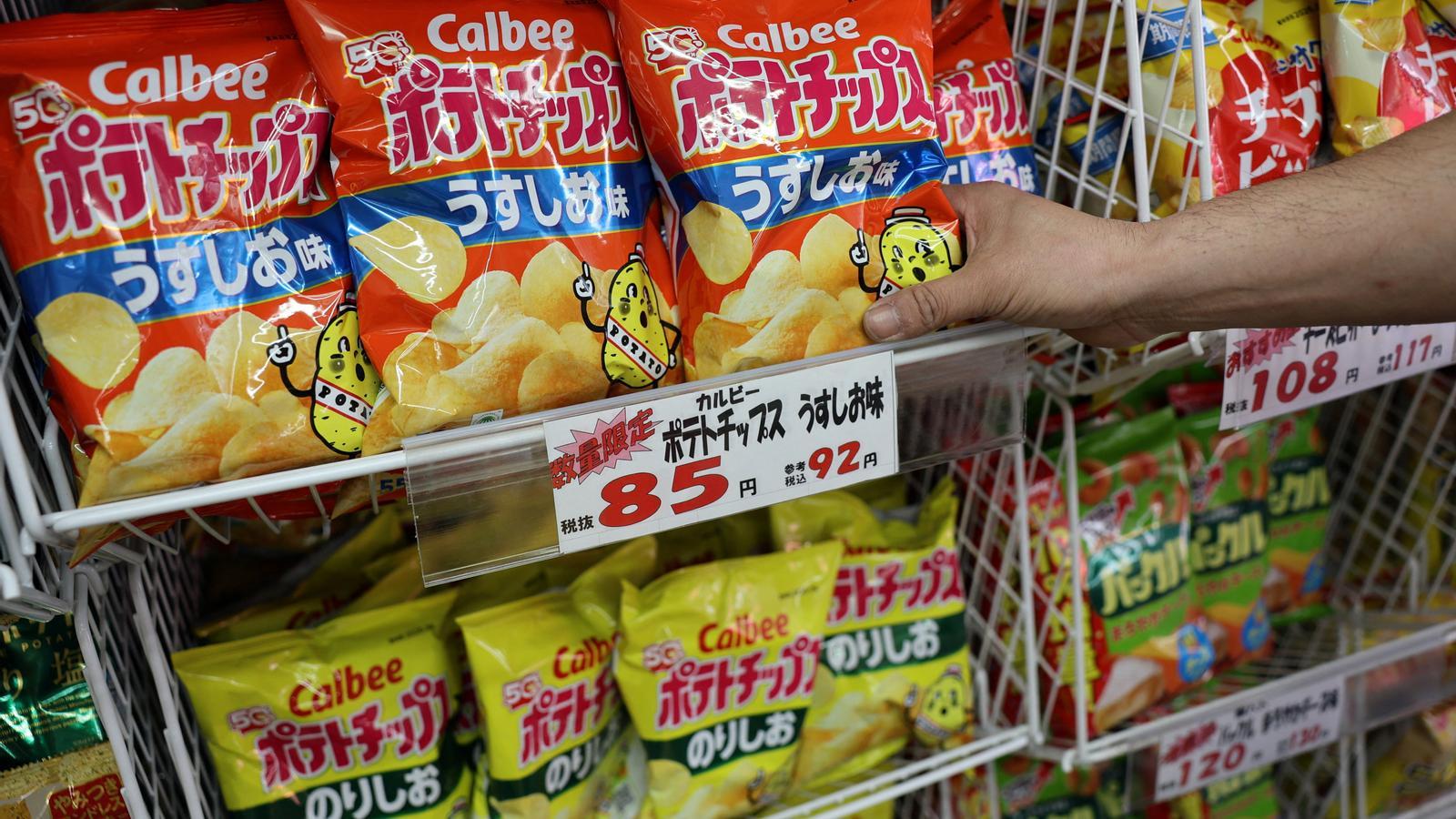
TokyoThe Japanese have been able to verify in recent days that Calbee's potato chip bags have suddenly changed their design. Where previously there were bright colors, eye-catching illustrations and intense orange tones, now more sober, almost bare packaging appears, dominated by black and white. The gesture, seemingly minor, responds to a decision that is unusual in the world of food marketing: to minimize ink usage to ensure continuity of supply.
The main snack manufacturer in Japan announced that, as of the end of May, 14 of its best-selling products – including popular chips and Frugra cereals – will go on the market with a simplified design. Behind the change is not an aesthetic strategy or a commercial campaign, but a much more pragmatic problem: tension in the Middle East following the conflict with Iran and the difficulty in securing the supply of naphtha, a petroleum derivative essential for manufacturing packaging ink.
Calbee's decision is not only understood within the limits of an industrial production chain, but also in a much broader context of global energy tension
. The company has explained that the change responds to the need to guarantee the supply of raw materials at a time of international market instability, especially regarding petroleum derivatives. Naphtha, key for the manufacture of ink and plastics, is one of the products most sensitive to disruptions in the import flow.
In Japan's case, this dependence has a structural dimension. Approximately 40% of the naphtha the country consumes comes from the Middle East. The partial interruption of maritime traffic in the Strait of Hormuz has further strained a supply chain already under pressure for months.
A tension far from supermarkets
Japanese authorities assure, however, that there is no immediate risk of shortages. The government argues that strategic reserves and partial diversification of suppliers allow for normality to be maintained, but at the same time acknowledges that some companies have begun to adjust industrial processes to anticipate possible disruptions. In this fragile balance, even seemingly minor decisions – such as reducing the colors of packaging – end up becoming a visible indicator of a tension brewing far beyond supermarkets.
The case of Calbee is not isolated within the Japanese food industry. Other manufacturers have begun to study similar adjustments in their packaging and production processes due to the rising cost and uncertainty in the supply of petroleum-derived materials. Companies like Itoham Yonekyu Holdings have acknowledged that they are evaluating simplifications in packaging, while they wait to see how the market evolves before making definitive decisions.
In parallel, the food sector had already been working for months with inflationary pressures that have been affecting both production costs and logistics. In this context, some companies have opted directly to raise prices; others, as in the case of Calbee, are seeking intermediate formulas that allow them to maintain supply without passing on the full impact to the final consumer, even if it means giving up highly recognizable visual brand elements.
The result is an unusual image in a country where product aesthetics play a significant role in purchasing decisions: simplified packaging, reduced colors, and designs that are more functional than evocative. What begins as a technical measure to guarantee supplies ends up introducing, almost imperceptibly, a change in the way products circulate and are perceived in daily life.
Beyond the industry, the Calbee case has had a certain symbolic impact in Japan. The fact that such a quotidian product as chips is affected by geopolitical tensions thousands of kilometers away has reignited the debate about the vulnerability of global supply chains. In a country highly dependent on energy imports, any alteration in the oil flow quickly translates into adjustments that reach the supermarket shelves.
The result is an unexpected scene: colorless packaging to gain stability, brands that simplify their image to adapt to global uncertainty, and a product as banal as potato chips turned into an indirect thermometer of the world energy system.
