Grifols Egypt raises investment in the project to €460M
The Catalan society with the Egyptian government seeks to double plasma donation centers until 2029 and assures that the project "will change the industry"

-
CAT -
CAST
CairoThe Grifols project in Egypt is accelerating its development beyond expectations. The joint venture between the Catalan multinational and the Egyptian government, dedicated to achieving self-sufficiency in plasma derivatives, will invest an additional 180 million euros by 2029 to complete the project and substantially expand the network of donation centers. Initially, the plasma-derived medicines company and the African executive announced an allocation of 280 million euros. With the new growth plan, total financing will reach 460 million euros.
Grifols Egypt for Plasma Derivatives (GEPD), it should be recalled, is a shared initiative with a 51%-49% split between the Egyptian state, through the National Service Projects Organization (NSPO), and Grifols. The investment announced by 2029 is divided equally, with 230 million euros corresponding to the Catalan company and the same amount mobilized by the North African executive.
The majority of the new investment will be allocated to expanding the plasma donation center network in the country. Currently, GEPD has 16 donation points, and will add four more before the end of the year, bringing the total to twenty. The goal for 2029 is to double its reach, to approximately 40 centers.
At present, the company has the capacity to collect up to one million liters of plasma per year; and expects to reach three million liters by the end of the decade. According to the vice-president of the GEPD board, Tomás Dagá, the joint venture seeks to "accelerate the development of the necessary industrial infrastructures" to ensure access to plasma-based medicines for patients in Egypt, Africa, and the Middle East.
Self-sufficiency in plasma
GEPD's objective is to achieve plasma self-sufficiency in Egypt; that is, to provide the country with all the hemoderived medicines it needs with local plasma. Until now, they regret from the company, "everyone uses hemoderivatives, but most of the plasma is North American." The African country achieved this milestone in December 2025, and the company is already targeting external markets, especially African and Middle Eastern ones. Also towards Europe, following the endorsement of the entire value chain by the European Medicines Agency at the end of last year.
It should be recalled that most European countries do not allow plasma extraction with financial compensation, with exceptions such as Germany or the Czech Republic. Nevertheless, company sources indicate that the EU "is beginning to wake up" in this area, and that there has already been interest from some EU country to move forward with a project similar to GEPD.
The company was created in 2020 and, according to the company, it was already planned from the outset to expand the announced initial investment. The good performance of the project has led the Catalan company to accelerate its growth plan. Grifols is showing itself to be particularly ambitious, to the point that sources from the multinational believe that GEPD "will change the world of plasma in economic and quality terms." Already in 2026, the joint venture could generate an EBITDA (earnings before interest, taxes, depreciation, and amortization) of over 100 million euros.
A "unique" plant
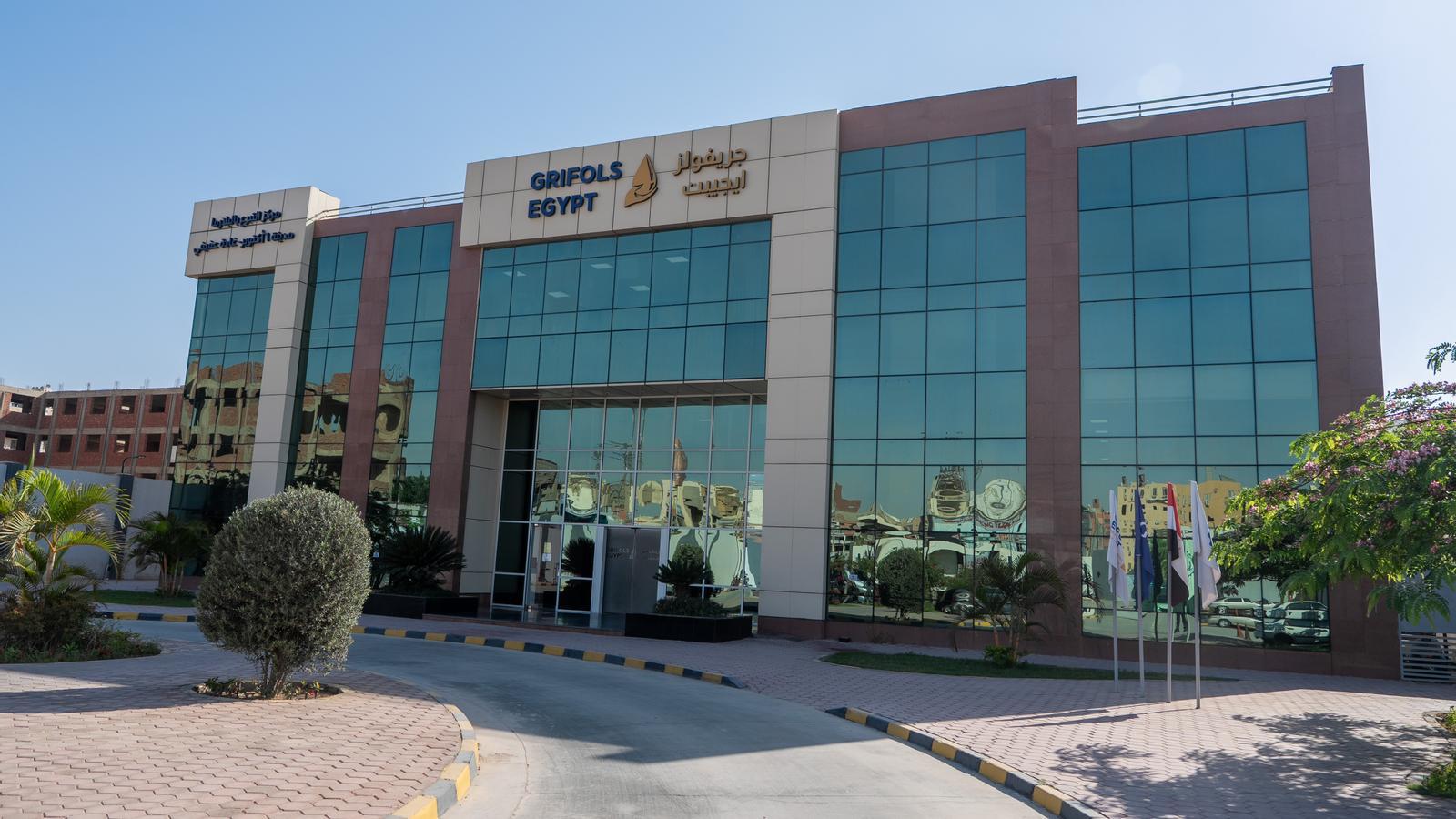
Currently, GEPD has about 1,500 employees, although the figure could approach 5,000 once the activity is fully deployed. Within the network of donation points, the main one, located in the City of October 6th, stands out. The center has a specialized laboratory that analyzes all markers of the collected samples to ensure their safety, as well as a logistics space equipped to preserve biological material, from where the extracted plasma is transferred to the country.
The jewel in the crown, however, is the new production complex that the company is building in the New Administrative Capital, the megacity that the Egyptian government is promoting east of Cairo. With more than 100,000 square meters, the plant is expected to be operational by 2030 and will concentrate practically the entire plasma value chain. Once completed, the facility will have a logistics center, a fully automated analytical laboratory – the first in Africa and the Middle East dedicated to plasma – and both fractionation and plasma purification plants, the two procedures necessary to produce plasma-derived medicines.
The New Capital plant will have the capacity to process more than one million liters of plasma per year, although this amount is expandable. Currently, the raw material obtained in Egypt is transferred to the center of the Catalan multinational in Parets del Vallès to be treated and transformed into medicine. Once the new center is operational, however, Grifols will be able to concentrate a large part of the value chain in the African country.
According to Grifols' forecasts, the new infrastructure will be fully operational by 2030. This year, however, the company will already be able to launch the first phase, the logistics center, which will become operational next October. Phase 2, the fractionation plant, would be completed in 2027 and would begin to operate at full capacity in 2028, once the relevant regulatory authorizations have been received. The final link, the purification plant, will be built in 2029 and would have to wait to receive the necessary inspections from the authorities until the following year.
