Pyrotechnics and tear gas: Bolivia plunges into a state of exception after six weeks of peasant revolt
The demonstrators demand the president's resignation while Congress approves a law that allows the deployment of the army
-
CAT -
CAST
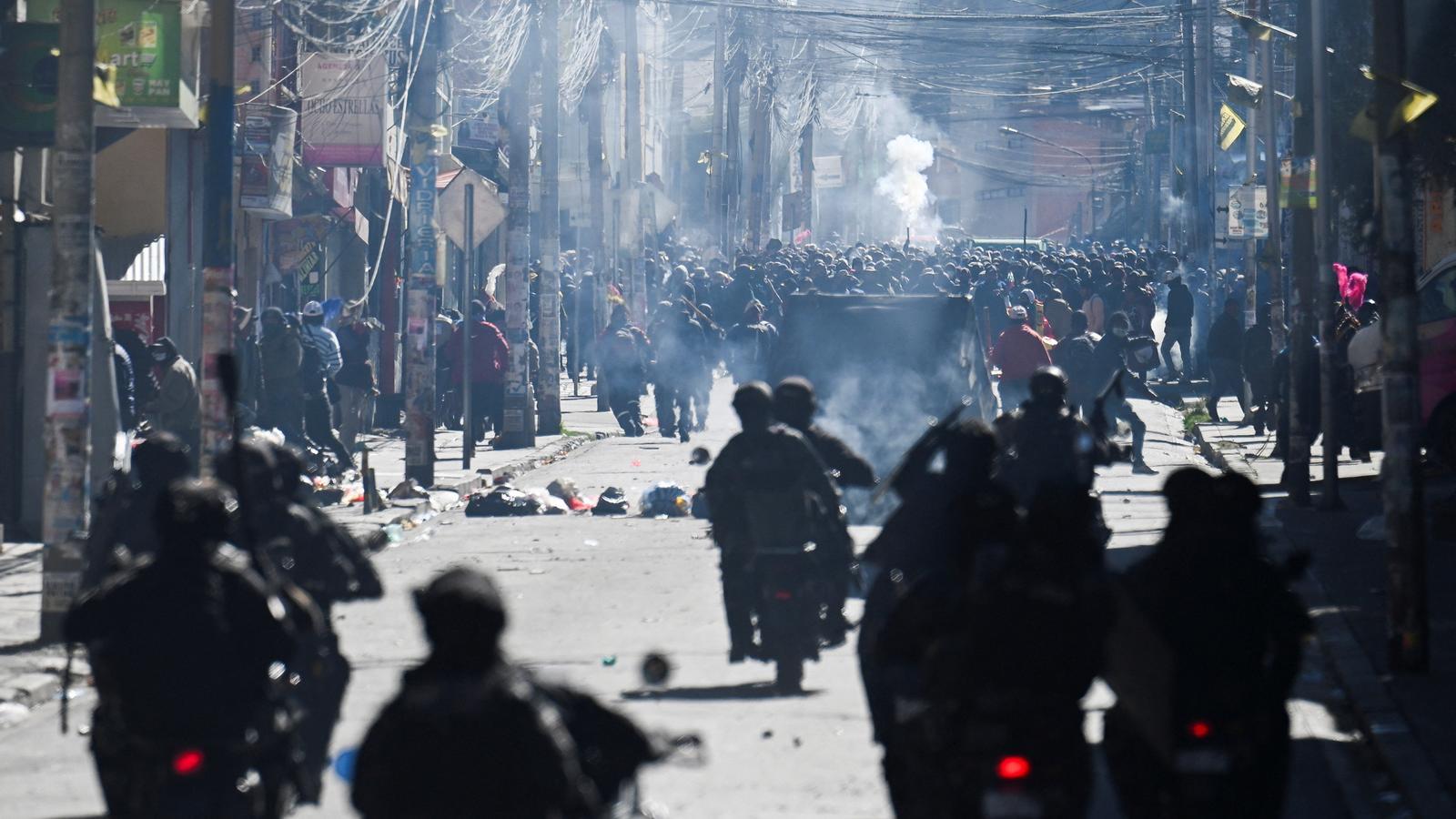
BarcelonaFireworks and tear gas have occupied the streets of Bolivia for days, where demonstrators and police have been clashing for a month and a half. Just six months after coming to power, Bolivia's first right-wing president in twenty years has already faced his first major crisis. Rodrigo Paz, of a moderate ideological bent, took office in November after almost two decades of governments from the Movement Towards Socialism (MAS), founded by former president Evo Morales, and has now encountered the largest protests in years in the Andean country.
Unions and organizations of workers and indigenous peoples have been collapsing cities and roads for six weeks with protests against austerity policies and other reforms that the new president intends to push. For now, nothing suggests that the gatherings will subside, and the government is preparing to repress them more harshly.
Sense of betrayal among indigenous peoplesCongress, in an attempt to curb the mobilizations, has approved a law regulating the state of exception and allowing the army to act to repress and control protests. But far from calming the situation, the law has added more fuel to the fire. Demonstrators complain about the repression and consider that the norm "weakens democratic guarantees and human rights protection," as stated by former president Evo Morales, who is in favor of the protests, although he has not initiated them.

Feeling of betrayal among indigenous peoples
By now, few demonstrators are seeking dialogue with Paz. Many Bolivians had placed in the new president a hope for change that has not yet been fulfilled. Unlike Jorge Quiroga, the conservative right-wing candidate who reached the second round along with Paz, the current president had presented himself in the elections promising gradual reforms and boasting of being a moderate candidate who could steer the country without drastic measures and without resorting to international organizations, as his rival proposed at the polls.
His promises had convinced several indigenous peoples, including the majority of the Aymaras and part of the Quechuas, the two main groups in Bolivia, who for many years had supported the Movement towards Socialism. During the last electoral campaign, however, they largely publicly supported Paz, convinced that his recipe was the right one to set the country back on track, and they became one of the main electoral bases and popular support for the new executive.

", Caricari summarized in the interview with CLACSO.
Gas and the International Monetary Fund
To solve some of the economic problems facing the country, Paz has turned to the International Monetary Fund (IMF), with whom he has negotiated a credit program worth 5,000 million dollars. During the campaign, the current president made it explicitly clear that he would not seek financing from the IMF, and as a result of this change of heart and some public statements he has made, protesters fear an approach to the US. "This generates a lot of susceptibility in the country, considering the US's intention to co-opt governments to implement policies aligned with its interests", summarized Caricari in the interview with CLACSO.

The declining gas industry also plays an important role in the protests. In the last decade, the exploration of new fields has drastically reduced, and the production and export of hydrocarbons, one of the main economic drivers of the country during the governments of Evo Morales, have plummeted. Bolivia has difficulties finding new fields, and the authorities themselves have pointed out that it is not impossible that the country will have to import gas. This scenario, added to the feeling of a lack of proposals to address the situation and the distribution of poor-quality gasoline in February, which damaged thousands of vehicles, is another of the factors generating discontent.

In the background of the protests, there is also an ideological rejection of the model of country that the executive is trying to promote. Paz has defined his proposal for Bolivia as a "capitalism for everyone", a model based on the reduction of taxes and tariffs, with an exchange rate system with maximums and minimums and more agile access to bank credits. Although he has defended that there must be "clear rules" for production and that the State must "help" in this task, his project contrasts with the intervention in the economy that previous executives promoted, and the demonstrators have repeatedly expressed their concern about a weakening of the state in favor of the private sector. Whether with concrete measures or achieving Paz's resignation, the protests seek, in summary, to contain a shift to the right of the country.
