The failure of the Franco-German fighter uncovers the shame of a common European defense
European leaders admit lack of integration and limitations of the European Union's war industry

-
CAT -
CAST
BrusselsThe official discourse of the European Union calls for a common defense, greater military autonomy, and less dependence on Donald Trump's United States. At this point, however, the reality is that the most pressing issue is unresolved. As community leaders admit in hushed tones, European allies still lack sufficient war industrial capacity to stop buying weapons from the North American power, a deficiency that has become evident again with the failure of the production of a latest-generation Franco-German fighter jet, which was also to have Spanish participation. the failure of the production of a fighter jet of Franco-German origin of the latest generation, which was also to have Spanish participation.
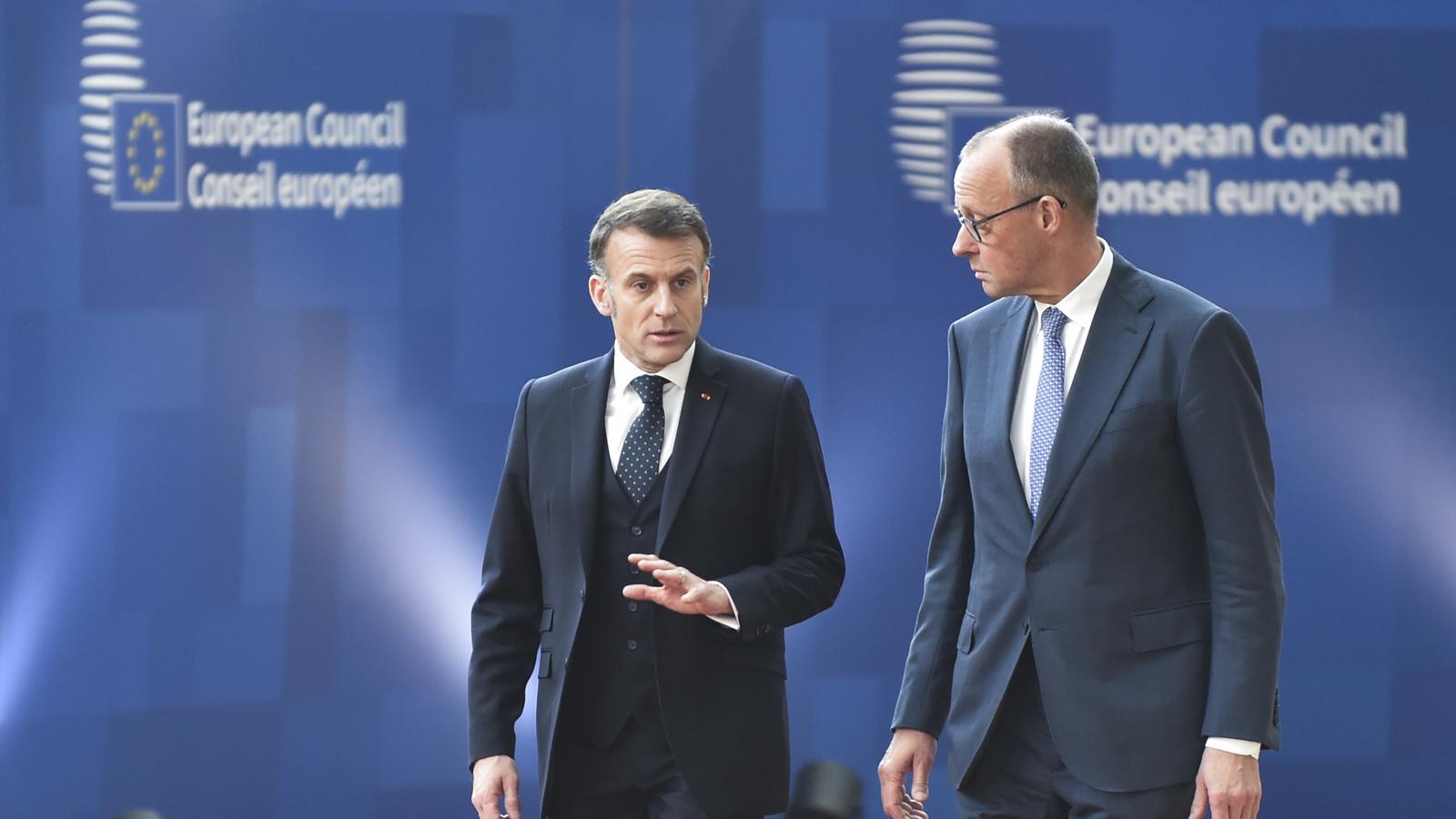
The project for a combat aircraft manufactured by the two major European countries, Germany and France, was announced with great fanfare. It was valued at 100 billion euros and aimed to compete with the F-35 fighters produced by American industry. Furthermore, the collaboration between the two main member states of the European Union, which usually pull in opposite directions, was intended to be a clear message in favor of a future common European defense. Even the French President himself, Emmanuel Macron, and the German Chancellor, Friedrich Merz, tried to prevent the derailment of the emblematic initiative.
Despite the political will, differences between the companies involved in the project led to its failure, and a Pandora's box has been opened. Several European leaders have spoken frankly about the lack of unity in European military industry matters and have admitted that the shipwreck has been a hard blow to the aspirations for autonomy of the European Union partners. One of the harshest descriptions came from the Belgian Minister of Defense, Theo Francken, who called it a "painful awakening" for the continent and the will to move towards the creation of a "European army".

No was the only European minister who was emphatic in assessing the project's failure. The same German Defense Minister, Boris Pistorius, assured the media that, although it was an "ambitious and large-scale European initiative," it had "capsized in the face of reality."
The reality is that, at least for now, European industry is not sufficiently integrated and the manufacturing capacity of each ally individually is insufficient to develop projects of this magnitude. According to various international media, Dassault wanted to lead the project and guarantee its intellectual property rights, while Airbus was open to a more varied partnership and technology transfers between companies. The initial intention was for the intellectual property to be divided into three equal parts among the French company, the German company, and Indra, which is headquartered in Spain.
Furthermore, Paris and Berlin wanted different aircraft models. The will of the French authorities and company was that the aircraft could carry nuclear weapons, although the German side was reluctant and did not find it necessary, as Germany does not have nuclear military equipment. Another of the red lines set by the French state was that they could operate from aircraft carriers, which also did not convince the German authorities and company, according to various international media outlets.
Given the differences between the various companies, the details of the next-generation European combat aircraft were not finalized. Nevertheless, the objective was for the new fighter to complement and eventually replace the French Rafale and the Eurofighter, used by Germany and Spain, around 2040. The new aircraft was to operate alongside drones that could accompany and support it, and rely on technology and information from satellites and sensors. And, beyond nuclear capabilities, Germany and France did agree that the new fighter could carry long-range, precision missiles, both air-to-air and air-to-surface.
The EU is not giving up
The setback is tough, but neither state nor community leaders are giving up. A few hours after the press reported the failure, the German government and several companies in the military and aerospace sector assured that they would try to create a new alternative project with the aim of manufacturing a state-of-the-art fighter jet. Pistorius stated that the failure had been foreseeable for some months and that he is already in talks with other European partners and a group of six companies led by Airbus —self-named Team Gen 6— to try again.
The European Commission is also not giving up. "We continue to work very intensely to increase our investments in our own defense companies," assured the community's Defense spokesperson, Thomas Regnier, at a press conference. And, in fact, Brussels has been the institution taking the most measures to try to boost and unite the European arms industry. Among other things, the community executive approved a loan worth 150 billion euros for member states to jointly purchase weapons manufactured mainly within community territory.
For the moment, however, as the head of European diplomacy, Kaja Kallas, or the European Commissioner for Defence, Andrius Kubilius, have recently admitted, the capacity of European industry is still limited, and therefore, they are forced to largely buy American weapons. In fact, 75% of the money that European partners allocated last year to buy military equipment within the framework of the great rearmament went outside the European Union, especially to the North American power, according to a recent study by the Atlas Institute for International Affairs with information from PESCO, the community body for European cooperation in defence matters.
