Seven men raped her, none was arrested: the Cornell case puts the focus back on universities
The outrage over the gang rape coincides with the Trump administration's decision to restrict protections against sexual assault on campuses

-
CAT -
CAST
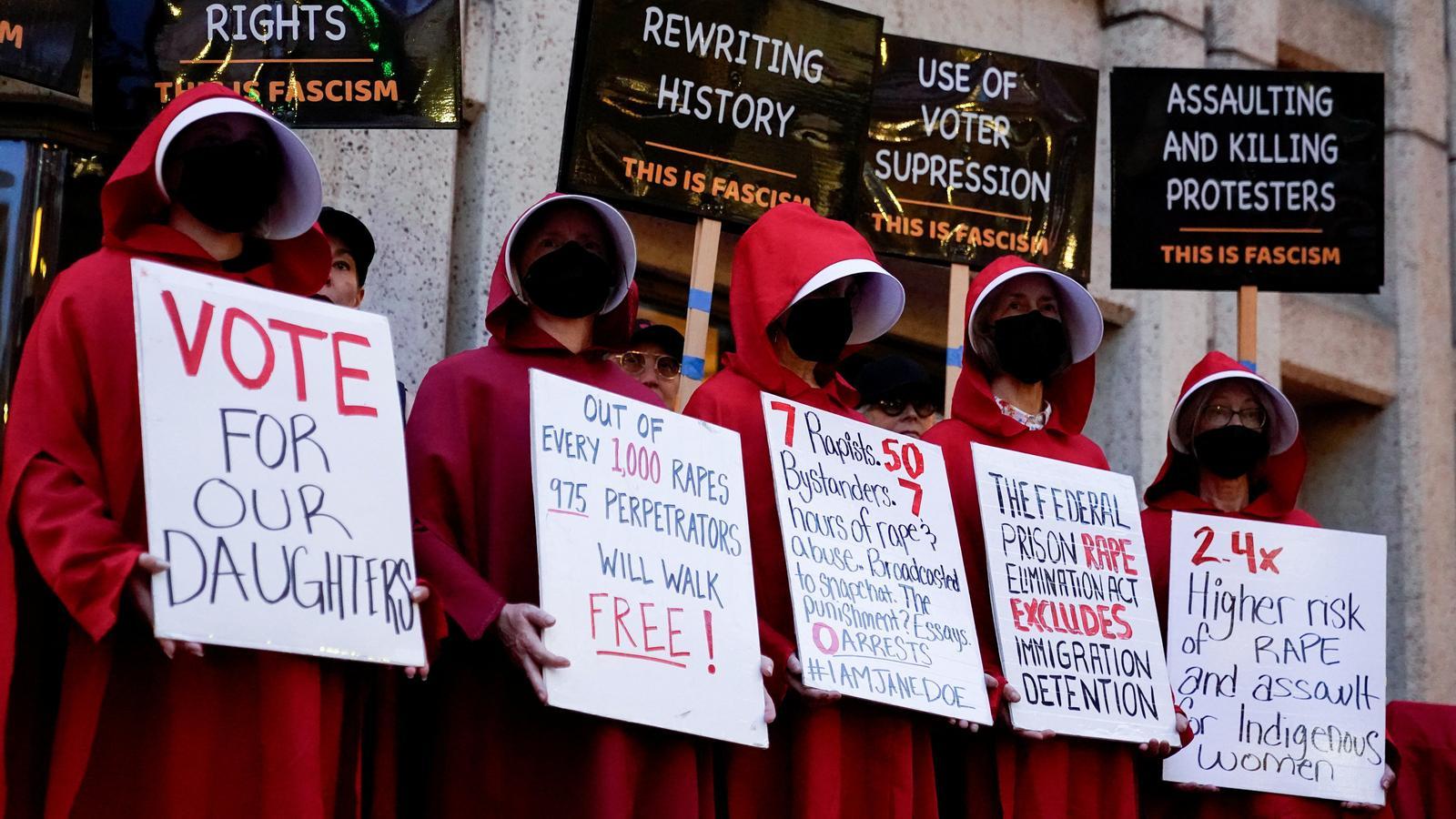
WashingtonIn recent days, social media in the United States has been filled with the phrase "I am also Jane Doe," a slogan that has also been repeated on the placards of the dozens of demonstrations that have taken place across the country this week. The reason: in October 2024, Jane Doe was raped by seven classmates at Cornell University for seven hours. She reported it, but none of the boys were arrested. Two of the attackers were expelled, and the other five only received minor sanctions, such as writing an essay about what had happened.
At first, Cornell managed to avoid the controversy. But the girl's lawsuit against the university and local authorities in Ithaca (New York) has reopened the case, which has quickly unleashed social outrage. The lawsuit filed by Doe's lawyer, Thomas Giuffra, includes screenshots of a group chat where there were about fifty men and where one of the attackers offered the body of the girl, who was drugged. "Free pussy upstairs," the message says. None of the members called the police or intervened, but five boys went up to the dormitory.

The case has once again put the focus on sexual assaults on campuses and on how often universities try to sweep the scandal under the rug at the victim's expense. "Universities have many incentives to prevent these cases from being officially recorded. They want to keep them as silenced as possible and protect their reputation," explains Northwestern University sociologist Laura Beth Nielsen to ARA, who has dedicated herself to investigating sexual assaults in the country's university fraternities.
In the United States, university campuses have their own police, and there is also a specific office to manage these types of cases without having to resort to the criminal justice system. In this context, explains Nielsen, the most serious sanction a university can impose is expulsion. Since expulsion is the worst thing that can happen to a student and can mark them for the future, there is a tendency to want to protect these "promising young men." "It is evident that there is a feeling that young boys have a free pass to commit this alleged error, even if that can ruin a girl's life," states Nielsen.
This September, a student at Louisiana State University, Kendall Francis, reported on TikTok that in October 2025, she had been raped by a football player from the university team in a campus dormitory. Although the center concluded that the boy was responsible for sexual assault, and initially suspended him for two semesters, the sanction was eventually reduced to four semesters of disciplinary probation. All this so that the elite player could continue competing on campus.
Beyond the tendency toward impunity for boys, "the big problem is that no one thinks about the number of women who end up dropping out of their studies after having suffered a sexual assault," denounces Nielsen, who points out that this figure "is very high." Specifically, 34.1% of sexual assault survivors drop out of university, according to a 2020 study. The National Sexual Violence Resource Center notes that one in five women suffers a sexual assault during their university years.
Trump cuts protection for victims
The internal management that university campuses carry out for these cases is regulated by Title IX, a guideline that depends on the Department of Education. During Joe Biden's previous administration, the circumstances under which universities had to take action in the event of sexual assault were expanded. "The problem is that this expansion that Biden made never fully came into effect because dozens of Republican and conservative states challenged it," explains Elizabeth Tang, senior legal counsel at the National Women's Law Center, to ARA.
The blockade applied by the judges affected, among other centers, Cornell University, and when Doe was raped, the Title IX of the first Trump administration still prevailed there. A text with a much more limited definition of when the university had to intervene.
Last week, in the midst of the Cornell case, the Trump administration made official that it was revoking Biden's Title IX to return to the 2020 version. "Trump's regulations made it more difficult for sexual harassment survivors to receive help. Before, universities had to intervene when the harassment was severe or persistent enough to limit or deny a student's access to education. Trump changed this criterion and established that it had to be severe AND persistent. Biden changed it back to recover the previous criterion," explains Tang.
One of the aspects that worries Tang the most is the fact that, under the Trump regulations, if the reported student leaves the center in the middle of an investigation –because they graduate, transfer to another center, or for any other reason–, the institution can choose to archive the complaint. "This creates a loophole that allows an alleged aggressor to evade any responsibility simply by changing universities," warns Tang.
In Doe's case, the question is not only what her aggressors did, but also what the institutions that were supposed to protect her failed to do. While the university decided how to punish the boys, the victim had to face the consequences of the rape. "Trump's regulations give many institutions the security that, if they do nothing, if they sweep sexual assaults under the rug or protect the aggressors, nothing will happen to them," warns Tang.
