Junqueras: "Who is the opposition in Catalonia? Albert Rivera"
The leader of ERC reiterates that Catalonia of 10 million is not viable for now

-
CAT -
CAST
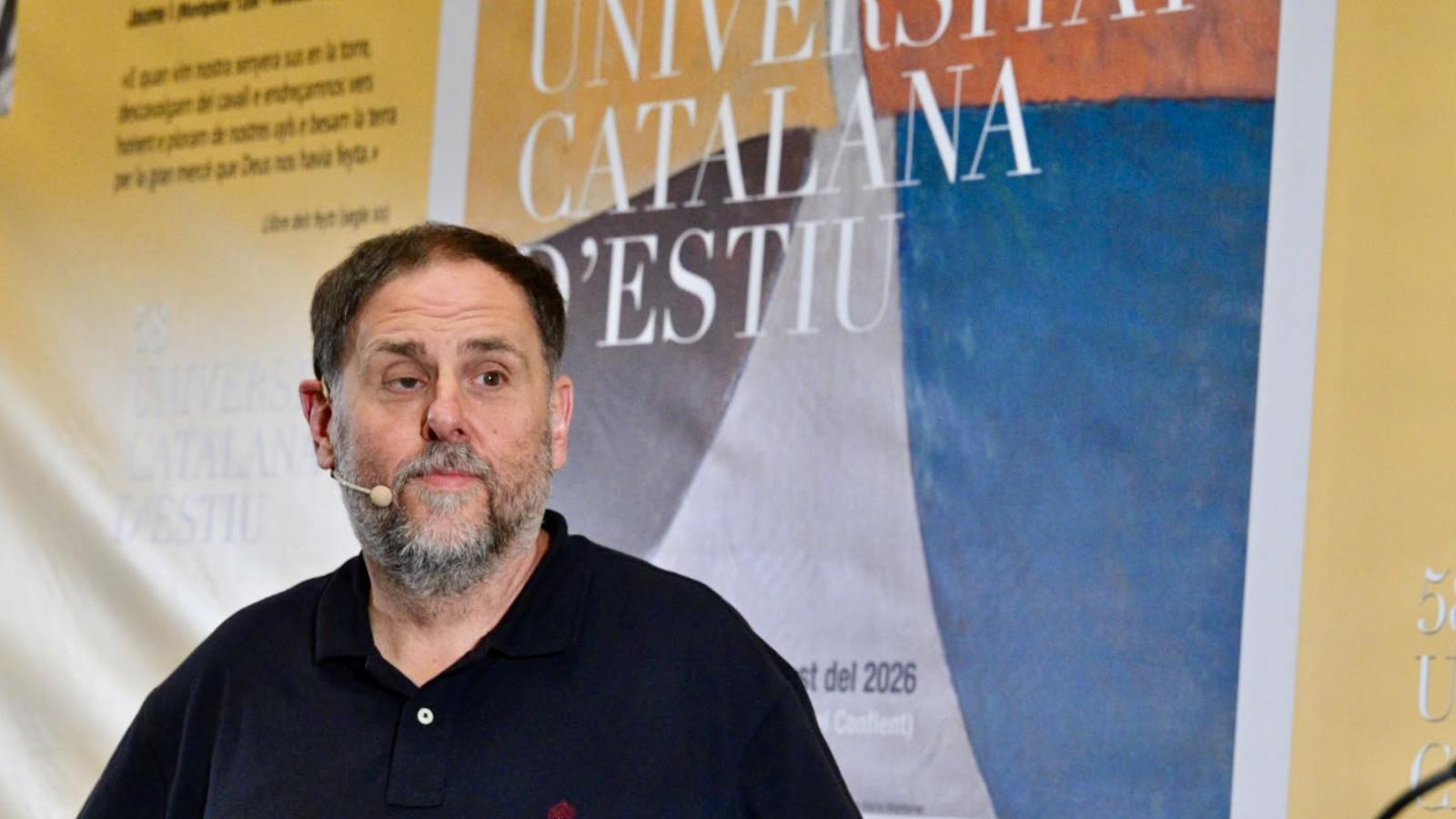
Prada of ConflentThe enemies of Catalonia and the cause of its freedom, as well as the reasons for the Principality's various defeats throughout history, such as in the War of Succession, have been detailed this Friday by the president of ERC, Oriol Junqueras, at the Catalan Summer University in Prada de Conflent. The republican leader reviewed the reasons for the defeats against Castile and related them to the struggle in recent years with the 'Procés'. Who today opposes the independence aspirations of some Catalans? Is the PSC part of this bloc? Junqueras dodged the questions posed to him in Prada, eventually resorting to a name: "For example, Albert Rivera." Seven years after his resignation and the dismantling of Ciutadans, Junqueras still remembers the orange party and its most representative leader as a symbol of anti-Catalonia, of the internal enemy that hinders progress and makes national liberation difficult.
With the objective of independence somewhat blurred in the short term, Junqueras wants to face various national challenges, such as migration. The president of ERC, who has confirmed he will attend the Diada demonstration, has once again clearly opposed the Catalonia of 10 million. In his opinion, at this time "the adequate circumstances are not met for Catalonia to have many more inhabitants than it already has", at least "under current conditions", in line with the "collapse" of services predicted a few days ago and in the same scenario by his number two, Elisenda Alamany, who already warned that the country is about to "explode". However, he also wanted to send a message against the far-right of Aliança Catalana, emphasizing that "hatred is incompatible" with the construction of a "shared future". Former president Pere Aragonès, with whom he hugged at the entrance of the Prada amphitheater, has taken up the challenge.
According to Aragonès, "national liberation and social justice must go hand in hand at a time when very rapid changes are occurring and when there are proposals that try to import far-right populisms to Catalonia with an exclusive idea of the nation". "Macià had an inclusive idea of the nation, but a firm one," he added, vindicating the former Catalan president. According to Aragonès, "the fastest path to strategic defeat" is the path of Sílvia Orriols, and he advocated for "grand alliances because the country's objectives are so ambitious that everyone must be included to achieve them".
Controversy
This Thursday, another former president of the Generalitat like Quim Torra insisted on the idea of renewing the leadership of the pro-independence parties – the only ones that have not changed since 2017 –. Junqueras responded to him, recommending that if he wants to change the leadership, he should request "the calling of a congress in Junts" and not do it through the media. Torra, however, does not belong to the party led by Carles Puigdemont.

The "end of the Catalan nation", according to Francesc de Castellví, was the War of Succession, which the Principality lost. But what is the reason for the concatenated defeats, according to Junqueras? "One of the keys was demographic reserve, each loss for Catalonia was irreplaceable, while in Castile, it was replaceable", because they were "15 times more populated". Extrapolated 300 years later, "things happen if you are capable of creating the material conditions for them to happen" and this "is worth in economic, political terms of building large majorities" and having "the fewer people against you, the better". "We don't quite succeed due to a matter of scale. We did not achieve it in 2017, nor in 1939, nor in 1934, nor in 1931, nor in 1919... But the only ones who survive as a nation in Europe, of our size, are us", he sentenced.
