"It cannot continue like this": the CDU's defeats put Merz and the Grand Coalition against the ropes
The SPD asks for a change of course from the federal government while the far right adds votes but does not increase its power
-
CAT -
CAST
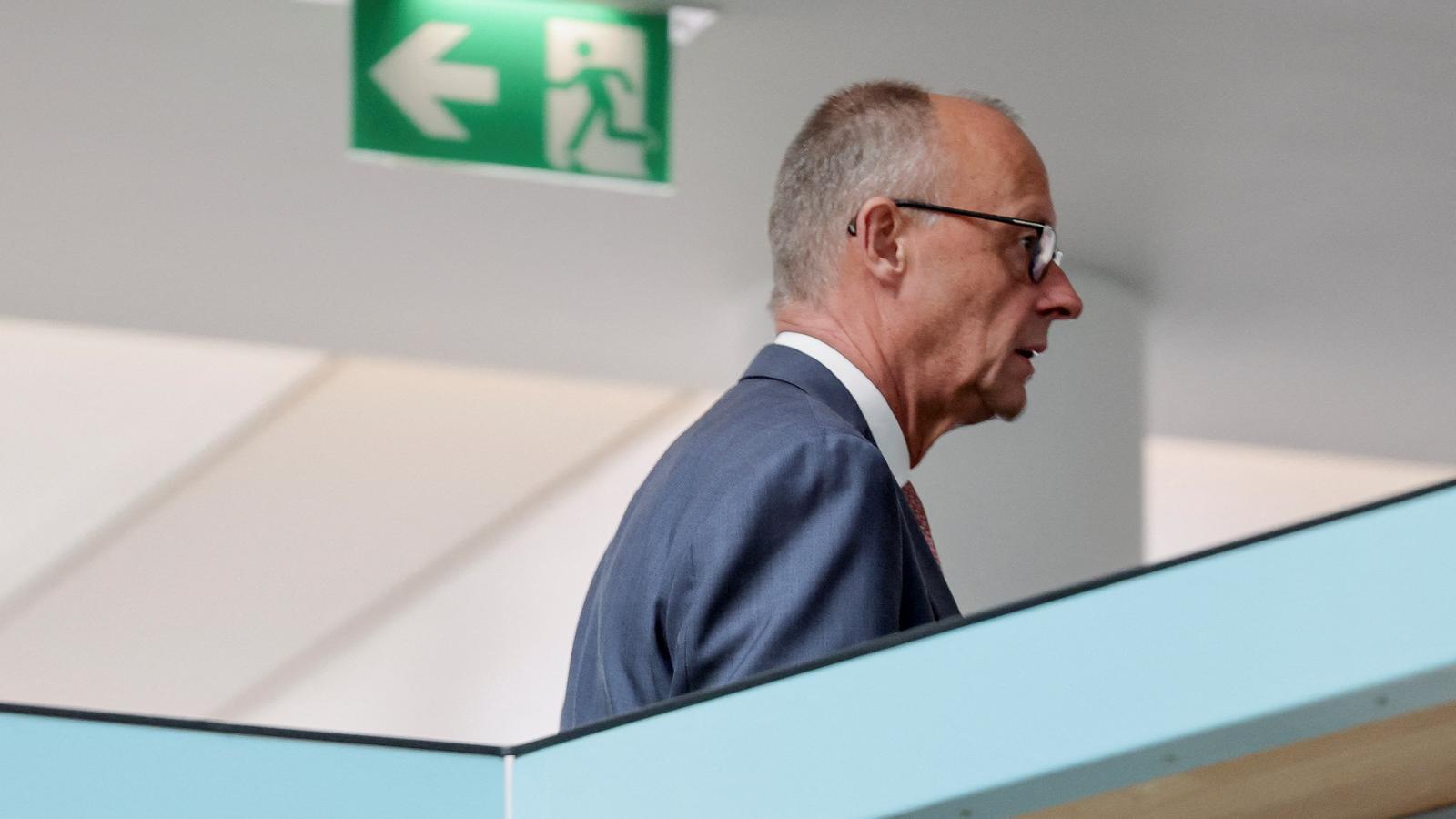
BarcelonaThe nightmare continues for German Chancellor, Friedrich Merz. If the defeat of his party, the CDU, and the triumph of the far-right in the state of Saxony-Anhalt two weeks ago were a shock, the results in the elections in Mecklenburg-Western Pomerania and Berlin have confirmed the deep crisis in which the traditional right-wing party finds itself. In Mecklenburg-Western Pomerania, for the first time, it has been left out of a state Parliament and in Berlin Die Linke (The Left) has beaten them.
"The chancellor's sunset has begun," predicted this Sunday the leader of the AfD in Mecklenburg-Western Pomerania, Leif-Erik Holm, after winning the elections. A judgment that hours later, this Monday, was echoed by the national leader and co-chair of the AfD, Alice Weidel, stating that "the government will disintegrate before the general elections scheduled for 2029".
Despite the electoral failures, the CDU leadership formally maintains its support for Merz. He has expressed his "concern" about Germany's drift, which is in the midst of a structural crisis with an economy that cannot manage to board the growth train after years of stagnation. Adding to the controversial social reforms that the federal government wants to promote, it is the breeding ground that the far-right has exploited to win in two states in just two weeks.
Confidence in Merz, who considered these elections to be a "turning point", has fallen within his own party, a fact that has increasingly fueled speculation about a possible replacement. "Merz must go. He is incapable of exercising leadership of the executive branch or communicating," asserted Christian Gräff, a CDU politician who was a member of the Berlin Parliament. Fellow CDU politician Philipp Amthor has attributed the historic defeat to the fact that some party members have raised the possibility of making pacts with the AfD. For Amthor, this has created "even more uncertainty" among voters.
The chancellor hastened on election night to make his continuity clear and reiterated it this Monday, stressing that "no one" in the party leadership had asked for his resignation. However, he acknowledged that his own figure, which suffers from "low popularity," had influenced both Mecklenburg-Western Pomerania and Berlin. In any case, a resignation at this moment would pose another problem for the CDU: that of who would want to assume the leadership of a party that finds itself at its most critical moment.
The Grand Coalition, in crisis
But the electoral crisis not only affects Merz, who now finds himself even more against the ropes, but also the coalition in the federal government with the Social Democrats. "We cannot go on like this," warned the SPD general secretary, Tim Klüssendorf, unhappy with Merz's commitment to maintaining continuity in reform policy despite electoral failures. In the opinion of the Social Democrats, it is necessary to "reflect on the messages conveyed by the voters" and, in the words of Klüssendorf, it is clear that citizens want "corrections and adjustments" to federal policies.
He is not the only voice in the SPD calling for change. On election night itself, the SPD leader and Vice-Chancellor, Lars Klingbeil, demanded that we "observe the results with humility and ask ourselves what can be done differently." In any case, both the conservatives and the Social Democrats emphasize that they have not explained well some reforms that, in their view, are positive for the country. "The debates we have had in Berlin have been limited to cuts," justified the SPD leader regarding the population's dissatisfaction with the social reform plan, which includes the abolition of early retirement at 63.
Merz, however, does not seem to have a change of course in mind. In his appearance this Monday, he assured that "we are determined to face the historical tasks that our country has ahead. What is at stake is the democratic future of our country." The Chancellor puts the far-right and the Die Linke left in the same bag. "More than 40% of the votes went to forces that are destructive, that question our political and parliamentary system and that try to excite people with radical and simple solutions." And faced with this situation, he opts for "stability and a clear course".
The other side of the coin is the AfD, the big winner in the elections of the last two weeks. The far-right party has claimed to have ousted the CDU as the "people's party" after its triumph in Mecklenburg-Western Pomerania and has asked Merz to leave the chancellery. Although it has no chance of governing, the ultra-formation has claimed the presidency of the state parliament.

The AfD's electoral successes have, for the moment, translated into little power. Since the victory in Saxony-Anhalt, little is known about what the far-right party's strategy is to reach power. The winner in Saxony-Anhalt, Ulrich Siegmund, ruled out a minority government, but the party's leader, Alice Weidel, asserted that, if it were up to her, she would be willing to form minority governments. In Saxony-Anhalt, Siegmund continues seeking the support of individual deputies to govern, without ruling out new elections.
Europe suffers with a weakened Germany
The rise of the far-right in Germany crosses the country's borders. Although it is not going through its best economic moment, the country remains the main economy and a key player in the European Union (EU), which faces an accumulation of challenges while trying to contain Russian aggression, the outbursts of the President of the United States, Donald Trump, and the economic and commercial threat from China, among others.
Germany is key in decisions in Brussels and a weakened country or one very focused on its internal affairs may subtract leadership from community responses at a time of little lukewarmness on the world stage. Defense spending, the European position on foreign affairs, or the always complicated negotiation of the European multiannual budget could suffer as a result.
Furthermore, Germany could be just a precedent for an upcoming year in which several European countries go to the polls, such as France or Spain, with far-right parties that aspire to shake up (even more) European politics.
