French students 'take' the Bastille: "We will continue until Macron gives in"
The government promises the incorporation of 3,000 teachers before Tuesday while the protests already go beyond education
-
CAT -
CAST
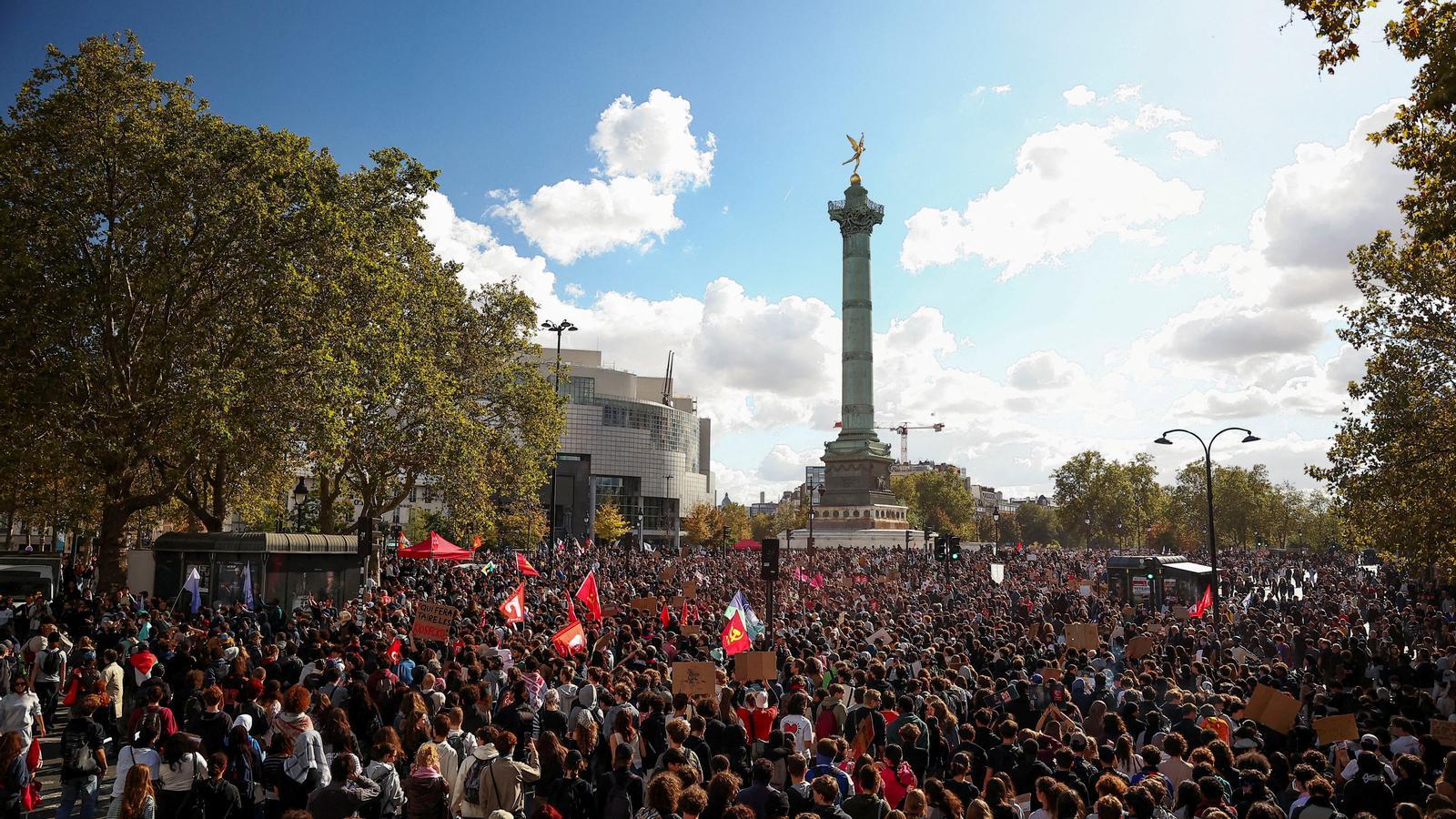
BarcelonaStudent protests in France are no longer just those of high school students. This Thursday, university students joined various demonstrations called throughout the French state, and more and more sectors are supporting the adolescents' mobilizations. Unions and student and teacher organizations have called for a new day of major mobilizations for October 13, and on November 5, the major French unions are also calling for a day of protest.
Meanwhile, this Thursday, at the Place de la Bastille in Paris, a setting loaded with symbolism, new clashes between protesters and police have taken place. The officers have tried to disperse the crowd with a water cannon, and the smoke from tear gas has again clouded the French capital, while the students made it clear with the throwing of cobblestones and pyrotechnics that they will not lower their demands. "As long as 10 billion euros are not put on the table, we will not stop the mobilization," warned Sabrine Kharbach, spokesperson for the Student Union, one of the main unions calling for the protests. From Marseille, representatives of the same organization have insisted that the protests have a very clear horizon: "We will continue until Macron yields and meets our demands." According to the Ministry of the Interior, 71,500 people have demonstrated throughout the French state, including 24,500 in Paris.
The organizations speak of a "historic" struggle that goes beyond education. On Tuesday, the largest mobilizations were experienced since the protests broke out on September 17. The blockades of high schools throughout France have become routine in the last three weeks, and the student protests have encouraged French-speaking adolescents in Belgium to resume mobilizations in the country against the increase in university fees and cuts in education. This Thursday, the authorities have banned gatherings of more than three people in the Walloon town of Liège, the epicenter of the Belgian students' protests, with the pretext of containing the disturbances.

In France, students are protesting against the lack of funding for the education system, which translates into a shortage of teachers and materials, very high ratios, equipment in poor condition, and significant inequalities between schools in wealthy areas and those in poor areas. Although they maintain concrete demands in the educational sphere, the reasons driving many young people to take to the streets now go beyond education. Various protesters are expressing to international media and through social networks a feeling of unease and indignation at the worsening living conditions, and are showing opposition to the cuts proposed by the new budgets of the Macronist government of Sébastien Lecornu.
In an interview this evening, the Minister of Education, Edouard Geffray, announced the immediate incorporation, "between tomorrow and Tuesday," of 3,000 substitute teachers who are currently not working and who will be assigned to reinforce a hundred schools, those where the situation is most serious. Among other measures, he has also promised to hire several hundred additional teachers, promote the possibility of extending school hours, and introduce some amendments to the budget draft to strengthen the substitution of teachers. Despite the announcements, the unions have already warned that they will not stop the protests because they do not consider the measures to be enough.
An "emergency plan" that does not convince
Before these announcements, the French Prime Minister appeared on Wednesday evening. Aware that the student revolt could fuel protests from other sectors already scheduled for this October, Lecornu announced an "emergency plan," with measures such as a reduction in the price of diesel and an energy voucher for low-income families. The horizon of the presidential elections in the spring is very present in the executive, which does not enjoy much stability, and fears that a triumph of the far-right or the radical left will complicate its task.
In this sense, Lecornu tried to calm the protests by recalling that the budget allocated to Education is one of the few that will not only not be cut, but will be increased. But the protesters are asking to go beyond the 1.2 billion euros additional provided for in the accounts, as they consider that they fall far short of the amount necessary to reverse the situation in schools. Furthermore, with the global character that the student revolt is taking on, the cuts in healthcare or pensions provided for in the budget do not help to calm the protests.

