In Wallonia, the French-speaking side of Belgium, students have also been staging protests for months that cyclically gain and lose intensity. In June, there were significant clashes between protesters and police in demonstrations against the increase in university tuition fees. In recent days, students, who claim they are in contact with their French counterparts, have returned to the streets to show their opposition to reforms and cuts in the education sector. This Wednesday, disturbances were recorded in the city of Liège, where local media report 107 arrests.
France temporarily bans the use of grenades: the keys to the student revolt
The government suspends classes at high schools until Monday after yesterday's major mobilizations and weeks of blockades
07/10/2026 - 20:18 h
-
CAT -
CAST
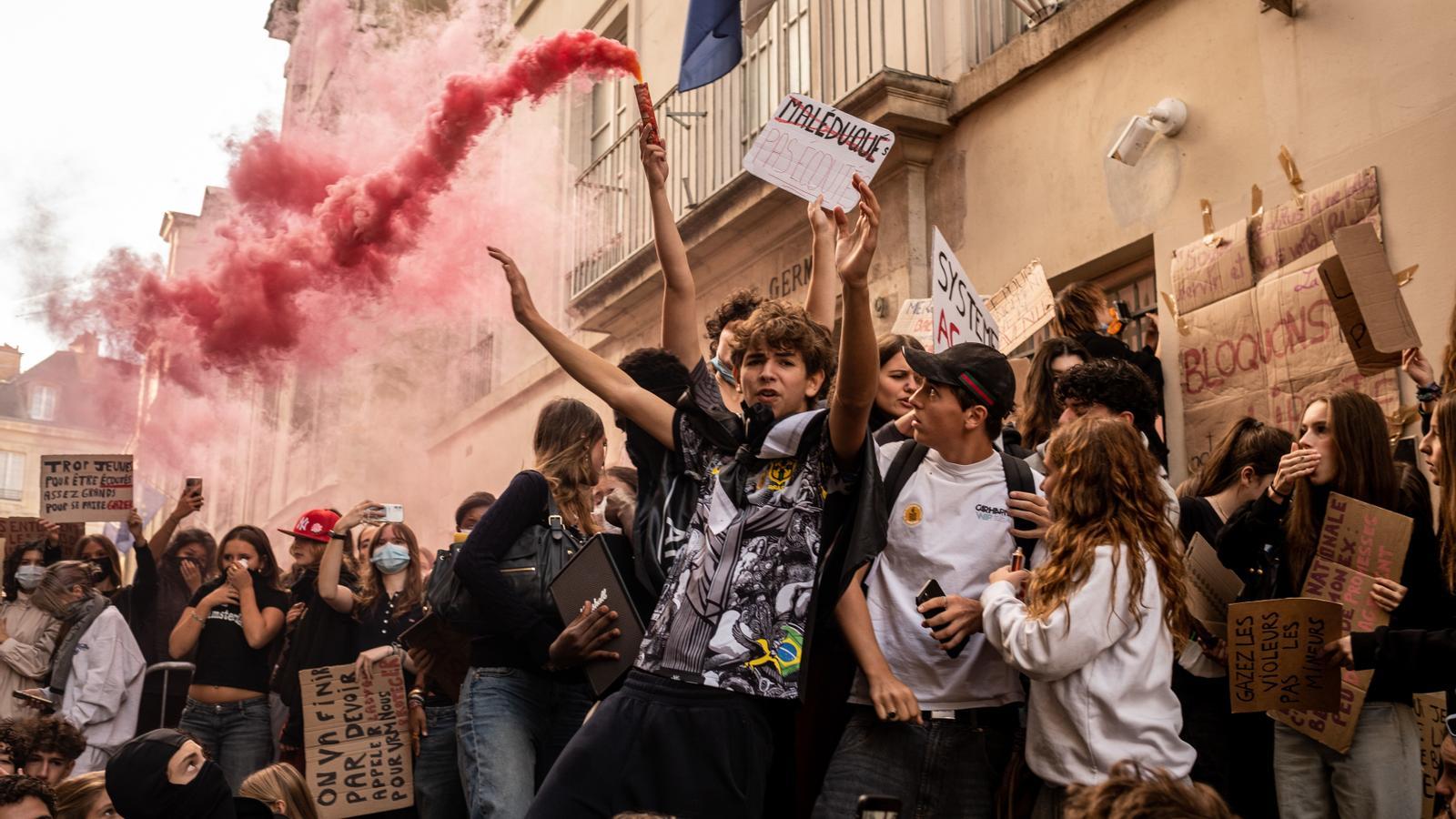
BarcelonaFrance has been experiencing historic student protests for three weeks. Students are blocking educational centers, clashing with the police, and thus paving the way for other sectors of the population who, suffocated by the cost of living and dissatisfied with the budget prepared by Sébastien Lecornu's executive, are pointing toward broader mobilizations throughout the French state during October.
Tuesday saw the most significant day of mobilizations since the start of the current protests. Between 266,000 people—according to the Interior Ministry—and 450,000—according to the organizers—gathered in various cities in France. Yesterday's mobilizations, which have been causing a new clash between macronism and the left at an institutional level for days, ended in riots, particularly severe in Paris, where the police tried to disperse the protesters with tear gas and water cannons.
From this Wednesday until Monday, the government has suspended classes across the country and has temporarily banned the use of grenades by the police after one of these devices mutilated a young person's forearm. The executive speaks of "unprecedented" violence by the protesters and human rights organizations denounce a disproportionate use of force by the police, while throughout the French state the number of detainees has already risen above 6,500 and there are more than 1,800 people being prosecuted, the majority of them minors. The government does not specify for which crimes they are being investigated and, although the blockades of high schools have decreased this Wednesday, the revolt seems far from over.

The fuse of the protests
The mobilizations started on September 17 at the Saint-Exupéry Institute in Créteil, in the banlieues south of Paris. Several students joined the center's teachers, who had begun a strike to denounce the lack of staff at the institute. They achieved some of their demands and the case began to be reproduced rapidly in other centers across the country. After a few days, the blockades began, reaching 1,800 inactive institutes this Tuesday.
The protesters' demands
Students are complaining about the deterioration of the educational system and talking about "financial disinvestment." There is a shortage of teachers, class sizes in some centers exceed thirty students, there is a scarcity of materials—especially computer equipment—and facilities are often in precarious conditions, they claim. Most of the problems are aggravated in the poorest neighborhoods and cities. For this reason, inequality between centers is another weakness of the system pointed out by adolescents.
Although it is the students, often minors, who have led the protests over these three weeks, teachers and educational staff have also joined some demonstrations. They are demanding better salaries and timely payment, and are also denouncing the complicated conditions under which they have to do their work in some centers.
Global unrest
The outburst of indignation from high school students has also brought to the surface the unrest among university students. The government has proposed cancelling the rental subsidies it grants to some students to help them cope with the price they have to pay when they change cities to attend university. It is one of the various cuts in public spending planned by Sébastien Lecornu's government. Another reason for indignation among university students is the increase in tuition fees for non-compulsory studies for students from outside Europe, as well as the cut in social aid for foreign students, measures that unions consider racist.

In a context of rising cost of living in the country, the reduction of public spending outrages and angers part of the population. Although the executive plans to increase the education budget by 1.2 billion euros, it is preparing significant cuts in pensions and healthcare. Now the student protests could pave the way for broader new demonstrations, and several unions and organizations beyond the education sector are already planning mobilizations this October.
The executive, at a crossroads
The French government finds itself trapped in a dilemma. While it discursively promises more resources to the population, in practice it is working on an austerity budget that aims to bring the fiscal deficit closer to the 3% limit demanded by the European Union. France has a debt that is equivalent to 117% of its GDP, and financial markets have been demanding cuts for some time.
In the mobilizations, some young people reproach the executive for investing money in military spending but cutting it in essential public sectors, and the issue of debt also appears among those gathered: "The public debt that we have accumulated is being placed on the backs of the young," declared Céline, a university professor, to the Efe agency from Paris yesterday.
The clash between the left and Macronism
In this sense, the mobilizations represent an amendment to the plans of Macronism, and the political clash has also moved to institutional politics. The left-wing France Insoumise (LFI) supports the protesters, to the point that Bally Bagayoko, mayor of Saint-Denis, a member of the party and the first Black person to hold this office in a French city, has stood in front of the police on several occasions to try to protect the protesters.
At the state level, Lecornu reproaches Jean-Luc Mélenchon for supporting the mobilizations. The French president has accused the LFI leader of "stoking violence" and trying to capitalize on the mobilizations a few months before the presidential elections. Mélenchon, meanwhile, asks the protesters for "prudence" but remarks that they are "entirely right" with their demands.
Incidents in France revive protests in Belgium
