Clashes and riots throughout France: Are the 'yellow vests' returning?
The mobilization of this Saturday makes converge diverse protests and makes grow the social tension with blockades and hard clashes with the police

-
CAT -
CAST
ParisIt all started with a video on TikTok that a young person posted at the beginning of September in which they called for a demonstration on October 17th due to the rise in fuel prices and a series of messages on different social networks appealing for the return of the yellow vests, the protest movement that in 2018 brought thousands of exasperated French people out onto the streets due to the loss of purchasing power. Eight years ago, the trigger was precisely the high price of gasoline and diesel. A few days after the publication of the video, students from secondary schools in the banlieue of Paris started a revolt against the lack of teachers, overcrowding in classrooms, class schedules, and the deteriorated state of many centers. The protest, still unresolved, ended up spreading to the rest of the high schools across the country, hundreds of which have been blocked for weeks.
During the last few weeks, the unions have also called for two days of strikes in the public sector in protest against the wage freeze and the cuts the government plans to make in the 2027 budget. With a debt that stands at 119% of GDP (a record since 1946), a public deficit that this year will far exceed 5%, and an economy that is in danger of recession, the executive led by Prime Minister Sébastien Lecornu has announced austerity measures – such as the freezing of the highest pensions – that have increased social unrest.
Given the climate of social tension that France is experiencing, the call that young person made on TikTok has had an enormous echo. According to the French press, behind the call there were no leaders of the yellow vests, even though many of them have ended up joining. Former members of the movement have tried to structure the movement in recent days and this Saturday's mobilization has reminded us, in a certain way, of the modus operandi of 2018.

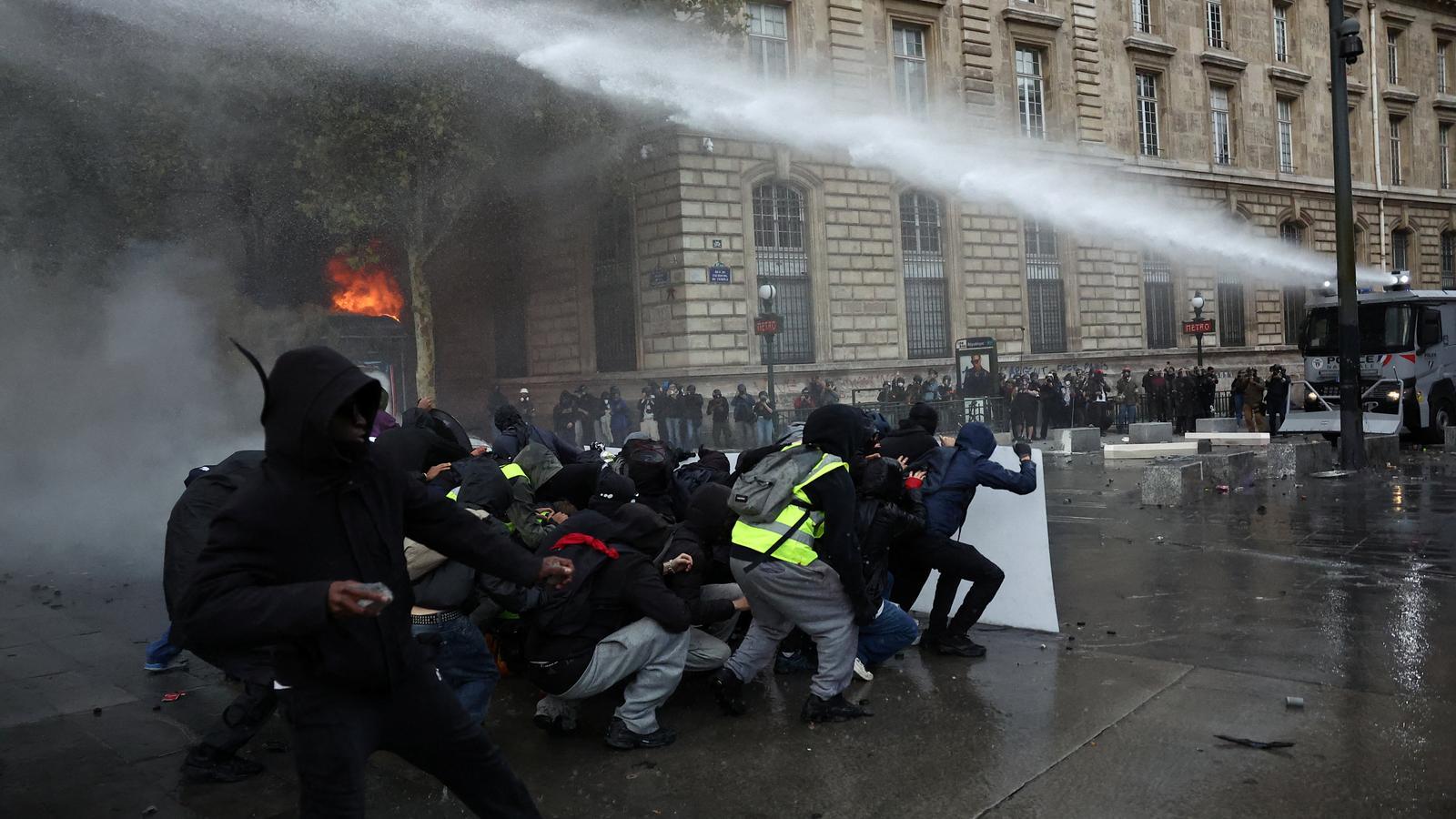
Throughout France, more than 90 mobilizations and 500 isolated protests have brought the country to a standstill. By early afternoon, the police had arrested 200 people who, according to the authorities, intended to commit violent acts. The major mobilization took place in Paris, with its epicenter at the Place de la République, but there were also significant protests in Marseille, Lyon, Rennes, and Lille. This Saturday's demonstrations are no longer led only by students, but different movements and collectives have also converged there –from students to workers– that could trigger a new social crisis.
New social crisis
Will there be a new mobilization of the yellow vests like the one in 2018? "Everything is possible, because the anger is there," assured Priscillia Ludosky, one of the movement's leaders from six years ago, to Le Parisien this week. On the street, the unrest can be felt. "It is true that this call on October 17th did not have a backbone structure or spokespeople [...], but what we see repeating constantly is the issue of purchasing power and the price of gasoline. With the mobilization of high school students and the cost of energy, people have real reasons to mobilize," Ludosky defended in the same newspaper.
With a government that, most likely, has its days numbered, with presidential elections in sight, and with a complicated economic situation in the country, the president, Emmanuel Macron, and the prime minister have little room for maneuver to make concessions. The probabilities that street protests will continue are real. "I don't know if it is a crisis of the Republic, but it is certainly a political crisis. Because all these protests result in social tensions that do not find a political framework to be resolved," points out sociologist François Dubet, former director of studies at the School for Advanced Studies in the Social Sciences.
Police repression
Secondary school students, who have the support of university students, also mobilized this Saturday to protest against police repression, which they say is very violent. Images of shocking police charges during the last few weeks and this Saturday, as well as the massive use of tear gas and stun grenades –one of them tore off the hand of a 15-year-old youth– against underage protesters, has triggered a wave of criticism, especially from the radical left party, La France Insoumise, without the Minister of the Interior, Laurent Nuñez, having engaged in self-criticism. In four weeks of student protests, the police have detained nearly 8,000 youths, most of whom are minors. There has also been significant damage to schools and dozens of police officers and students have been injured.

"We are seeing that the students' protest is becoming entrenched without being resolved. It is a situation similar to what we have seen in other recent protests in France. For this reason, all of this could end up fostering a kind of crisis of the system," maintains Dubet. "In the case of the high schools, there is a certain use of the crisis by political parties, but without any perspective that anything will change," concludes the sociologist.

