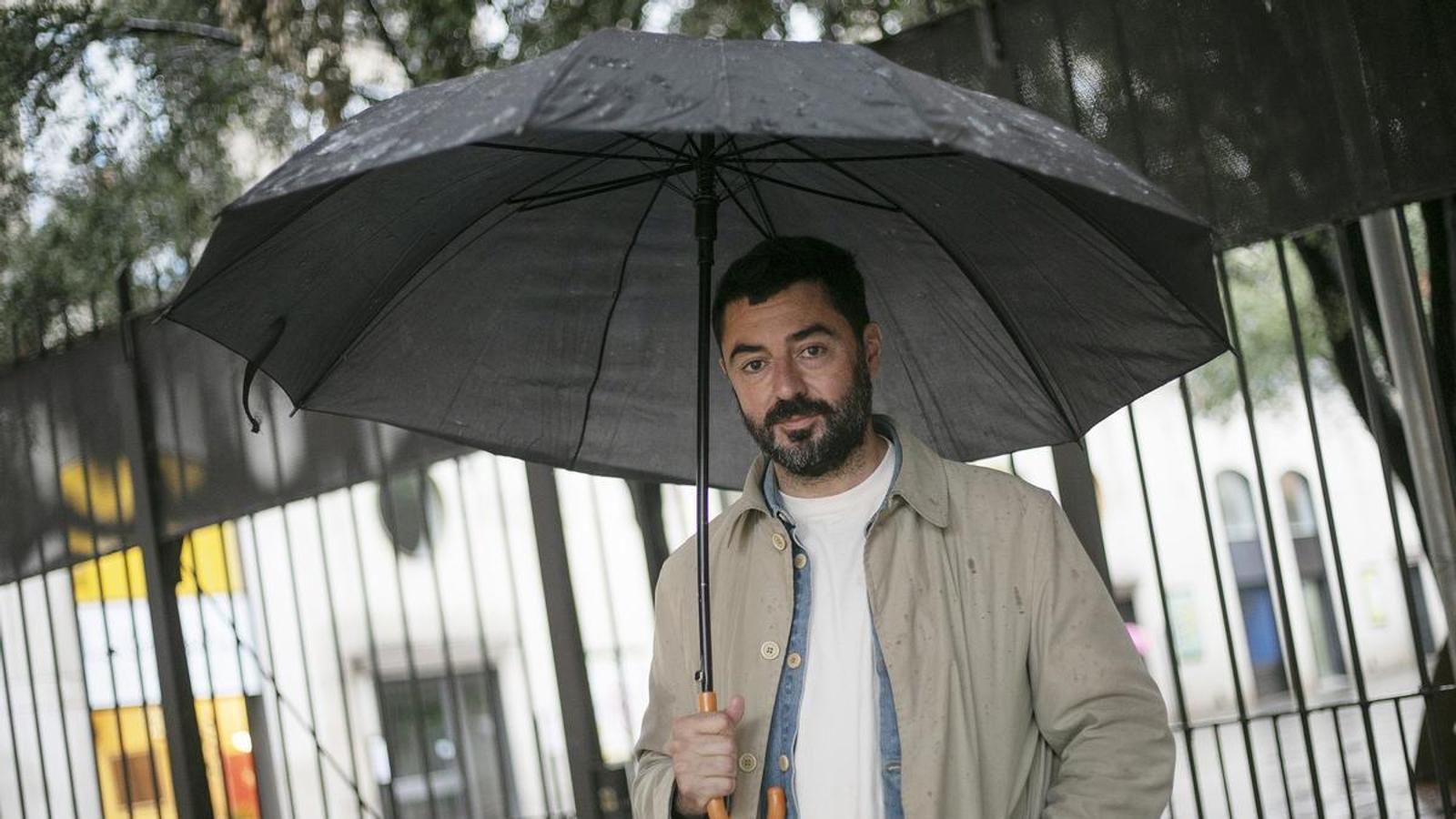
Daniel Verdú: "Male journalists are a cocktail of vanity and ego as there is in no other profession"
Journalist, author of 'La bola'

-
CAT -
CAST
BarcelonaThe editor of the magazine JotDown, known by the (false) name of Mar de Marchis, caused a revolution in the Spanish press not only with her publication but by becoming friends or a confidante to numerous figures with media power at the time without leaving home, due to agoraphobia and depression. The journalist and correspondent for El País Daniel Verdú wanted to explain who was really hiding behind this pseudonym, but, above all, to show what the media landscape was like a decade ago, which was sensitive to this gale of ideas, shamelessness, mystery, brilliance, and deception that was De Marchis.
The excuse for the book is the search for a mysterious and elusive character like Mar de Marchis. But, what is the subject, really?
— The decomposition of truth following the 2007 financial crisis. It was when we realized that everything was a lie, including politics and journalism. A feeling of being swindled sets in, which leads to the protest camp at Puerta del Sol and the whole works. That is why the book is called La bola: it is what they called Mar de Marchis because of the JotDown logo, but a 'bola' is also a lie and, above all, something that grows bigger as it advances.
Did you have doubts about dismantling the false identity behind which he protected himself?
— I did not want to put him on trial. I did not want to write The Imposter, by Cercas. I did not need to dismantle it or condemn it, but rather to explain that many times lies, or fiction, are the only vehicle to explain certain truths.
The book focuses on the moment of peak intoxication for digital media that lived in the wake of networks that inflated their audiences... until they stopped doing so. “A well-designed tweet shared a hundred thousand times mattered more than the front page of a newspaper,” you write. Are we no longer here?
— Fortunately, some social networks have been surpassed. X has become Elon Musk's cosmic dumping ground and we can no longer take it as we once did, as a builder of new narratives, of freedom, of progress. Now, artificial intelligence is what social networks represented back then and it will also be the engine of a crisis of economic model, of journalistic model, and of being able to distinguish between what is true and what is not.
To what do you attribute the fact that the family did not want their story to be told?
— Mar had a very complicated life. She didn't make life easy for anyone close to her, starting with her family. She was a person with an extraordinary capacity for fabrication. She lied a great deal, but she had wonderful qualities, and I wanted to explain it all. However, I understand that families are often afraid that the bad parts will also come to light. The book is respectful, and Mar had things that could have been much more unpleasant to tell that do not appear in it.
The partner of JotDown who has survived him does not see it that way. He says that you reduce the magazine to the simple game of deception and seduction that De Marchis used to recruit male contributors.
— I am not sure if she has read it, based on the comments she makes. Furthermore, the book is neither a biography of Mar nor a history of JotDown, which I don't think would be enough: it is a portrait of an era. That said, I actually gloss over the sexual deceptions she engaged in. I portray Mar as a highly intelligent, funny, corrosive, insistent woman, with talent and intuition... She was like those animals that, just before an earthquake, start running before the others. She noticed that it was a world in crisis, in the midst of change, and that it could be an opportunity.
But sending photos of a hairdresser friend who was asked to pose in little clothing while pretending to be her is truly a heterodox recruitment method.
— Yes, and this is where she skims the goalpost, regarding morals and ethics. It remains the impersonation of another person to achieve what you want. With the hairdresser, who is the only person whose name I change, she reaches a kind of agreement, because both had many problems and helped each other. But she never really knew where all those images were ending up. And that is very serious. But look, in this, she was also ahead of her time. catfishing, filters... in a way, nowadays we are all a bit Mar de Marchis. We are on social media and tell fantastic lives, but it is a lie as big as a cathedral.
From this vaudeville of images on WhatsApp, they don't come out very well either, of course: is vanity one of the evils that condemns the profession?
— Absolutely. Think that back then there was a very big crisis that had people scared. Ideas were lacking and she was a specialist in male journalists, who are a cocktail of vanity and insurmountable ego like none in any other profession, in any other corner of the world. And, effectively, it says a lot about how easy it is to deceive people, how easy it is to trick them.
Not only rank-and-file journalists, but also directors and other people of great power.
— We think that power is a closed room with fourteen padlocks, and sometimes it is just people who are incredibly bored, strung out, lonely, with many problems and a desire to be made to laugh. She had a lot of nerve: she would cold-call and speak to you as if you had been friends your whole life even if you had just met her.
His insuperable feat was managing to get Juan Luis Cebrián, then the omnipotent factotum of Prisa, to let himself be photographed with a Darth Vader helmet while his media empire was cracking due to the crisis and there were waves of layoffs.
— This scene has always fascinated me. And it says a lot about this journalistic vanity. If you look closely, the book shows that men and women saw her very differently. They imagined her as a Mata Hari posing in Victoria’s Secret lingerie, and women, as someone vulnerable, with psychological problems, social phobias... In the end, she was a person who never accepted herself as she was and built a new identity to be loved. JotDown is not a publication that gave her money: only love, respect.
It is paradoxical that someone with this ability to detect talent could not manage to make a profitable magazine.
— Yeah, but who manages to make a magazine profitable nowadays, right?
Was it a magazine more admired than read, the JotDown of that time?
— There is no doubt about that. They were magazines that served to be stacked and to place a nice lamp on top, because it was very aesthetically pleasing.
There is a moment when the masks fall off, but nothing much changes either.
— Everyone gets worked up, starting with Enric González, as he himself explains. They go right into the kitchen and do inexplicable things over the phone with this lady. They would try to meet and there was always a last-minute excuse to cancel. Until El Confidencial publishes the story in 2007 of who she really is and she suffers an extreme crisis and wonders if she wants to keep living. She thinks about the disappointment the others will suffer, she believes she will have to go into exile in North Korea, but then she makes the most fascinating discovery: that people decide to keep believing in that.
We all need deception...
— People, deep down, do not want to see the magician's trick. We know that many things that politicians tell us are not true, but if they fit the type of answer we want to hear, it is convenient for us not to ask ourselves certain questions. This explains Vox, for example.
One of the most fascinating relationships he had was with Antonio Caño, the director of El País during the years of the Procés.
— He told me that, at a given moment, she was one of the people who had the most influence on many of the decisions he made. “But more than your management team?”, I asked him. And he told me: “Probably, yes”. I asked him if he realized that that person, in reality, did not exist. And he told me something very poetic but also unsettling, for a newspaper editor: “She didn’t exist, but her ideas did”. She gave him new, fresh ideas, and many signatures came on board because she suggested them. She also explained the office gossip to him: a director is often very lonely and no one tells him what is really happening below. Power has that; it cannot speak directly.
The human factor always reveals the rust of glittering power...
— She didn't have a damn clue about journalism, it's incredible that she was a minister. But Caño explains it well. It was a moment of total crisis: in the PSOE, in Catalonia, at the newspaper itself, which had an open war in the board of directors... “And, suddenly, this lady would call me, with that suggestive voice, and explain to me a little about what was happening here and there”.

When is Mar de Marchis born?
— She discovered this mystery thing accidentally, when she shuts herself away for five years in an apartment in Santa Pola. She has a very messy divorce, falls into depression, is diagnosed with a kind of agoraphobia that prevents her from leaving the house... She stumbles upon internet forums and stays there, locked away, learning to decipher the psyches of her interlocutors without having them in front of her.
He is born, then, in a house locked with bolt and key. And who was it?
— Whoever the interlocutor wanted them to be.
Another sentence from the book: “Journalism always ends badly”. Wow...
— Well, this one is from Enric González, who has a very unique way of seeing this profession... and little patience with bosses and the more structured processes of newsrooms. So I think he told it to me with himself in mind, because he always ends up leaving places feeling a bit annoyed.
You make it your own, however?
— We could extend it to everyone, I suppose. Journalism is a wonderful, precious craft, and one that we enjoy very much. But in recent years we have seen how many colleagues have ended up dismissed, leaving with bad blood. There are few happy stories at the end of the profession. Bru Rovira published a book called Matar al director, for example!
There is a moment when you receive a photo of her and you decide not to see it. Why?
— There were very few images of him. At first I wanted to look for some, but since I couldn't find any, I understood that perhaps the interesting thing was to try to build a narrative about how others had imagined him. And I thought that, if I saw a photo of him, it would destroy my entire ability to get into people's heads, because the spell would be broken. One day, Isabel Coixet, who didn't know I had stopped looking for them, said to me: "Here, I'm sending you this." When I opened it, I deleted it immediately. I didn't want to have the visual contamination of something that was based on fantasy.
In the book, you explain the story of that Tuscan nobleman who commissions the portrait of his beloved from a hundred painters. But, out of jealousy, he does not let them see her.
— Yes, the nobleman gives them the most accurate description possible, but when they return, no portrait is the same... and none of them look like the woman. I reached this conclusion: in the minds of all these people who had never seen her, there were 150 or 200 Mar de Marchis, all different.
Her death also happens as if off-camera, after a coma and after living her final times self-exiled in Rome.
— Of course, many people were left with doubts or did not believe it. Rumors circulated that she was detained in an Ecuadorian consulate, that she had gone to Wisconsin to do I don't know what... Talking later with many people who had a relationship with her without having known her, I realized that it is very difficult to close the mourning for someone you have never actually seen.
Has he left a legacy?
— I believe that, modestly, the book will help ensure that there is a legacy of theirs. I can understand the family's reluctance, but we must also do a little justice to the character. Perhaps the new generations will not know who they are, but there was indeed a change in model with the magazine they created, with the type of journalists they hired. There are still echoes of Mar de Marchis in many of the things we do.
The Prisa Group of today is less convulsive than the one from a decade ago, which you show in your book?
— I wouldn't want to get into thorny issues, because working there I cannot say much and it is a delicate subject. But I will say that the best news for a newspaper, and I suppose also for a country, is stability. Tranquility and independence. And this is achieved with a long period in which the same owner invests in the medium, cares about it, and wants to make it grow. Abrupt and frequent changes of ownership... are not good at all, let's put it that way.
Do you have confidence in the future?
— Big newspapers like El País might have it a bit easier, with the subscription system that is becoming increasingly solid. When advertising went to hell following 2011, the press was not yet prepared for subscriptions and we were obsessed with clickbait. We have not yet consolidated a solid model that allows us to think that the media are a good business and a good investment for shareholders. This makes the landscape have a certain generalized weakness.
So, you are optimistic and do not think, like Enric, that in journalism everything ends badly?
— I see very good things that have happened in journalism. The quality of journalists. I see super-prepared people. They say that newspapers were written better before and it's a lie: you go to a newspaper from 1985 and they are worse written and are a drag, except for some crazy people like Enric who broke away from the inverted pyramid. Not to mention that back then they did one news story a day and arrived at the newsroom at six in the evening, after having gone to lunch with I don't know who and stuffing themselves up to here with bottles of wine, because the newspaper paid and everything was easy pickings. And today you produce much more.
The last question is inevitable, with only a few days left until the elections. The polls predict a majority for PP and Vox.
— The entry of Vox into the government would seem like terrible news to me: for freedom of information, for culture, for social rights... And, as happens with these movements, they would have a feeling of revenge. This far-right has come with a spirit of revenge because it has felt in the minority and excluded.
