Jordi Jacas: "Buy the anchovies with salt; discard those that are sold with olive oil"
Cook

-
CAT -
CAST
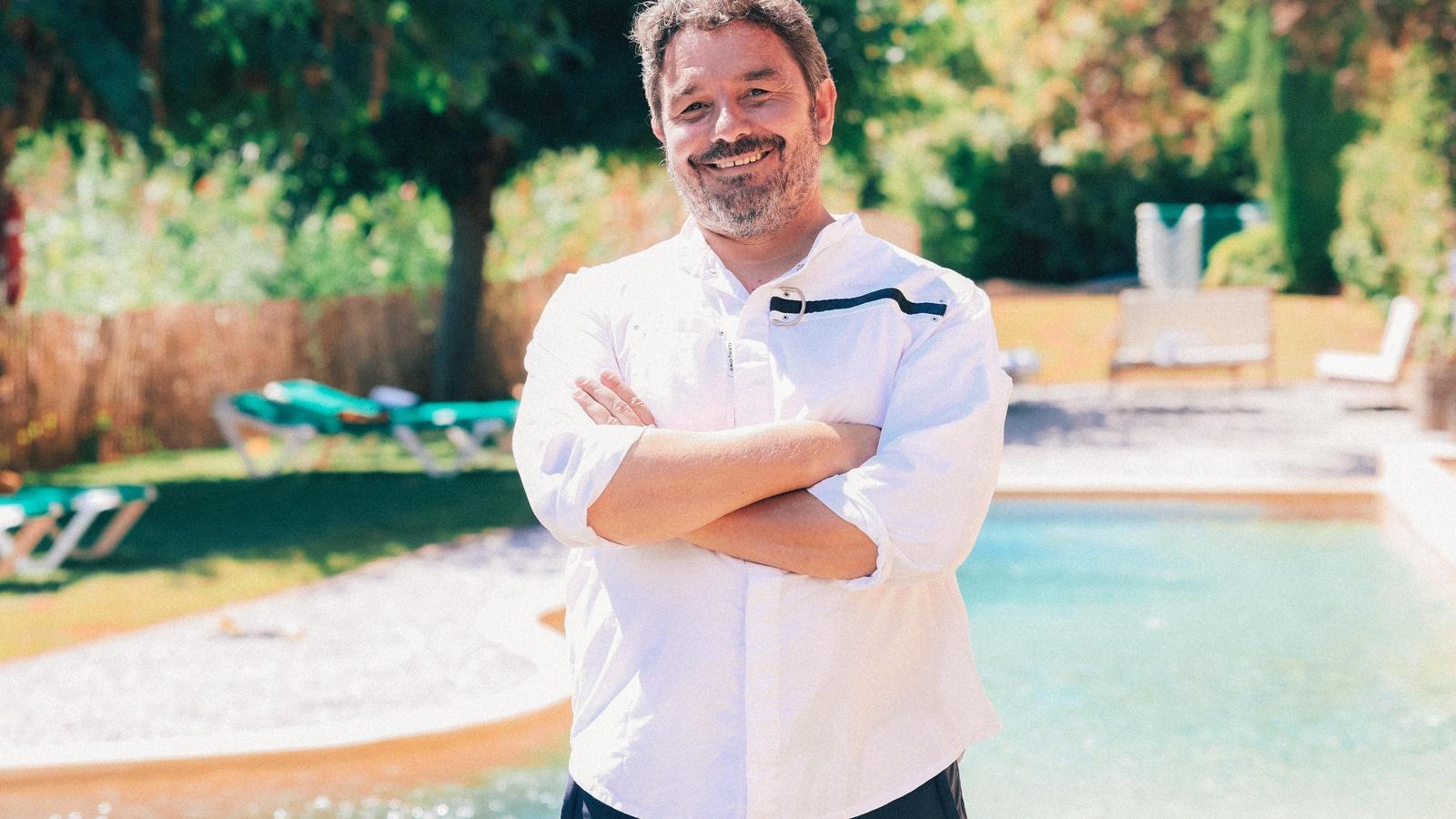
Cassa de PelrasI am interviewing chef Jordi Jacas on the day he prepared a catering service at a private home, where the Catalan Academy of Gastronomy and Nutrition welcomed academic Sandro Rossell. He prepared a meal there with foods in which honey and oil shone. For dessert, the pastry chef Oriol Balaguer provided the 'bisbalencs', small puff pastry bites filled with angel hair. Jordi is an ambassador for the cuisine and produce of L'Escala, where he was born, grew up, and where he works at the restaurant El Molí. And L'Escala has always been linked to fishing since ancient times: studies indicate that between the 17th and 18th centuries, fishermen from Empúries and Roses settled there and it became a town.

You have served anchovies on toast with smoked butter and, afterwards, chopped in a salad with canned tomatoes, with extra virgin olive oil and a drizzle of honey.
— We from L’Escala are very proud of the anchovies for many reasons. The first is because they are made in our town. We have seven companies dedicated to it, four of which are grouped under the name of Union of Historical Salters of the Anchovy of L’Escala. The tradition of fishing for anchovies is ancient; there were many fishermen who dedicated themselves to it, and in our town there was a lot of industry. The sardinal technique allowed for large quantities to be caught, and above all, it was helped by what has been called the concord, the reduction of the debt of the tithe to the fishermen, which dated back to the Middle Ages but lasted for centuries. The reduction of that toll made fishermen from other parts of the Mediterranean come here. And also because we had a salt storehouse, a large building where salt that arrived in ships from outside was stored. Today there is the L’Escala Museum.
Salt was, and is, a food preservative.
— The fishermen's wives were the ones who salted the anchovies that the men caught; they turned them into anchovies. They used the alla vera carne technique, which came from Sicily, and which consists of placing the anchovies in contact with each other, with little salt. With the arrival of tourism, it began to disappear because they built premises on the seafront. What I mean by all this is that L'Escala is a town that has a method and history linked to the anchovy. And above all: women are the ones who have always led the anchovy industry in L'Escala. Without women, we would not have had salted fish.
Not many anchovies are fished in the Mediterranean.
— No, and what is caught is small, but the salting industry is indeed carried out in l’Escala, and it is very powerful and well done. We ourselves, at the restaurant, use some from every one of the factories that are there. For the anchovy to be good it is very important that we know at what time of year it was caught and, afterwards, what stage of maturation it has. When we know these two variables, then we buy them.
In which dishes do you use it?
— In many. And I use the water too, the colatura.
Can you explain to me what it is?
— The colatura, from the Italian colatura di alici, is the liquid produced during the maturation of anchovies in salt. It is not discarded, but rather filtered and made into a condiment. I use it for snacks with rice and nori seaweed, which is crunchy, and is eaten with one's hands.
Do you make salted products at the restaurant?
— Yes, but the amount of anchovies we use at the restaurant is higher than what we can supply with our own salted fish; we have to buy them. Around the anchovy, there is another industry, which we also use for the restaurant, which are the anchovy-stuffed olives. I buy those from El Xillu. The fact is that wherever I go I always carry a jar of anchovies under my arm.
At the restaurant you order the steak tartare.
— And it is a very good combination. Also with cured ham; with tomato; with dairy products like butter, cottage cheese, and a bit of jam to play with the sweet and salty. And the best dish: alone, in fillets. Without anything else. I always recommend that everyone buys it in salt; discard those sold in olive oil. Then clean it at home; if necessary, remove any remaining bones, dry it a little to remove the remaining water and serve it on a plate with a drizzle of extra virgin olive oil, a pinch of pepper and, if you have a spray bottle, a touch of vinegar. And that's it.

In addition to the anchovy, rice dishes are also protagonists at El Molí.
— Since we opened, thirty-two years ago, I opted for traditional cuisine: casseroles, stews, the product, which obsesses us and for which we buy the fish directly at the market, grilled meats and, yes, rice dishes too. We are a very rice-focused restaurant. At lunchtime especially they work very well, and even more so on Saturdays and Sundays. At night they are requested by foreigners. The fact is that we are lucky to have great rice crops nearby, like that of Pals by Albert Grassot, who is a genius. Every year I am a judge in three different rice competitions. At the one in Sant Pere Pescador, at the Club Nàutic de l’Escala, and at the Festa de la Reparada in Cinc Claus, where the neighbors compete against each other.
On the restaurant menu you also have mimosa eggs, which we have tasted today.
— This dish has been made for twenty years, and we have it here because it is a wonderful dish, which we prepare with parts of fish that are not well-valued, such as conger eel. Since we are very close to the fishermen, we maintain a dialogue with them, and we want to give value to fish that are off the market. The conger eel is one of them; I use it for the bouillabaisse, and the tail, which I prepare as if it were a brandade, for the mimosa eggs.
For ten years now, the El Molí restaurant has also had rooms.
— In 2016 we built four rooms, and now we have fourteen. Having them helps us a lot to work all year round, especially in the winters.

Jordi, at what vital moment do you see Catalan cuisine being in?
— I see that there is a diner with a lot of criteria and knowledge. Furthermore, in our sector costs have increased a lot and, therefore, it is complicated for us to make a profit. And to continue, I see a young generation that I like very much, that has clear ideas and that does it very well. Therefore, I consider that Catalan cuisine is in good health. And yes, it is true that there has been a fusion with trends and products from other cuisines, but the base is our recipe book.
To finish, what new projects are you working on?
— In a new business line, which will be added to the restaurant, the hotel, and the catering services we provide. This new line will consist of food prepared by us that you can buy to eat at home. We have made a beer, a canned tuna, and a pickled sardine. We will create a website to sell them; it will also be possible to buy them at our restaurant. For now, we have started with these three products, and I cannot tell you the name yet because it is a novelty. But we are launching it to the market now.
