Jaume Balaguer: "I worked as a computer engineer in a multinational company, and one day I left everything to work in the wine world"
President of the DOQ Priorat

-
CAT -
CAST
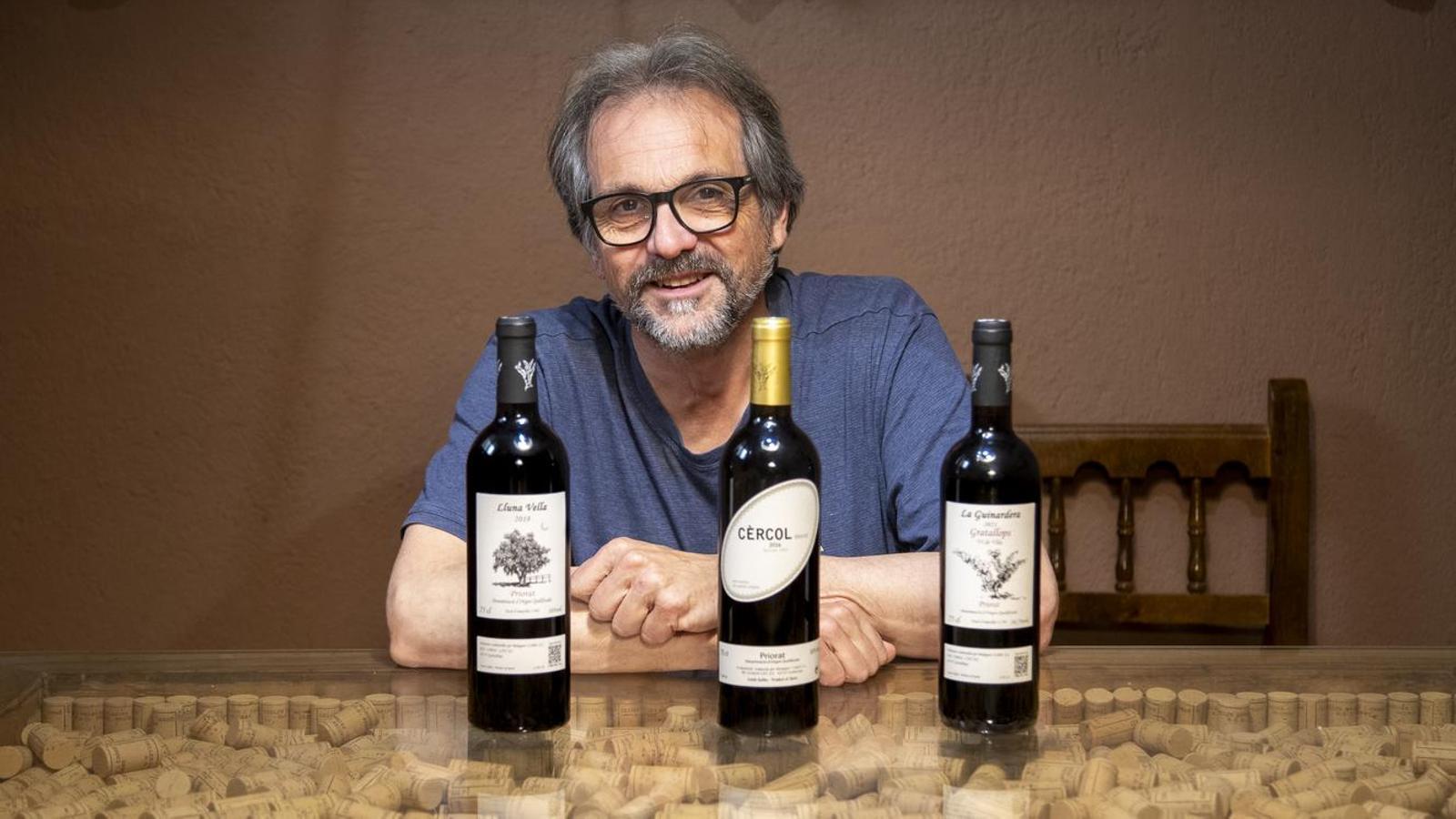
GratallopsI interview Jaume Balaguer (Gratallops, 1971) in his family shop in Gratallops, the Bon Viure wine shop. He has just been proclaimed president of the DOQ Priorat after the death of Salus Álvarez, and he will be in office for a year and a half, because then elections will be called. Jaume had been working for seven years in the Regulatory Council in different working groups, and years ago he had run for president in a different candidacy to Salus Álvarez's, although over time they worked together.

You have replaced Salus Álvarez without elections having been held.
— No, we haven't because we had a governing commission made up of six people, who were the ones who decided who should take over. I wanted it to be someone else, and I said so, but they called me, and they told me it had to be me. I can't say who that other person was. The fact is that I have accepted it, but with a series of conditions.
Which ones?
— I have said that DOQ Priorat is very broad, there is a lot of talent, and I want it to be there. I want more young people, more farmers, more talent to enter DOQ Priorat. I think we haven't known how to do it until now, myself included, but now all this has to change. I am 54 years old, I am already of an age, but in the territory there are many young people, a youth that is coming up behind us, whom I would like to see integrated into working groups. We have to open the base because we cannot afford to lose talent.
How many wineries are there within the DOQ Priorat?
— The last figure I have is 118. Perhaps it varies by one more or one less, because one recently closed in Torroja because the family members did not want to continue. The figure is quite stable because we are not a denomination of origin in which wineries want to leave and go on their own.
You were working in the promotion commission until now. Do you think more advertising than ever is needed given the current sales figures for wine in general?
— Yes, and we have started to do so. Until recently we had never supported wineries to attend fairs, and now we do. It was a request made to us by various wineries, because if the designation of origin asks us for help, it will always have more strength to obtain it than if they ask for it alone. To get to the point. We are present at Barcelona Wine Week, we provide financial support to wineries to be at the stands, and at the last one there were already thirty-four.
In Priorat, do you notice what is called the wine crisis?
— Sure. In the world there is more wine than water. It's a wine and alcohol crisis. In Germany, beer consumption has dropped by 30%. Why? It's said to be the healthy lifestyle trend, which has demonized alcohol, but I think the reason is economic. Being able to go to a restaurant and order a bottle of wine requires an economic situation. Young people, perhaps up to thirty years old, can't afford it. And then I also emphasize another reason: we are a country that drinks a lot of foreign wines, which are not any of our twelve designations of origin. It's not normal for a country to drink more foreign wine than it produces, and even less so when they are wines of such quality as ours. It's a joy to be able to drink a Conca de Barberà, a Penedès, a Montsant, a Priorat, of course.
Have you set yourself the goal of drinking more Priorat wine in Catalonia?
— We all have to make an effort to drink more Catalan wine. If more Catalan wine is drunk, then, statistically, Priorat will also be drunk. All denominations of origin have to row together to achieve this. I also have to say that when I started, sixteen years ago, the landscape was different. From then until now, we have managed to make Catalan wine gain ground.
In Priorat, wineries export a large percentage of their production.
— There are wineries that export 60%, others, 90%. The moment we are living is not easy, there is a global wine crisis, and we have to work hard to get out of it. There are wineries that have also seen product diversification as a way out.
You say you started sixteen years ago. How did you decide to work in the family winery of Gratallops, Balaguer and Cabré?
— I worked as an IT engineer, in data protection, for a multinational company. One day I woke up in London, because I traveled constantly, and I asked myself what I was doing there. I decided to take a sabbatical year and, after a month, I was already working at the company Euroselección, which at that time was dedicated to exporting wines. I was there for three years, and my father told me that he needed me at the family winery. The first thing I did was convince my father that we didn't need any distributors, that we had to do it ourselves. At that time, my father made 2,000 bottles and, because of the volume, I told him that I would take care of it.
And how was it?
— I went to talk to other wineries so that we could distribute our wines together. Three from Priorat, one from Montsant, and another from Conca de Barberà. Instead of going there alone, I told them that I would act as a shared salesperson and explain the range of wines I carried. And that's how I started. First in our domestic market, and then the wineries told me to handle the international market. And I did that too.
What volume of bottles do you have in your cellar now?
— We went from two thousand to twelve thousand bottles. I started making white wine. We are the only winery that produces all wines with single-varietal garnachas. The white, with white garnacha.
Wineries say that white wines are the ones that sell the most currently.
— They are the ones who are best adapting to the times we are living in. The world of wine has always followed trends. When we started in Priorat, people were clear that they wanted to make an international wine, so they brought varieties from outside, winemakers from outside, and when they saw that the prescriber Robert Parker was crazy about wood, then we parkerized the wines. However, the second revolution in Priorat was in 2000, when we stopped making wines that Robert Parker liked, when we got to know ourselves. Then we made wines that express the territory.
Did you stop using wood?
— Yes, but that's not the point. There has been a big change: we have understood that the territory has to speak to us through our wines. I'll give you the example of Mas de la Rosa, where Vall Llach, Torres, and now also the Peyri family work. Well, in Mas de la Rosa, the vineyard is telling us what it's like, it's making us know a territory that we didn't know. That is to say, we are making wines that instead of wood have people who have interpreted what the vineyard is like.
The Penedès DO has become the first in the world to be ecological. There was a time when the Priorat DOC seemed like it could be too.
— There are wineries that do not see that being ecological is a value. My own father tells me to do it when the winery is solely under my charge. Organic or biodynamic viticulture must be done out of conviction.
I'm asking you about the Arrels del Priorat project, which your father started with René Barbier to recover rancid wine.
— It all began with a dinner between the two of them. They were worried because they thought the stale wine was going to be lost, and they started asking for mother yeasts from different houses in the region to have a base. Now we have thirty, sixty, and one hundred year old ones, all made with mother yeasts from families that preserve them.
What production do they do?
— Forty-six bottles of 375 milliliters. Rancio wine is experiencing a good moment, not in large production volumes, but in good positioning in restaurants.
To conclude, last Friday the winemakers of Priorat paid tribute to Salus Álvarez. Will the Regulatory Council also do so?
— We will do it with a project that explains the evolution of Priorat and that I cannot explain. His death has been a strong blow to the workers, to the territory. Meanwhile, my most immediate challenge is to achieve greater participation of wineries, of young people, in the Regulatory Council.
