The Neapolitan of discord: Barcelona stops making it while in Paris there are queues to buy it
Sweets made with croissant dough and filled with chocolate have been modernized in the French capital and are present daily in all popular breakfasts
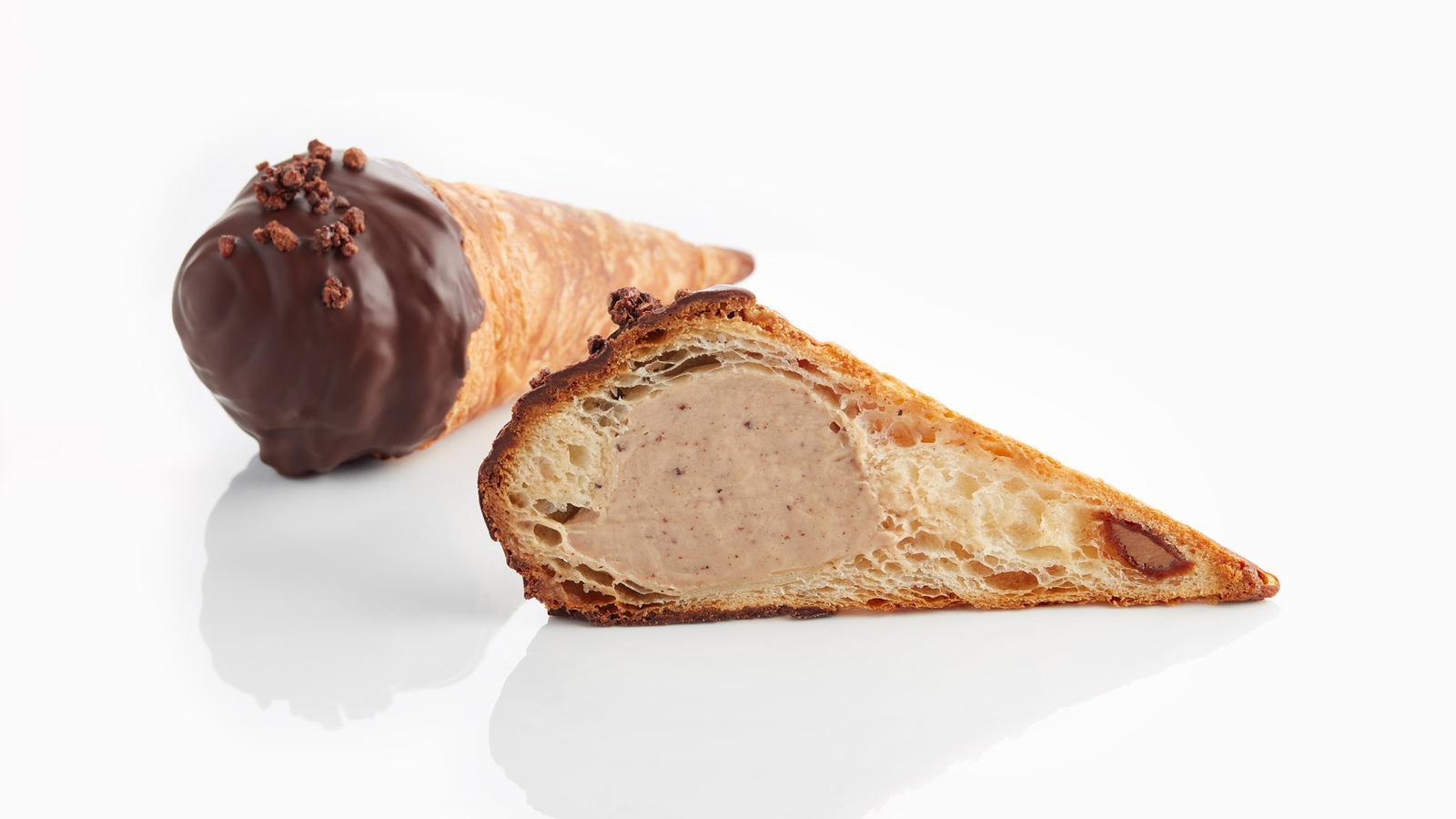

Paris / BarcelonaOn the Avenue de l'Opéra in Paris, there is a daily queue of people, organized with security guards and elastic tapes, who patiently wait to buy sweets. The two adjacent establishments of pastry chef Cédric Grolet have pains au chocolat (chocolate napolitans or rolls), croissants, and frozen fruits on display. They are arranged like jewels, on fine ceramic plates with small golden signs indicating the price. They appeal to the eyes and the stomach, and make people wait an average of twenty minutes, or more depending on the time of day. I am one of them, and when I get my pain au chocolat –which costs me seven euros– I realize it makes me think of one of the sweets that stirs passion in our home: the xuixo from Girona.

Cedric Grolet's pain au chocolat has a more elongated and bulging shape than neapolitans, which are usually more square and flattened; I notice the fat in my mouth, which tells me the dough is fried. The originality compared to all the pains au chocolat I will try in Paris is this frying (if it were called xuixo, this point would not surprise Catalans) and the chocolate filling in bar form, on one hand, and in liquid form, on the other. With every bite, the liquid chocolate protrudes from the sides, so eating one standing up on the most artistic avenue in Paris without getting stained is a sweet risk sport.Cedric Grolet is probably the most daring pastry chef in Paris when it comes to pain au chocolat. The croissants he makes are also daring: they are painted with dark chocolate on the outside and have the appearance of a shiny jewel. I can say they are the exception, along with those from the Ritz Paris Le Comptoir pastry shop, where the pain au chocolat has the same elongated and narrow shape as the croissant, like a thin churro, and they serve it to you in an elongated cardboard wrapper so you can eat it like a sandwich.Uneven pricing between traditional and creative pastry shops
In other bakeries, the pains au chocolat maintain their traditional shape and are sold at a slightly higher price than croissants, but without reaching the seven euros of Cedric Grolet or the five of Ritz Paris Le Comptoir. In general, they cost between €1.50 and a maximum of €2, while croissants remain a staple food: between €1.20 and €1.80. And both are what are offered in cafes every morning for breakfast, along with a slice of bread and butter. I mention the names of some of the boulangeries with traditional pains au chocolat: Gosselin (€1.50), The French Bastards (€1.40), Maison Marques (€1.80), and Maison Julien (€1.50).

In hotel buffets, pains au chocolat and croissants are the stars at breakfast and snack time. And what pains au chocolat! I enter the Mandarin Oriental hotel, where to the right of the lobby is the pastry shop of master pastry chef Julien Dugourd. Anyone can come in to buy or eat them. As soon as you cross the door of the café, a long, large display case shows all the sweets made with croissant dough. There are many, varied, and next to the traditional pain au chocolat, there is another that also ignites passion among Parisians: the Swiss brioche. It's like a pain au chocolat but flattened, with chocolate chips inside and a thin layer of pastry cream, which they tell me sells as much or more than the pain au chocolat. There is still another sweet with croissant dough: the chausson aux pommes. Therefore, the same dough yields different results depending on how they fold and fill it. I order a pain au chocolat and head to the café's green garden, where some of the hotel rooms are located. An oasis among the central streets of the 1st district, which bases its personality on the city's sweet pastries, and where you can spend time without spending a lot of money, less than what I spent, standing, at Cedric Grolet's. I check that the Mandarin Oriental's pain au chocolat has a bar of chocolate inside, good, solid, which is well-wrapped by the dough. It doesn't leak out the sides, nor does it make a mess. Buying a pain au chocolat at the luxury hotel in the city, where personalities stay in suites with views of the Eiffel Tower, costs (attention!) three euros.In Barcelona, I head to the Natcha pastry shop, to Forn Mistral, a la Foix and to La Colmena, where they tell me they don't make them, neither napolitanas nor cañas, as they also call them. Instead, of croissants, all imaginable. The city that annually awards the best croissants prefers this sweet with or without horns. traditional, there is another that also ignites passion among Parisians: the Swiss brioche. It is like a However, at L’Atelier, French pastry chef Eric Ortuño, along with Ximena Pastor, they prepare two types of pain au chocolat that could compete with the best in Paris: the classic and the innovation. They cost €3.30 and are made with croissant dough, with an inverted lamination and with lines of cocoa on top that make the croissant dough look like it has veins, black veins. It has a bulging shape and the bite is crunchy, ethereal. It also has just the right amount of chocolate, neither too much, nor too little, nor liquid. At Mervier Canal pastry shop, Toni Vera also prepares them; he sells them for €3.20. "People buy more chocolate croissants from us even though they are made with the same dough and the same filling," comments Vera, who highlights the innovation they have made with their pain au chocolat: the dough is bicolor, because it is more attractive that way. And, furthermore, they have also started making Swiss brioches. They are aware of the big trend coming from Paris. For his part, pastry chef Oriol Carrió points out that he makes and puts three chocolate bars in (2.50 €). At La Morreig, Alsatian pastry chef Matthieu Atzenhoffer prepares pain au chocolat (€2.80) with chocolate coating inside, because he believes that classic bars have more sugar than cocoa. "Ours are less sweet and tastier," he says. At Forn Sant Josep they also make, along with butter croissants (with horns), which they sell up to 80% more than butter ones, states the owner, Emili Feliu.
Finally, baker and pastry chef Anna Bellsolà, from Baluard bakeries, explains that she also makes pain au chocolat and sells it for €2.45, and Christian Escribà maintains that he sells more of the croissants he makes than his pain au chocolat (€2.50). However, he has created two good alternatives to the croissant: "The cremadet and the kouign amann from French Brittany are at the same sales level as croissants", all made with croissant dough, but in the case of the kouign amann, with more butter than sugar; on the outside, crunchy like a palmier, and on the inside, a croissant. I end with a conclusion: Paris and Barcelona are united by creativity with croissant dough, which ignites passions in different forms.
The second edition of Croiss & Fest, in Poble Espanyol
From May 1st to 3rd, some of Barcelona's bakeries met at Poble Espanyol for a festival that aims to showcase the great moment that croissants of all kinds, both sweet and savory, are experiencing. At the festival, the winning bakeries were Takashi Ochiai, which won the jury's prize, and El Secreto de Ciscu, from Terrassa, which won the prize for the best croissant by public vote.
