The century-old story of overcoming of a great Barcelona bookstore
The Alibri bookstore (formerly Herder), founded at the end of 1925, is an essential part of Barcelona's cultural history and today it continues to be very active
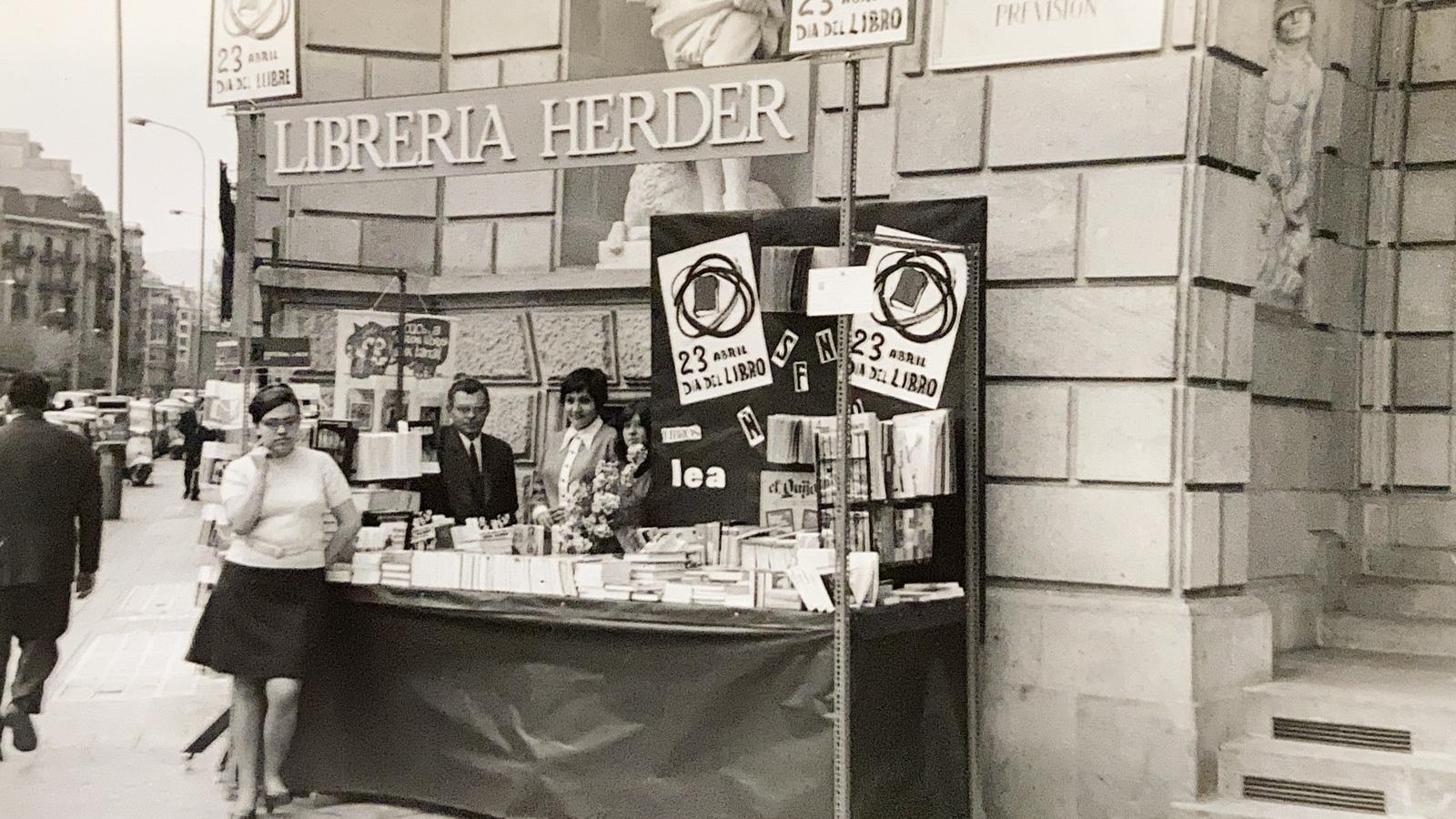

"If your partner doesn't read, leave them for Sant Jordi," says a sign, hung in the Alibri bookstore (formerly Herder), signed by laincorrecta.cat. This phrase already tells us that this establishment does not shy away from humor, and even provocation. But at the same time, it remains a classic place: it has a hundred years of history and an immense collection of books. Initially, they were about thought, religion, psychology, language learning... and now they are of all kinds. For some, it continues to be the "German bookstore" in Barcelona, not only because of the numerous publications it has in that language but also because it was founded – and directed for many years – by Germans. And of course, as Germans are the kings of discipline, this has been one of the components of the establishment. All books have been – and continue to be – meticulously organized, and in the past, the booksellers wore uniforms (with a smock, on which their name was written). Salespeople were only allowed in the bookstore to work from 9 to 11 in the morning. "As soon as it struck eleven, Mr. Nahm (manager of the bookstore) would shoot out of his office like an arrow and kick us all out, even if we hadn't finished our work," recalls Martí Romaní, former salesperson and book distributor, founder and first director of Casa del Libro. "Everyone... except me," he specifies: he was exempt from this rule, as he managed a special section that required time: the Penguin Bookshop, a bookstore in English (with books on all subjects, not just literary) within the bookstore.There are so many anecdotes that the bookstore has accumulated over this century! Here's another one. One day, a young man came in asking for the "old" booksellers. He was attended by one who had been working there for the longest time. That young man told her that, some time ago, when he was studying at university, he had taken some books from the bookstore that he hadn't been able to pay for. He simply didn't go through the checkout. He needed them for his studies but didn't have enough money. Now he had finished his degree, was working, and was coming to settle the debt.The Herder bookstore (renamed at the turn of this century as Alibri –fromstudents and books–), has experienced – and overcome – strong storms: throughout its history, it has been repurchased by its owners on two occasions, but it has not lost its way.Born in an adverse context
It was November 1925 when Anton Schaedel, a German bookseller trained at the Institut Herder in Freiburg, opened the Herder bookstore in Barcelona. The project was in response to the initiative of Hermann Herder, who had decided to open two bookstores in southern Europe, one in Barcelona and another in Rome. The new establishment, located on the first floor at number 22 Balmes street, was dedicated primarily to the import and sale of books in Spanish and Latin published by the historic Herder Editorial.The bookstore is born in a time of lack of freedoms: under a dictatorship, that of Primo de Rivera. The first years, therefore, already has – and overcomes – a lot of obstacles. It grows in an adverse international context, marked by the economic crisis of '29. For Herder – and the other commercial establishments on Balmes street –, 1929 is an important year because the Sarrià Railway is buried, which until then ran in the open air along Balmes street, in front of the bookstore. Due to the numerous accidents that occurred, this street was known as the “street of death”.In the 1930s, Barcelona was buzzing with cultural activity. The bookstore participates in this vitality and begins to specialize in the university and scientific fields. It is already more than a bookstore: it sells tickets to cultural events held in the city (even boxing matches). It is precisely in 1931, the year of the advent of the Republic, when April 23rd becomes Book Day (an event created in 1926 by the writer Vicent Clavel, a Valencian residing in Barcelona). But in the 1930s there was also strong tension on the streets, which led to gunfights and violent actions. Years earlier (in 1920), in front of the current headquarters of the bookstore, Francesc Layret had been murdered as he was leaving his home to intercede for his colleagues Lluís Companys and Salvador Seguí, who had been arrested in a state campaign against trade unionists, republicans, and nationalists.That tension on the streets was a harbinger of the Civil War, which caused turmoil for the bookstore, which was collectivized by the FAI (Federación Anarquista Ibérica) and renamed La Internacional. During the war, the Herder booksellers managed to hide the most valuable books in an apartment in the city, waiting for better times, but shortly before the end of the war, that clandestine hiding place was discovered and the books were destroyed.During the war, as is known, the city was often bombed. On March 17, 1938, a bomb exploded four steps from the bookstore, at the intersection of Gran Vía de las Cortes Catalanas with Balmes street, and hit a military truck loaded with explosives stopped at a checkpoint. The explosion generated a large column of smoke visible from afar. 23 soldiers died in the truck, and numerous passers-by lost their lives. The bookstore's windows were shattered.Due to debts, the Herder company of Fribourg decided to close the Barcelona branch. Leo Fetscher was commissioned to liquidate the entire business. But the bookstore would be reborn. The 20th century was also overshadowed by wars. The Spanish Civil War merged with World War II, the outcome of which also harmed the bookstore, which suffered significant losses.

Just after the war, in 1940, Antonio Valt and Leo Fetscher buy the bookstore and reopen it. And in 1949 the bookstore is auctioned and bought back by the owners. The University of Barcelona and the Herder bookstore have always kept good company. They immediately establish a strong bond. Shortly after the war ended, in 1941, the Herder bookstore receives the title of "university bookstore" from the University of Barcelona. We are still in the darkest stage of Francoism: precisely in 1941, an exhibition of German books is held in the Paranimfo of the University of Barcelona, in which Nazi symbolism is omnipresent.In the 70s the bookstore is reorganized: it goes from a pharmacy structure to a supermarket structure (open access to shelves), so that the customer can pick up the books themselves and browse them. The renovation is directed by the architect Josep Ribas González (1929-2011), known above all for being the author of the Torre Colom, located in the Raval neighborhood of Barcelona, and the church of Baqueira.In 2020, the bookstore successfully overcomes the setback of the coronavirus pandemic. But very soon another setback, no less important, will come. In 2022, with the centenary just around the corner, bitter news arrives: economic difficulties threaten to close its doors. Once again, the bookstore will be reborn. At the end of 2022, the book subscription company Bookish buys the bookstore and ensures its continuity. Bookish intended to open a large bookstore in Barcelona, but when its managers learn that Alibri is about to close forever, they prefer to try their luck by keeping one. Bookish has revitalized the bookstore, reinforced its cultural programming, and opened it up to new audiences.

Some of the best-selling books
During the first decades of the bookstore's operation, publications on Catholicism accounted for a significant portion of sales. They were the establishment's DNA. You could find books in the style of how a Catholic woman should be, and you can imagine that it suggested she should be a very submissive woman. Thousands of religious prints were also published and sold (for first communion, for example). But over the years, the bookstore began to incorporate religious publications of diverse, non-doctrinal trends. Herder made a commitment to ecumenism. One of thebestsellers was The Dutch Catechism. The Vatican authorized its publication, despite some dissenting voices, because it was not orthodox. With the boom in psychoanalysis, the book The Art of Loving, by Erich Fromm, sold in large quantities. Herder brought modernity to this country in the 1960s and 70s. "I started teaching at the University of Barcelona in 1968, a time of political, social, sexual revolution... And the books that students of the famous May of '68 in Paris were reading were by three authors: Marx, Freud, and Saussure. We found all of them at Herder," explains Sebastià Serrano, professor emeritus of linguistics at the UB. Furthermore, the Herder bookstore (Alibri) has been, and is, one of the main points of sale for Herder Editorial, based in Barcelona.
