Recover the oil made in Barcelona: "If the Verdi cinemas disappeared, there would be a outcry, right? Well, the same should have happened in Collserola"
The New Oil of Barcelona launches a project to recover traditional crops in Collserola and thus generate landscapes resilient to the climate crisis

-
CAT -
CAST
BarcelonaVery few people know that oil was produced in Collserola. In the middle of the last century, owners of farmhouses in this mountain range surrounding Barcelona owned olive trees, made self-consumption oil from them, and sold the surplus. But with the abandonment of the countryside throughout Catalonia, all this productive activity was also lost and the olive trees of Collserola, some centuries old, were swallowed by the forest. If in 1956 21.5% of Collserola were cultivated land, now it is only 6.4%. This not only represents a loss of the typical biodiversity of the area, but also has a dangerous collateral effect: it increases the risk of fire.
Now, l'Oli Nou de Barcelona, which has just come onto the market with 311 bottles, is the first oil from Collserola cultivated with the aim of preventing fires. An extra virgin olive oil that, moreover, is made with recovered native varieties, such as the vera del Vallès, which had been on the verge of being lost due to the abandonment of olive cultivation, and These two varieties, along with the popular arbequina, and all three cultivated organically in the Collserola mountain range, have resulted in a first harvest of oil with a social and environmental vocation, but also a gastronomic vocation. "It is also about highlighting the great quality of Catalan oil, a product of the land that generates identity and is also a superfood," points out Pau Moragas, vice-president of the L'Olivera cooperative, which produced it.L'Oli Nou de Barcelona is the pilot test of a project that aims to recover 156 hectares of forest in the Collserola mountain range to convert them back into cultivated land and thus slow down the risk of fire. They will mainly be olive trees because it is the traditional product of the area that generates the most economic return. The initiative arises from a collaboration between the L'Olivera cooperative, the Catalunya La Pedrera Foundation, the Collserola Natural Park, and the Association of Forest Owners of Collserola. "The Catalunya La Pedrera Foundation is the largest owner of private forests in Catalonia, we have a great responsibility, and that is why our board decided to prioritize fire prevention projects," explains Miquel Rafa, director of sustainability and territory of the Catalunya Foundation.

But not all of these hectares will be cultivated by L'Olivera; it is expected that other operators, including owners of farmhouses in the area, will join the project to recover their abandoned olive groves, plant new ones, and thus collaborate in fire prevention and the recovery of the biodiversity typical of a peri-urban environment. In fact, about fifteen preliminary agreements have already been reached with owners to recover and plant olive trees in some areas of their plots, which means that by October the project will have recovered approximately 20 hectares of crops, with the aim of reaching a total of 156 by 2030.
A community mill in Collserola
To promote this olive tree recovery, negotiations have been launched to build a community mill in Collserola. "It will be a cornerstone of this project," because "it will ensure its long-term viability," states Rafa, and assures that they already have several location offers within Collserola, which in principle should be on industrial land, as a mill is considered an industrial facility. The mill will allow the recovery of self-consumption production, like that which existed in this region until the last century. The project has already mapped the area and identified the possible locations for these 156 hectares to be recovered.
"The heart of Collserola in 1956 was already forest land, but if you look at the map, there are indeed strips where recovering crops makes sense," also explains the managing director of the Consortium of the Natural Park of the Serra de Collserola, Raimon Roda Noya. In reality, the olive tree recovery project in the Serra de Collserola is not just a weapon against fire, it is also a way to recover the biodiversity inherent to these places, which was based on the agro-forestry mosaic. "The objective is also to generate landscapes resilient to the climate crisis," points out Roda. The olive tree withstands drought much better than other trees, such as fruit trees, and it is a dry-farming crop that adapts very well to low and medium mountain areas and allows for efficient water management. "For us, fire prevention is one aspect, but not the only one; recovering the agro-forestry mosaic is also linked to biodiversity issues," explains Roda.
Landscapes resilient to the climate crisis
At the Oliveres Reverter estate in Sant Just Desvern, where part of L'Oli Nou de Barcelona has been produced, the song of a common turtle dove drifts over the sound of the brush cutters with which L'Olivera's workers clear the scrubland. "This is good news, because this is a species that has decreased by 60% throughout Europe," explains Miquel Rafa. Recovering traditional and ecological crops also favors the recovery of the biodiversity typical of a peri-urban landscape like this.
In fact, the 156 hectares that have been identified as recoverable are within the Special Plan for the Protection of the Natural Environment and Landscape of the Collserola Mountain Natural Park (PEPNat). "Protection does not mean that nothing can be done there; it must be ensured that production is respectful," explains Roda. This is why Collserola's urban plan has made the economic uses of farmhouses more flexible, on the condition that the owners commit to carrying out an estate plan that identifies risk and biodiversity factors, explains the Park's managing director. Roda also adds the aspect of "applied research" and explains that the Natural Park is in talks with IRTA to study the possible recovery of old crop varieties more resistant to drought, or with CREAF for the specific study of fire prevention. "To prevent fires, we need ruminants, crops, and controlled fires; here we can recover crops and try to recover ruminants," explains Roda, aware that controlled fires in the current climate context could pose a risk and are difficult to implement.
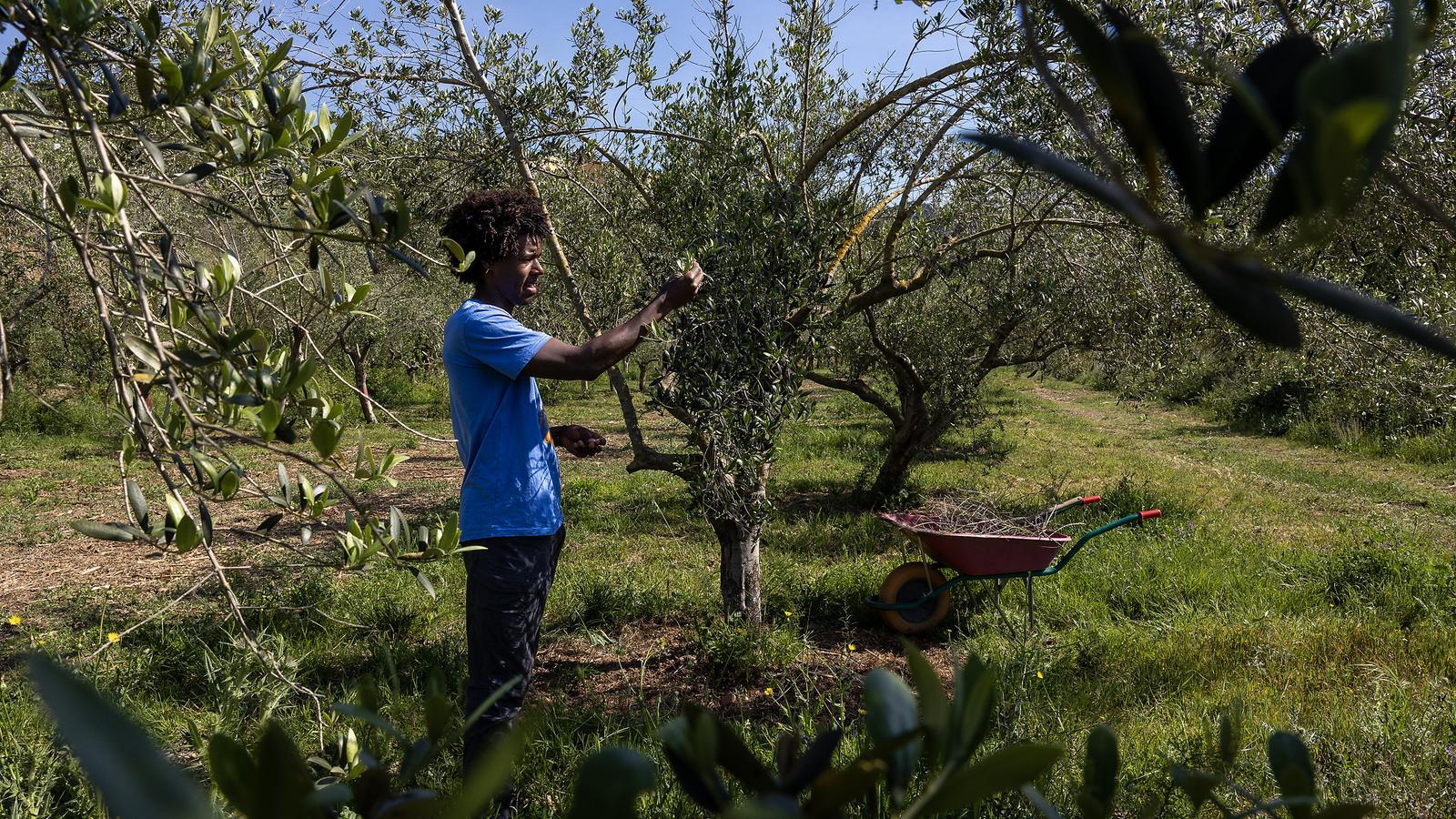
At the Oliveres Reverter estate in Sant Just Desvern, workers from L'Olivera clear the olive groves until the terraces are clean and tidy, as they must have been more than 15 years ago, before the forest encroached on them. Then they prune the branches of each olive tree, one by one and with great care. This cooperative provides work for people with vulnerabilities, intellectual disabilities, and at risk of social exclusion. And this is yet another pillar of this project driven by L'Oli Nou de Barcelona, a social component that joins the environmental, forestry management, and gastronomic aspects. "We have been a social enterprise for 52 years, and therefore projects like L'Oli Nou de Barcelona will not be projects that prioritize productivity," explains Pau Moragas, who also highlights the "emotional aspect" of producing our own, indigenous oil, with "added value agriculture." It is the model already used by L'Olivera at the Can Calopa farmhouse, where they have also revived the urban vineyard, and where they also produce an oil, L'Oli de Finques, which has been recognized as the best arbequina oil in the Guia Evooleum, one of the most prestigious guides in the world of olive cultivation.
At the Oliveres Reverter estate, there are even centenary olive trees that have withstood all sorts of calamities but can still produce oil, one even more prized for its organoleptic qualities. "In Catalonia, we have a great gastronomic heritage that we champion, and it cannot be that at the same time we are the region in Europe with the fewest farmers," states Moragas, adding: "Around food, there is a much more potent cultural base. Wouldn't there be an uproar if the Verdi cinemas in Barcelona disappeared? Well, the same should happen in Collserola in the food sector." Fortunately, Collserola oil has not closed down; on the contrary, it is in full renaissance.

