Lluís Fernández Punset: "The mother started to cook, and she began with the calamari a la romana: the first time she made them she did not flour them"
Cook

-
CAT -
CAST
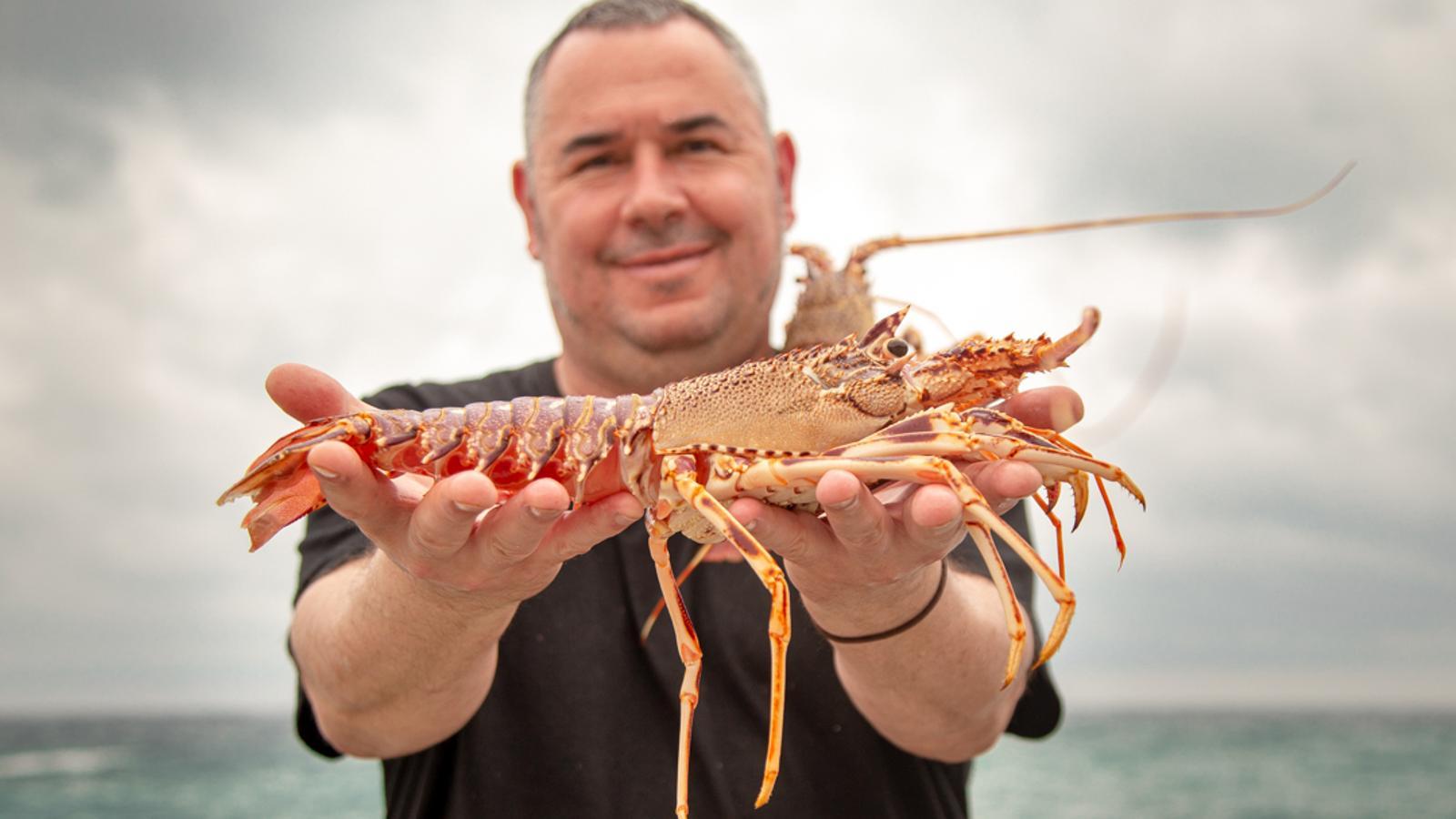
LlançàI interview the chef Lluís Fernández on a summer evening at his restaurant Els Pescadors, in Llançà. He radiates good nature and love for his work, which he does as a family, with one of his sisters, Maria Àngels, and his brother-in-law. Both of them in the dining room. The restaurant is full of tables that speak to Lluís with familiarity, as the loyal customers they must be. Whoever goes to Els Pescadors knows they will eat lobster from Cap de Creus, because the family has one of the most important nurseries in the country, but it is not just about eating lobster for the sake of it. Lluís cooks territory, serves culture, and since these are his mottos, this year he has printed them on a tote bag. And the lobsters are numbered. Those who eat one take home a card, with a drawing by his chef friend Paco Pérez, with the numbering and a note from the restaurant.

I have tasted with each dish on the menu a very good selection of DO Empordà wines.
— It is the house's wish to showcase the region we have. We have some very good wines, which pair with the dishes we prepare.
Remind me how it all began.
— My mother, Anna Maria Punset, was from Lladó, and my father, Lluís Fernández Soler, from Maçanet de Cabrenys. Since my mother did not like livestock, she would go to spend seasons at the Hotel Terrassa, in Roses, owned by the Gotanegra family. And my father worked there as a cook. They met and decided to open businesses, including one in La Jonquera. The anecdotes they have always told me are that they made baskets with sandwiches and drinks for the people who were queuing to cross from the Spanish state to the French one. My parents say that no one wanted to jump the line so they could eat what they made.
It was a good deal, the one in La Jonquera.
— They made their first buck, so to speak. But then the highway was built, and my parents stopped believing in La Jonquera, because the highway swallowed up the cars, and people no longer passed in front of their restaurant.

So what happened?
— They came to Llançà, and took Hotel La Goleta, with twenty-eight rooms, which has been built in three phases. There was a time when people spent a month at the hotel. Those were the days when planes were not taken as much to go away. With the clients we became a family, because you got to know them during the month of vacation they spent there.
They must have also had their meals at La Goleta.
— Yes. Before, people who stayed in a hotel also had full board there. We used to serve lunches and dinners, with traditional dishes, like vegetable minestrone and pilaf rice, made with chicken broth. Now it is no longer like that. Now at La Goleta they ask for bed and breakfast.
But you keep a restaurant there, El Mos, which everyone has recommended to me for tapas.
— El Mos, as a tapas restaurant, has an explanation. My parents took over the Hotel La Goleta, but at first it didn't quite work out for them. Then, after three years of being here, they had the opportunity to take over the Els Pescadors bar, which was the town's café, a kind of agora where the fishermen played botifarra and canari while smoking caliqueños and farias. It was here that my father came into contact with the seafaring people, because the port of Llançà is right in front. Now you see the promenade, but before it wasn't like that; before there were two piers, and all the port's activity was concentrated right here.

Did the parents make coffees and dishes there?
— From coffee they moved on to tapas. It must have been the early 80s. My father was a very enterprising person. Think about it, he would go and look for groups of tourists so they would come and spend the day in Llançà. He went to trade fairs abroad, in Belgium, in France, wherever, to organize visits to the area that included the Els Pescadors café. The thing is, my mother started cooking, and she began with calamari a la romana: the first time she made them, she didn't flour them. Then she asked chef friends, because it was a time of great camaraderie, how they were made. My father was the professional, and my mother was the one who had been in the dining room, but since my father would leave to look for groups to stay at the hotel and eat at the bar, my mother then had to go into the kitchen. On one of these trips of my father's, my mother prepared tapas, sandwiches. And everything sold out.
Your father must have been surprised when he returned.
— A lot. He, who had worked at the Motel Empordà, at the Hotel Colón and in others, verified that what my mother cooked worked.
Does the relationship with the Subirós family stem from the time when your father worked there?
— Yes, I always say that the Alt Empordà is a big village of many villages. You studied primary school in your village, but then you did secondary school in Roses or Figueres, and there we met more people. It was a time when we didn't have any social media, but we saw each other a lot; we would meet up to go to Roses or Llançà, and I would say that we socialized much more than now.
Is Els Pescadors where you started working?
— Sure. You would come back from school and help out. We started from the bottom, doing whatever was needed, because there was a lot of work. I am the third child, and my sister Maria Àngels, the two of us who work at the restaurant, is the first. My other two sisters chose different paths: one is a doctor and the other is a nurse. I always say that at Els Pescadors and La Goleta we have a gastronomic and healthcare combination.
Are you going to study cooking?
— Yes, in Bellaterra, where the School of Hospitality was located, which depended on the school on Muntaner Street. And from there I went to work at El Celler de Can Roca, which was very useful to me, because at home there was a lot of work, but at El Celler I became motivated in the craft. And I continued in other restaurants, such as Akelarre, with Pedro Subijana. Later I worked with the chef Xavi Pellicer, at Àbac on Rec Street, and I continued at the Bilbao restaurant, by the chef Jordi Oliver. I learned a lot there. We worked without order tickets; the waiter would call out the dishes to us and we had to memorize them. Later I also went to France. And all in all, I have to say that the cuisine that left a big mark on me was Joan Roca's.
We return to Els Pescadors, where you establish yourself as a cook.
— During my training, my parents were working there. They made seafood cuisine, stews, and zarzuela. And it was when I started, when I thought of David de Coca, a fellow student from school, with whom I often spoke. He had opened the restaurant Sa Llagosta in Fornells to cook lobster and promote it. In the Alt Empordà, the lobster from Cap de Creus had always been used, especially in the 70s and 80s. And I liked resuming the tradition. This was despite the fact that there were years when it was not cooked. David de Coca, from Sa Llagosta in Menorca, was a pioneer in his cuisine.
Cooking lobster is not easy.
— No, because you need facilities to keep them alive. You have to have a tank. And we also have closed seasons, like in Menorca. At the end of August there are some. My job is to make the client lose the fear of eating lobster. I socialize, familiarize, and democratize it, which is why I always start the service by showing it and saying whether it is male or female. I have created an argument for it, which is “We cook territory, we serve culture”, so that people don't just come to Els Pescadors to eat lobster, but because there is a history behind it. We have knowledge of the territory, and we want to disseminate it and add value to it. Every year I make some cards, numbered, which are an accreditation that people have eaten a lobster from Cap de Creus. This year the illustration was done by the chef Paco Pérez, with whom we have a very good relationship, and also with his whole family. There was a year when the illustration on the card was done by Pilarín Bayés. Another year, by Juli Capella.
How do you cook lobster?
— In ten different ways. Some, with recipes that the fishermen of Llançà have passed on to us, such as fried without flour. David from Coca told me that he used to add flour, because that way you create a layer and the lobster juices come out, and on the outside, it remains a crispy layer. I started doing it, but using a wheat derivative, and the result is a light brown color on the lobster. We use olive oil from the Alt Empordà, of the Argudell variety. Also Picual and Arbequina. I try to make the lobster in the way most faithful to the traditional Llançà style, because my parents came into contact with the wisdom of the fishermen. They explained to them how the 'ranxos' and the anchovy 'suquet' were made – and the thing is, we call 'anxoves' what are actually 'seitons' (anchovies), that is, the fish when it comes out of the sea – which goes without potatoes... And all this culture I have inherited and I practice it. It was a time when there were no videos or digital platforms, but rather recipes were explained by word of mouth. It is a sea culture that is not written down and that we maintain.
It is the one that gives identity to the territory.
— And it must be maintained. It must be documented. At Els Pescadors we have three pillars as our principles. The first principle is that people should feel at home. The second is the cuisine of the product. And the third is the cuisine of memory, passed down from parents to children: in our case, from the fishermen to the father, and from the father to the son. These are the three lines we want to follow.
Does your service always begin by presenting the lobster at the table?
— Of course, you have to see it, because we have it alive in our tanks. And the way for the client to enjoy it is by showing it before cooking it. It is our Cap de Creus lobster, and we want people to get to know it. In the world, there are about seventy varieties, but the most valued one is ours, the red one. It is also the best because it is ours, because Cap de Creus is exceptional.
You convey passion.
— I provide an argument so they know what they are going to eat. And because I don't have more time when I go around the tables, otherwise I would tell them more stories. It's not about eating lobster just for the sake of it, but it is culture, and that is our reason for being.
