The ancestrals, the unknown face of the Penedès bubble revolution
They enrich the range of sparkling wines that are made in our home and that seek to be a faithful expression of the vineyard and the territory where they are born
5 min
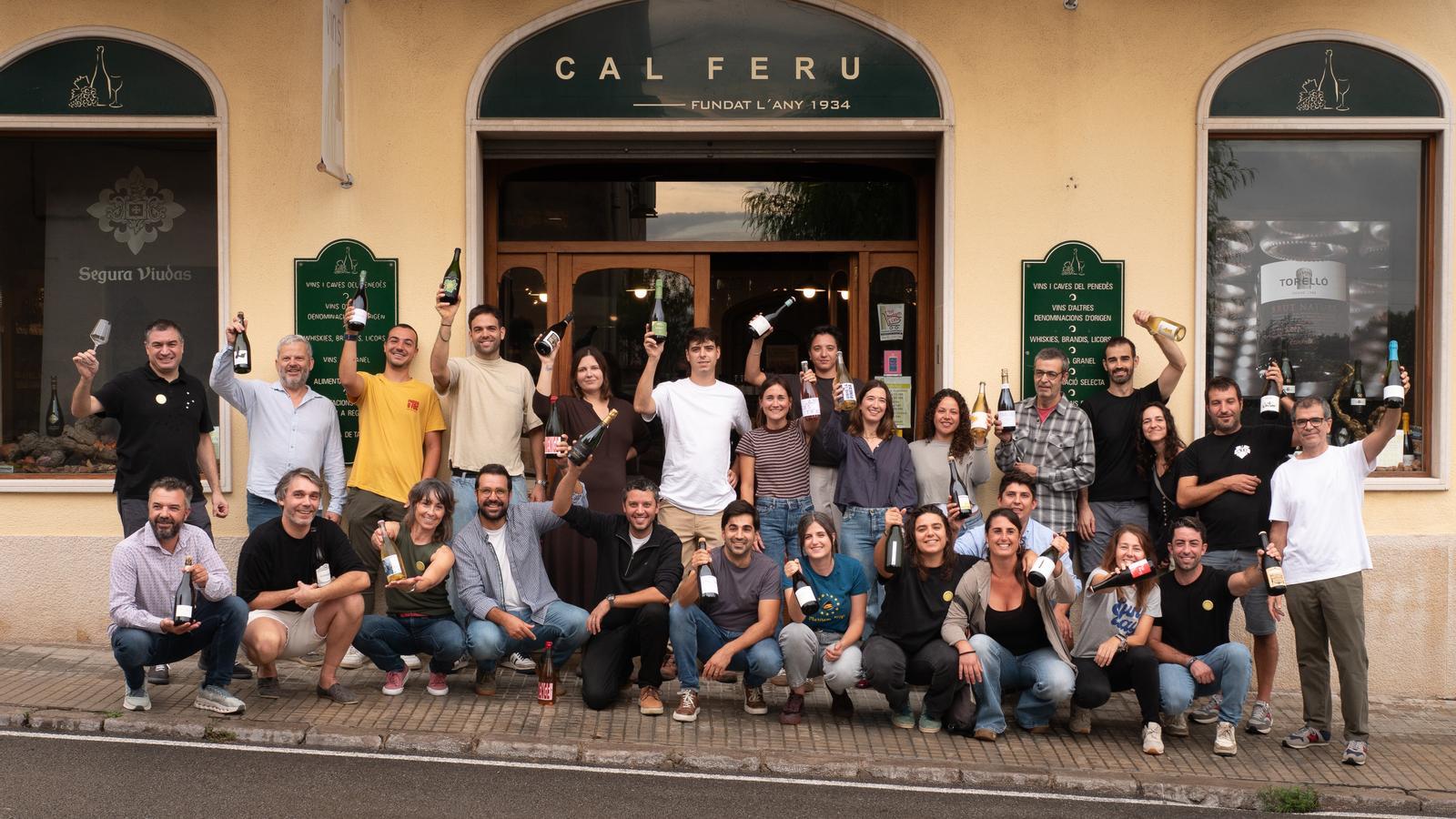
The wineries that participated in the 5th Meeting of Effervescent Producers at Cal Feru.Cedida
Saint Sadurní d'AnoiaNot everything is turmoil among the sparkling wines produced here at home. The departure of producers from the DO Cava, the majority to join Corpinnat or Clàssic Penedès, has monopolized the attention paid to bubbles for years. With all this commotion, another of the movements that have been decisive for the revolution of Penedès sparkling wines to take place has been left in the background. It is about the multiplication of ancestrals, bubbles that strive, as so many other producers of sparkling wines made with the traditional method –cava style– also try to do, to vindicate the Penedès and its vineyards.
The word ancestral itself can leave those who have never heard of it quite bewildered. In fact, in Catalonia these sparkling wines are still quite unknown. "Many people say: ancestrals are those strange ones, and to me they are not the strange ones," states sommelier Xavi Roig. The main difference from cava and other traditional method sparkling wines –most Corpinnat and Clàssic Penedès are also these– is that ancestrals undergo a single fermentation, while traditional method bubbles undergo two, and the method used is perceived afterwards in the glass.
There may be "unique" ancestrals, Roig admits, but they have ceased to have the appearance they had a few years ago as an alternative bubble that only a handful of producers made, often from the orbit of so-called natural or minimal-intervention wines. Back then they could be identified at a glance, because the bottle was capped with a crown cap and they could have a touch of cloudiness, because they had not been disgorged – the remains of the yeasts that remained from the production process had not been removed from the bottle –, but nowadays many are disgorged, there are some capped with cork and there are some that seek to lengthen the aging. Now there are "very good" ones, emphasizes Roig.
Born to reclaim their origin
A good sample of the wide range of ancestral wines from the Penedès could be tasted this October at the 5th Meeting of Effervescent Producers promoted by Roig, now under the label of the Territori Efervescent initiative and which was hosted by Cal Feru, a shop that the sommelier runs in Sant Sadurní d'Anoia and which is a benchmark for buying wines and sparkling wines from the Penedès. This year it has brought together 25 producers, and many of them make ancestral wines –some are Corpinnat or Clàssic Penedès, and the rest, without DO–, but this is not intentional. Roig's wish from the very beginning has been to gather sparkling wine projects that were not common. "From young people or those who are giving great importance to the vineyard, the origin, the territory", he relates, and the fact is that many producers have innovated through the ancestral method.
Sommelier Xavi Roig, from Cal Feru, raises a glass of ancestral wine.Provided
This is how "the resurgence has been generated, of young people who say: 'I have these grapes, I want to do something with them, I want to make bubbles... How can I do it easily?' With the ancestral method," continues Roig. Since they can be finished in 15 days from the moment the grapes are harvested until the bottle is capped for the fermentation to finish inside, it does not take much money to start producing them, and this has given an opportunity to a new batch of young producers. Such as Anna and Joan Santacana, from Heretat Can Serra, one of the latest additions to the Penedès ancestral universe with their La Pineda 2025. From a family of winegrowers, they had long wanted to make wine to promote the family estate and give their vision of the territory.
"If we had started making wine 20 years ago, perhaps we wouldn't have considered making ancestral," reflects Anna Santacana, but by crafting these bubbles with a "young, fresh, and fun" style, they have found a way to feel reflected as young producers. Furthermore, "it is a way of showing that there isn't just one way to make sparkling wine, there are many," she continues. Now, a few years have passed since other producers took the same step as the Santacanas, and the ancestral method has consolidated, to the point that it is no longer just a sparkling wine to have with appetizers or light meals. Some are bringing ancestral wines to the market with longer aging, while others look further ahead and are already trying to make the leap to the traditional method, which remains the most prized among consumers.
More aging and a leap towards the traditional method
At Cal Feru, the Esteve i Gibert winery has brought the ancestral Blanquet 2021 and La Vie en Rosé 2022, or Enlaire Vins, the 7mm Mauser 2022 and the Agulles de Plata from the same year. "Why must an ancestral wine always be an easy wine, a refreshment? Why can't we make a serious wine if the vineyard is serious?", poses Mar Capdevila, from Enlaire Vins, while Albert López, from Esteve i Gibert, celebrates that he is no longer alone or almost alone with long-aged ancestral wines. He highlights that, unlike the traditional method, in which brioche notes can impose themselves over time during aging, in an ancestral wine with aging there is a higher chance that the fruit taste will be maintained. The fact of having carried out a single fermentation, instead of two, may have a lot to do with it, according to Agustí Torelló, from Anima Mundi (Corpinnat): "It allows the dialogue between the vineyard and the final product to be more direct, without so many screens in between".
Aurora Carafí, from Vinya Lluny, has new horizons. "It was thanks to the ancestral that I made myself known," she admits, but she is already experimenting with her first traditional method sparkling wine. She also debuted with the Dumenge ancestrals, but from the 2026 vintage onwards, all her productions will become traditional method. According to Jaume Vilaseca, one of the partners at Dumenge, "if you have good grapes, you have a good ancestral," but to play in the first division of sparkling wines, he considers it necessary to do so with traditional method and aging. "Our goal is to do it better every year and with the ancestrals we have reached the limit," he assures. That said, as they already do at Casa Jou, the other winery of which he is a partner and which only makes traditional method, the intention is to use fresh must from the same vineyard to carry out the second fermentation, instead of adding sugar from other sources, which he sees as a qualitative leap: "You take a sparkling wine from anywhere in the world and they have brioche notes. Ours have fruit, vineyard, landscape."
The Penedès is no longer understood without ancestrals
The ancestral method, highlights Capdevila, "allows harvesting when the grape is at an optimal point of ripeness", while with the traditional one it is customary to harvest when it is greener to ensure that the freshness is maintained even after the second fermentation. Although producers like Agustí Torelló see how their ancestrals have more demand in other countries, they predict a great future for them. Torelló guarantees that the Mediterranean is "perfect" for producing them precisely because the grapes must be harvested ripe. "Perhaps in the north they have more acidity, but in the Mediterranean we have the taste", he highlights.
In the Penedès there has always been a lot of restlessness. While in its day it internationalized its sparkling wines, now it is looking for how to reclaim their origin. "They must explain the territory, the people behind it, and this is the future; it is what gives you differentiation from another area, and the traditional and ancestral method allow you to do so", asserts Roig, for whom in the future we should not talk about method, but about product: "In the end, what we want are good sparkling wines, and whether it is made one way or another should not matter".
The Forcada vineyard of Jean Leon.ProvidedMireia Torres and Montse Escoté, from Jean Leon.Provided
The first sparkling wine made from Forcada goes on sale
The winery Jean Leon has just brought to market a Clàssic Penedès traditional method wine made from Forcada, a variety recovered by the Família Torres winery –owner of Jean Leon– and of which until now there were only a few white wines. It is a 2023 brut nature with 27 months of aging, of which 11,000 bottles have been produced, and it stands out for its high acidity, meaning it could have a long life ahead. Torres located the Forcada in 2005 in the Ripollès region and, according to oenologist Mireia Torres, they saw that it could work well in the milder climate of the Penedès, even more so with climate change, because it "ripens late and has good acidity," which also gives it "great potential" for making sparkling wines. She now hopes that more Penedès wineries will vinify it.
The DO Penedès, of which Clàssic Penedès is the sparkling wine division, approved the Forcada in 2017 and today there are about 50 hectares planted, 35 of which are between Torres and Jean Leon. For his part, the vice president of Corpinnat, Roc Gramona, recently said that Forcada needs more time to better assess whether it can be a good candidate to become a benchmark variety for Penedès sparkling wines.