Maldon, the small English town from which the only crystal salt sold in bulk in Catalonia comes
We travel to the English town to visit the workshop where the salt that is exported to sixty countries in the world is made

-
CAT -
CAST
Maldon/EnglandMaldon truly exists. It is not just the brand of salt that has spread to sixty countries, especially Spain, which is the second largest consumer – the first being England–. Maldon is also a town located northeast of London, about sixty-odd kilometers from the British capital. The village seems taken from a fairy tale, with exposed brick houses, local shops, independent bookstores, pubs where you could spend hours, terraces full of warm light garlands, and a small hotel (The Blue Boar), located opposite the Church of All Saints. A church – Protestant – which is a meeting point for the townspeople, young and old. The day we visited, the grandparents were singing songs in a choir to their grandchildren, who were playing up and down in front of them.

The first thing I check when I step into Maldon is that the neighbours pronounce the a as an open o sound, and the second is that people feel comfortable there. They tell you that the shops are pretty, that it's a good place to live. The river has given them a lot of life, and has made the local economy function since historical times. Just in Maldon, the river, named Blackwater, flows into the North Sea, and for this reason it widens, it gets big, and the water is both fresh and salt.This is the origin of the salt pans: it is known that since Roman times there were natural ones around the river. And today if you take a boat from the town itself, mainly for tourists and foreigners, you can navigate there and also check that it is called Blackwater because the water is turbulent. If you take the walk in the middle of the afternoon, it is likely that they will offer you a snack, and then you will taste the scone (the English afternoon tea pastry) with butter, jam and some Maldon salt crystals. And here we must highlight a very clear fact: in the English town, the locals are proud of it, they use it everywhere and you will find it from breakfast to dinner, with transparent salt shakers, which must be turned upside down so that the salt comes out crushed in the quantity we want.Company secrets that are not revealed
As the Roman era is long gone and times change, in the 19th century, specifically in 1883, the Osborne family opened a workshop in a house by the river, where they established the pools with water, which enters through pipes to the interior. At this point, it should be noted that the Osborne of Maldon salt is not from the same clan that settled in Cadiz to market Jerez wines, and which has the bull as its symbol in Spain. Today, in the same town, there is the historic workshop, which is in operation, but outside the town there is the rest. The company keeps the production volume secret – it's not the only thing they won't tell me – but it is large, because they export to sixty countries, have one hundred and fifty employees on payroll and, they assure, have sixty pools in operation.

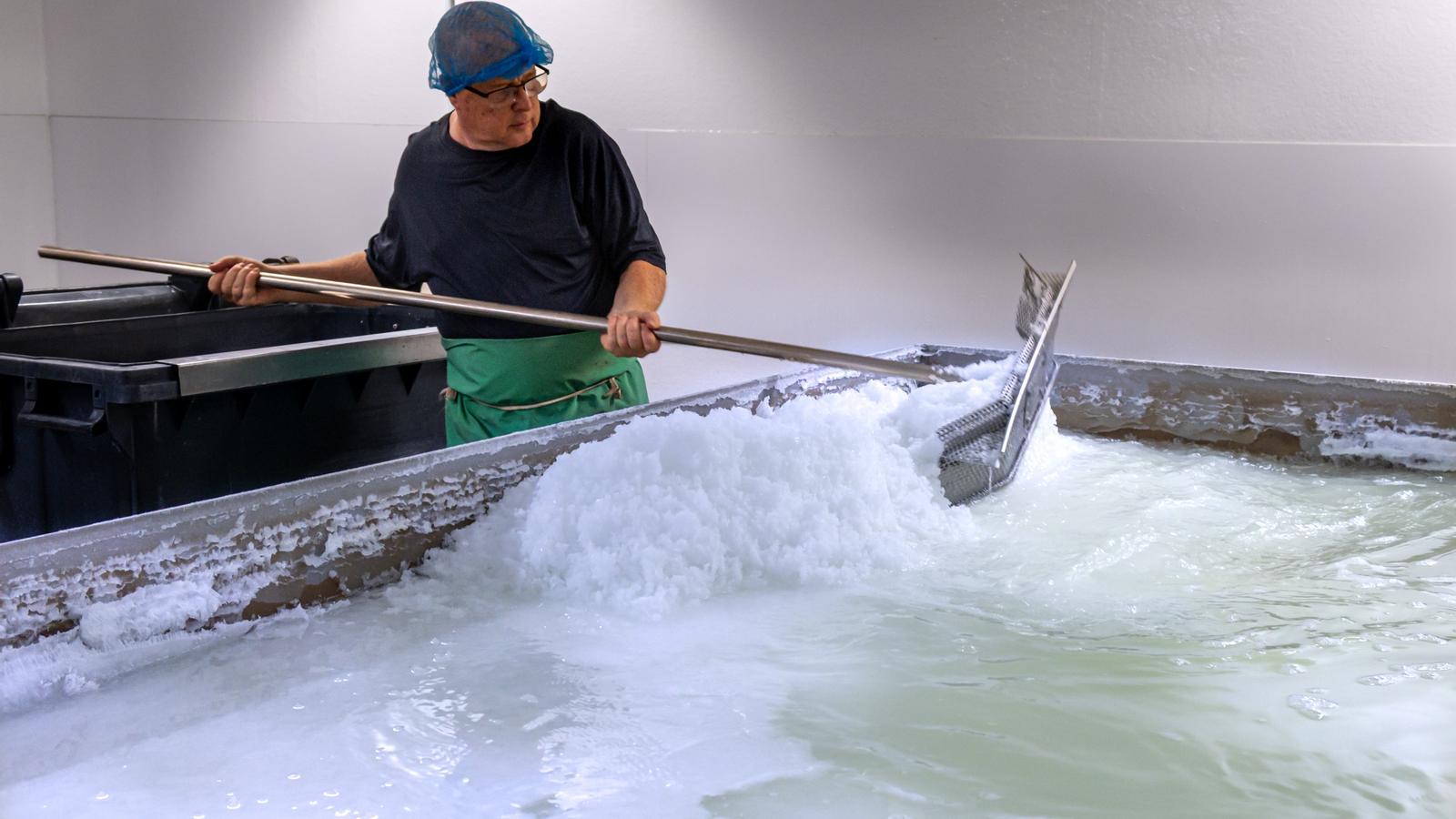
When you enter the workshop you discover that the salt pans are very different from what you had imagined during the walk along the Blackwater River. There are large stainless steel drums, pipes, the sound of ductwork, and, best of all, Gary Bertley, who is master salt maker (salt master), the company's best salt crystal producer since 1993. Bertley is not authorized to reveal what the company's other great secret is, which is the water temperature in the two ponds where the water filtered from the river is held inside. The company insists it is a state secret. I notice it's a bit warm in here, but Gary is used to it. His work tool is a giant metal broom, which he uses to stir the water and drag the salt that is in it. Next, he collects it with the giant broom shovel and throws it into some black containers. Then he takes the containers to another room, where there is a machine into which he pours the salt. Once poured, it passes through a turbine, which dries it, and from there it is transferred to a container, and it will be ready. The process is more laborious in time than what we have explained, but the central steps are these. Of course, it is a modern salt pan, from the 21st century, in a country where there were not many sunny hours or heat in the past. This summer England is experiencing temperatures above thirty degrees, but the Maldon brand salt pans are designed not to need sun drying.
And at this point, it must be explained why Maldon salt has become so famous around the world, to the point that its name is often used to designate any flaky salt. The company's guide assures that there is not a single reason, but a combination of factors: the pyramidal shape of the crystals, which is created naturally, the taste and the quality.In our home, chefs incorporated it years ago into their cooking. And in Maldon, naturally, too. In the village's cooking space, where residents book a table to cook together and then dine, the chef prepares sea bass in Maldon salt with almost ceremonial delicacy. He uses a piece weighing a kilo and a half and covers it with a mixture of two large containers of Maldon salt and whipped egg whites, with no other ingredients. With this paste, he completely encases the fish, as if locking it in a chest, and bakes it for about forty minutes at 180 degrees. When he breaks the hard, compact crust, a sea bass appears, cooked in its own steam, succulent and with an exquisite texture. For the inhabitants of Maldon, this salt is a source of pride; for the rest of the world, the discovery that Maldon is not just a brand, but also a place that truly exists.
