The double danger of the general strike
The promoters trust in a sufficient stoppage in the morning and massive demonstrations in the afternoon, but they fear possible disturbances

-
CAT -
CAST
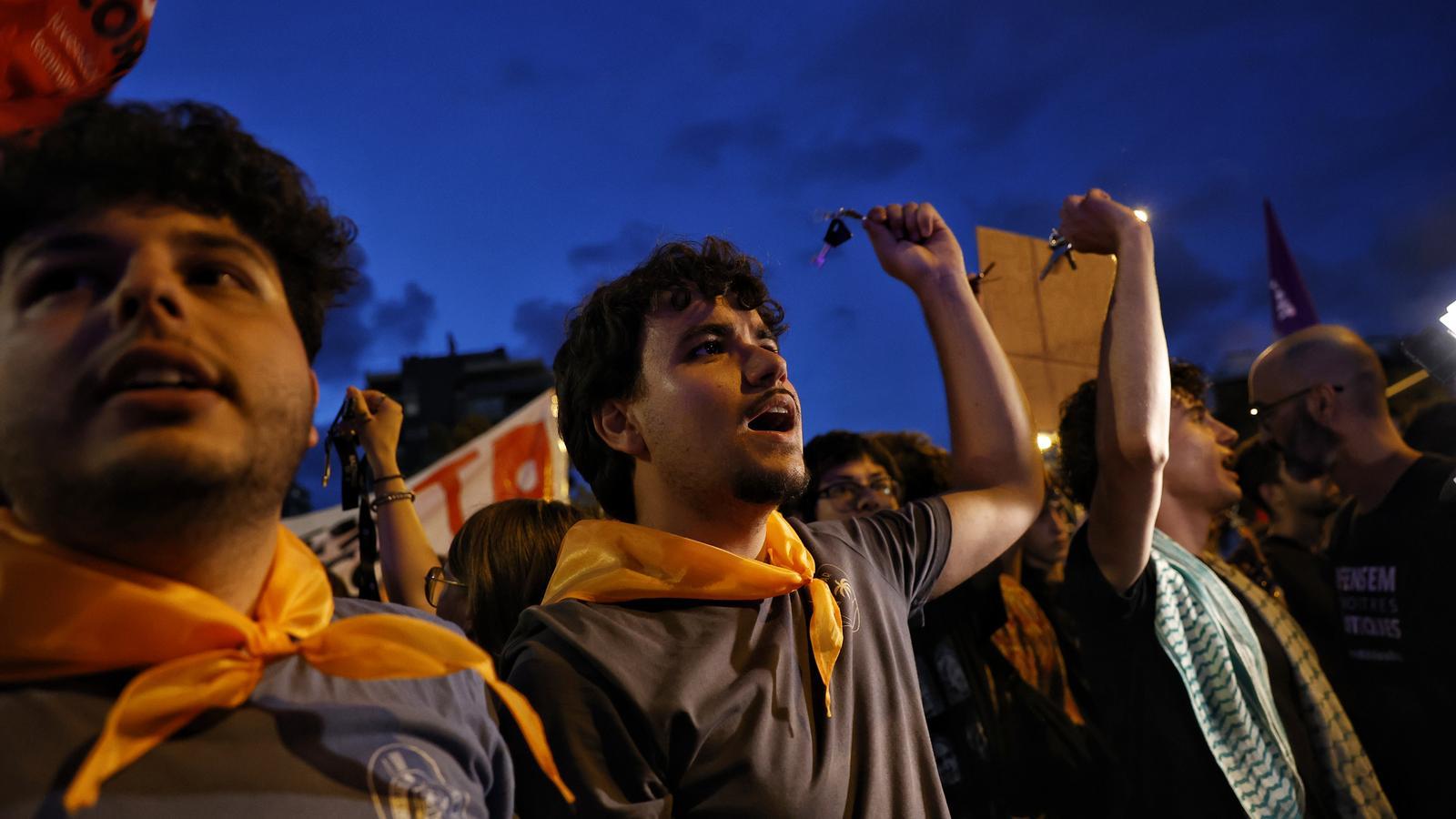
BarcelonaFrom the point of view of the general strike's promoters, which includes the political left that supports it, the call to action carries a double danger. The first and most obvious is that it fails and allows the right to claim victory right on the doorstep of the election campaign. And the second is that it devolves into a pitched battle, in the French style, which ends up activating the law-and-order vote ahead of November 29th. The majority trade unions are aware that the November 11th strike will not halt economic activity in a generalized way, but they do aspire that, especially on Wednesday morning, there will be enough of an impact, particularly in large cities, to save face. They are confident that with mobility affected, the classic picket lines at Mercabarna, and the shutdown of heavy industry with Seat as a symbol in Catalonia, it will be enough so that no one can say there was no strike. The disturbances in Blois, moreover, may dissuade small merchants from opening their shutters on such a significant day.
In any case, the hope is that the afternoon mobilizations will indeed be massive, and they trust that the people who could not strike, whether because they cannot afford to lose a day's work or due to corporate coercion, will join in. In Catalonia, the big test will be whether the protesters fill the Passeig de Gràcia, the stage for great past mobilizations, whether it be for independence (the first ANC demonstration during the 2012 Diada), against the Iraq War (2003), for the assassination of Ernest Lluch (2000), or for the Statute during the 1977 Diada.
Doubts on the left
This is, as we were saying, the optimistic scenario. But there are many doubts. Not everyone on the left considers it to have been a good idea to call a strike on the eve of the election campaign, which makes it, de facto, the most political strike in recent history. But, in reality, the strike responds to a very specific juncture. Major unions and social collectives like the Tenants' Union are aware that with a PP and Vox government they will lose any capacity for political influence. It is, therefore, a preventive strike against parties that have not yet won the elections and that today are the opposition. In fact, the undisguised objective of the organizers is that they do not win them.
When the unions are asked about the political contamination of the strike, they respond that the CEOE has not negotiated the Agreement for Employment and Collective Bargaining (AENC, by its acronym in Spanish) for more than a year, because it is waiting for there to be a PP-Vox government that will allow it to curb wage increases. Without this framework agreement, which sets the scope for increases, all collective bargaining negotiations are at a standstill. It is a boycott de facto that, for the unions, is also a clearly political option. And, therefore, they respond with their own weapons. The CEOE is very indignant about the general strike and this suggests that it will not be easy to recover a minimum level of social dialogue in the future, especially with a government that is explicitly against trade union demands (wage increases, reduction of the working day, etc.). This strike must also be read in this light: it is the calling card for future social unrest.
One of the things that has strained the atmosphere of the general strike is the Urda accident, which has diverted the focus from the fight for decent housing and, in fact, the PP has taken advantage of this to ask the unions to call off the strike. From the PSOE, the situation is seen as so desperate that they already consider that everything that serves to refocus on social debates (housing, cost of living, salaries, etc.) is fine by them, even if they have to assume many risks, as is the case. In fact, right now what worries them most is that many people still do not know that there will be a general strike on Wednesday.
From the point of view of the Tenants' Union, it is an unprecedented success. Never before had a social entity been able to drag the major unions into a general strike and force an entire Spanish government to take measures against evictions and vulture funds. Their most effective demonstration of strength was, however, when they forced Podemos to vote in favor of the Spanish government's decrees, since the purple party was hesitant because they seemed too timid to them. This combination of street pressure and pragmatism distances them from other more theoretical and academicist movements like the 11-M. Their survival, whatever the result of the strike and November 29th, seems assured. The housing problem will not disappear overnight. On this, all the actors who will face each other first on November 11th and then on November 29th are clear.
