Carlos Duarte: "It is not said enough that pregnant women should eat fish"
Oceanographer

-
CAT -
CAST
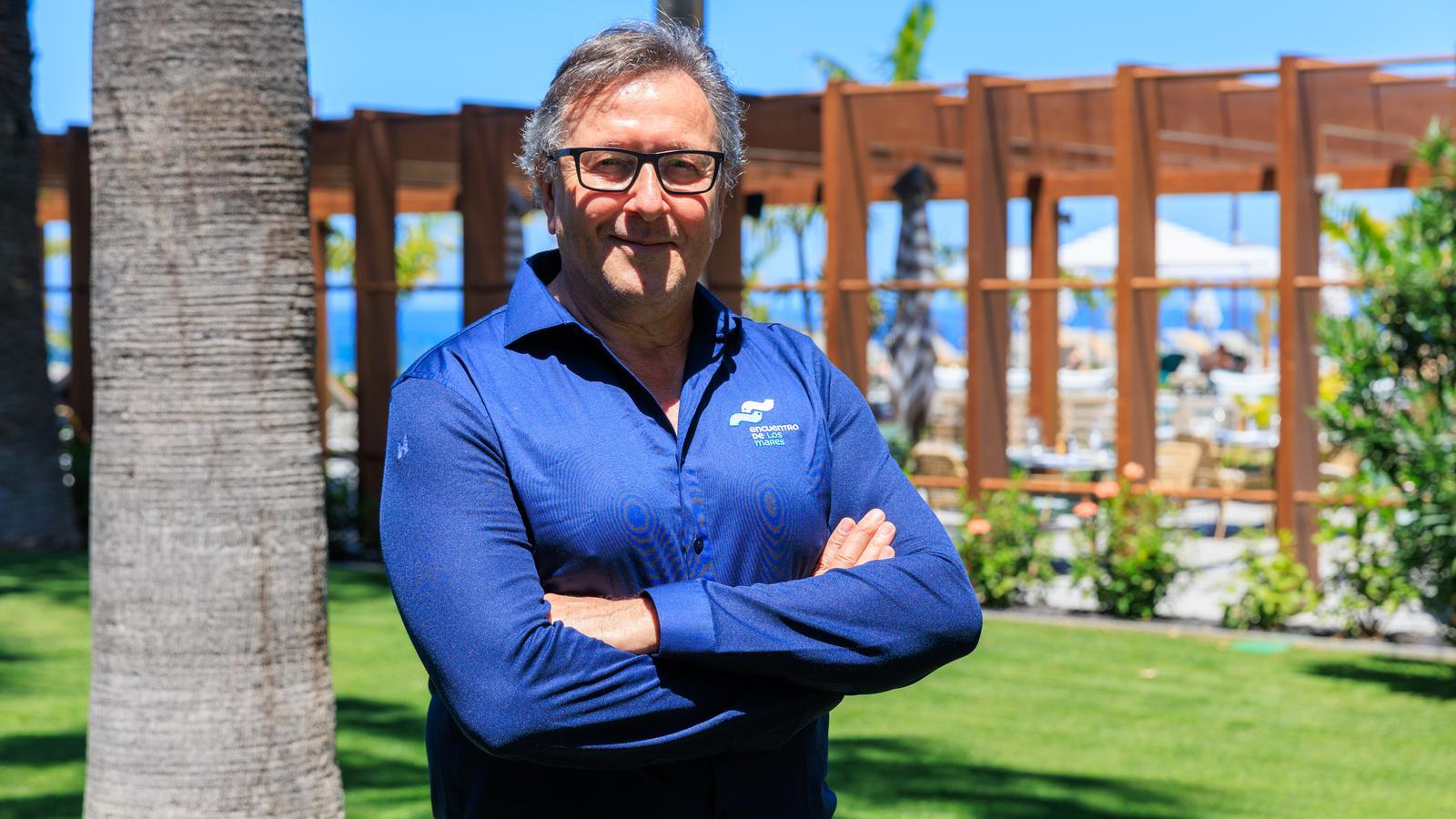
Puerto de la Cruz (Tenerife)Carlos Duarte (Lisbon, 1960) is one of the most prestigious oceanographers in the world. He now resides in Mallorca, but has lived in Catalonia, Canada, Australia, the United States, and Saudi Arabia. His lectures always provide revealing data about the sea, some alarming. But he always tries to find an optimistic approach in turbulent times. Duarte, moreover, is the scientific advisor for the congress 'Encuentro de los Mares' (Meeting of the Seas), held in Tenerife, where the scientific community, fishermen, and chefs meet for four days to exchange knowledge.
Fish consumption is declining.
— Yes, and it's an important problem. There is extremely important evidence of our dependence on seafood. And it translates into many dimensions, but I would highlight two. One is mental health, both from the perspective of early life development and mental well-being, which depends on components that come from seafood, such as omega-3, but also selenium and iodine. Problems like depression or bipolar disorder are treated with a seafood-based diet. The other is reproductive health. It is not said enough that pregnant women should eat fish. The essential nutrients, which will be the way the developing embryo will acquire them, are fundamental for the quality of life of this baby to be born.
What type of fish should a pregnant woman consume?
— All food of marine origin has its benefits. But it is important that, for example, when we develop marine food through aquaculture, we do so without breaking the marine food chain. In many cases, they are feeding fish with feeds formulated with soy and other terrestrial foods that do not have these properties. We must maintain the custody of the marine chain throughout the production process, even if it is aquaculture. Currently, it is not done properly, but it is easy to solve this problem with a little research.
Some people consider eating fish to be expensive.
— These health benefits are not particularly associated with high-value seafood. Sardines and oily fish in general have high omega-3 and healthy nutrient content, but so do other more modest marine animals, like mussels. And algae are also important sources of omega-3 and essential nutrients. A diverse marine diet, and the diversity of seafood, is far superior to the diversity of land-based foods, ensuring very important human health. To the point that in the European Union it has been calculated that for every kilogram of seafood consumed, two euros are saved for the public health system.
The sector is asking for a super-reduced VAT for fish. From 10% to 4%.
— From an economic point of view, it makes sense to subsidize seafood, but also from an environmental point of view. It has a much lower carbon footprint than any land-based food, it does not consume pesticides, fungicides, it does not consume water. Many people who are considering having a diet that is responsible with the planet and who opt for vegetarian or vegan diets for this reason, could perfectly incorporate seafood because it would help them, on the one hand, to further reduce their impact and their ecological footprint and, on the other hand, it would make them healthier. It is not just an economic issue, it is also about a healthier population, which is also a happier population and, if you like, also more productive.
What do we have to do to save traditional fishermen?
— To traditional fishermen, we must return what has always been theirs, which is a space in the sea, which is increasingly reduced by declarations of protected marine areas or even polygons for wind energy and other appropriations of space in the sea. We must also return their role in society, investing in them, investing in this social capital of knowledge that is artisanal fishing and then economically valuing the products they generate from the sea, which have a care and commitment to the environment very different from that of industrial fishing.
You have given a presentation in which you try to define marine capital. Who owns the sea?
— The sea is a heritage of nature and, in fact, shared with the beings that inhabit it, not solely of people. Among humans, I believe it should be a heritage of humanity, at least; the genetic resources of the ocean, which are difficult to distribute, should be a heritage of humanity because they have enormous potential to generate wealth through biotechnology applications.
The Roman Empire decreed that the sea belonged to no one.
— The Romans declared in the Justinian Code, from which all legal codes of Western countries emanate, that the sea was terra nullius, meaning nobody's land. And then it stated that all marine organisms and living beings were res nullius, meaning they belonged to no one. Simply put, the first one to take possession of something was the owner, and this thinking has led, contrary to the concept of private property on land, to the sea being abused to its limit. When it ceases to be nobody's and rights are granted, then those who hold these rights take care of the sea.
Do you want to sell the sea?
— For example, you were asking about the future of artisanal fishing. Right now the dominant thinking is to declare protected marine areas where these fishermen are excluded. However, the models that really work are those in which concessions are given to these fishermen. These fishermen know the sea better than anyone, better than national park managers. In countries that have implemented these co-management models, the results in terms of marine conservation are superior to those of protected marine areas. So the ownership vacuum in the ocean is what has led to its abuse.
Do you consider that we have legislated too strictly without knowing the reality of these fishermen?
— Absolutely. I believe that these fishermen are not a problem for the conservation of the marine environment but rather an opportunity for the knowledge they have accumulated over many generations dedicated to fishing in this territory, and that this knowledge and this capacity to understand the marine environment have been ignored due to arrogant behavior where science prevails. Science should be a part of the solution, but it should not impose solutions.
Many restaurants depend on what their fishmonger provides them.
— There are fishermen and cooks who have been working together for decades and have developed a trust regarding the quality and traceability of products that is normally lost when we buy them at the supermarket. Because unfortunately, fishmongers are also disappearing. And fish is consumed in large supermarkets already packaged in the form of fillets.
A well-known supermarket has dispensed with the traditional fishmonger format to present it directly, already packaged and cut.
— This new ready-to-eat concept has the negative dimension of the waste of all the parts of the fish that are discarded. And, on the other hand, we also get the fish wrapped in plastic. And this also has implications for consumer health because these plastics end up being part of our diet too.
In fact, there are people who are wary of eating fish because of the issue of microplastics.
— It is true that many fish have microplastics, but almost all are in the digestive system, not in the muscle, which is what we eat. But salt also has plastic. After a day, we may have ingested two to six microplastic particles just from salt. There are also some in the water we drink at home. But it is the air we breathe that accounts for 90% of the plastic we ingest, especially in urban areas. And these are no longer microplastics, they are nanoplastics, even smaller, which are produced by tire abrasion.
And what about mercury in large fish?
— The mercury load in fish like tuna is offset by the selenium that the same fish contains. Selenium has an opposite effect to mercury. And this is also not communicated to the consumer.
How much seafood should we eat?
— Authorities recommend consuming at least two servings per week. And they only recommend pregnant women, for example, that during this gestation period they try to consume less tuna and large fish and consume more sardines, squid, and other equally healthy marine products, but which have a lower load of these metals. But only as a precautionary measure in these delicate times when it is also particularly important to consume food of marine origin. Food of marine origin should not be abandoned.
Algae are not part of our usual diet.
— It's one of my personal battles, as I believe that in the future, algae cultivation is imperative. Algae are regenerative crops. Right now, there are 2,000 square kilometers of algae cultivation worldwide. If we compare this to terrestrial plant cultivation, we have transformed 50 million square kilometers there. And the ocean is much larger. In the European Union, there are no more than 5 hectares. Algae cultivation can grow up to at least 3 million square kilometers without any negative effects, only benefits for the ocean. We need to learn to use the sea intelligently. In the future, the capture of wild ocean species will be a small part, almost, if you will, a boutique aspect of ocean food provision, and most of our food will come from controlled aquaculture with a significant base of algae.
Explain that, throughout their lives, species have been reduced by 56%.
— Since I was born, which was in 1960, until now, 50% of all greenhouse gases accumulated in the atmosphere have been emitted, more or less half of all documented species extinctions during my lifetime have occurred, and we have also lost 50% of the abundance of animal and plant populations on land and in the ocean. It is impossible for me to look you in the eye and tell you "We have been sustainable". The commitment cannot be sustainability, it must be regeneration. Last year I was in Canada, where I did my thesis in the 80s. Back then, if I drove for two hours, I had to stop to clean the windshield because it was full of insects and I couldn't see anything. Now I was driving for 12 days and I didn't have to clean the windshield once, and that is dramatic, you realize the enormous loss of biomass.
You defend the role of private companies in this fight.
— We cannot think that private enterprise and ourselves exist separately, but we are part of this ecosystem as consumers. Not only for an ethical reason, but also because it is very strongly documented that companies with solid commitments to the environment have better long-term results. And there is a concept that I consider very negative and paralyzing, which is greenwashing. Because many companies hesitate to implement positive policies or investments because they fear they will be seen as mere appearance. There is an expression in English that says that when you go towards a rainbow, you never reach the end. The path towards a responsible attitude towards the environment and our planet is a path towards the end of the rainbow. You will never be perfect, you can always do better, but you have to take steps and we must always encourage those who take steps and decide to embark on this path.
