School canteens: a puzzle of 16 different menus
On average, primary schools have between 8 and 10 adapted menu proposals and Catalonia has one of the highest prices for canteen service

-
CAT -
CAST
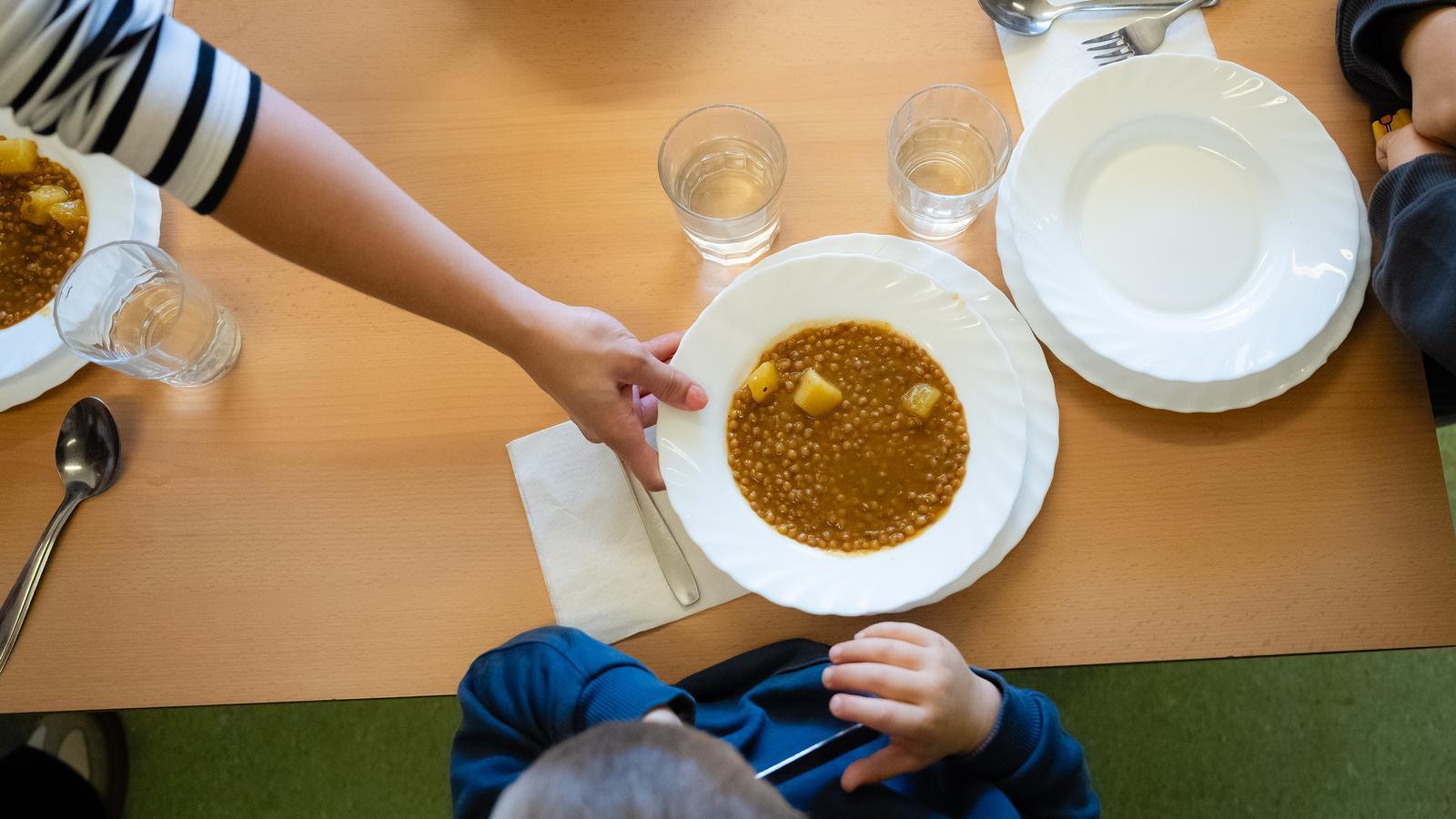
Girona"Too much vegetable protein", "Excess legumes", "What do we do about sugar?" The menus served in schools – in accordance with regulations and under nutritional criteria – generate a disparity of opinions among families. In Catalonia, 49.5% of children use the school canteen service, according to data from the Program for the Review of School Menus of Catalonia (PReME), based on the centers evaluated. Some schools have their own kitchens and others are supplied by companies that serve them meals. The objective is, in all cases, to offer menus adapted to needs, whether medical or for religious or moral reasons, which go beyond food: sufficient time to eat in peace – if the din allows – added to a care service before and after sitting at the table.
Currently, 50% of public schools have their own kitchen and 30% have a catering service, according to the Department of Education – taking into account the responses from 50% of the surveyed centers. Jordi Comas has been the cook at a rural school in Pla de l'Estany for three years, which has had a long tradition of chefs since its inception. Every day he prepares food for a hundred students, in addition to being responsible for logistics and receiving products, all from the local area. Local food, designed by a dietitian. “Food needs to be tasty and the presentation has to be attractive,” indicates Comas. A few weeks ago, he offered a very original mashed potato. “I put it inside a pastry bag and drew a poop shape. The puree had spinach in it, so it turned into a green poop. They all ate it!” he describes.
In collective catering companies, one of the most outstanding services is precisely that of school meals, in which BOiSA specializes. They offer both the option of cooking the food on the same day at the school center – which involves managing the entire process from the purchase of raw materials to the plate the child receives – and also preparing it in the central kitchen and transporting it to the schools. One of the criteria the company takes into account in managing these centers is that the distance between the central kitchen and the school canteen does not exceed 20 minutes, with the aim of preserving the nutritional quality and food safety of the meals. “It comes out hot; it is transported hot in isothermal boxes, and it also arrives hot,” states Núria Sitjà, nutritionist and dietitian at BOiSA.

Six different menus
Although she and her colleague are responsible for designing the menus –following the directives of the Official State Gazette (BOE) and previously the recommendations of the Public Health Agency–, “it is important to know the students, the families, and the school's philosophy,” Sitjà points out. “Working together with the school facilitates that the festivities and special days celebrated at the school also continue in the dining service,” she adds. Whether with a cook or a catering service, menus in schools are adapted to medical needs, such as allergies, food intolerances, or celiac disease; as well as moral or religious reasons, such as vegetarian, vegan, or halal menus.
It is sought that all children have an adequate alternative as similar as possible to the general menu. “The student should not feel discriminated against for eating differently, and a balance must be found. It is a challenge”, admits Sitjà. From the Public Health Agency, up to sixteen different menus have been identified, and the most frequent are the gluten-free menu (due to medical diagnosis) and those linked to allergens, followed by the pork-free and vegetarian menu. On average, primary schools have between 8 and 10 adapted menu proposals. 94% of the centers evaluated by PReME during 2024 had adapted menus.
The Public Health Agency of Catalonia, which offers a menu review service for centers by dietitians and nutritionists, establishes recommendations to improve the quality of meal programming and promote the recovery of the Mediterranean diet. In the Spanish sphere, the ministry has recently approved a royal decree on food safety and nutrition with specific criteria for school canteens. Sitjà considers this new regulation to be a “win” because it moves from “recommendations” to ‛obligations”, which allows for a common framework and clearer parameters.
Some of the aspects included in the royal decree on school canteens, which came into force this April, are the reduction of pre-cooked foods and processed red meat, the promotion of whole grain consumption, or the obligation that at least 5% of food be organic. These were already included in the guide Healthy Eating in the School Stage, but at that time it was a justified recommendation, and now, on the other hand, it is mandatory. "They have defined minimum criteria from which to work. For example, we said there should be wholemeal bread, but we did not exclude the double presence of wholemeal bread and white bread, and they stipulate, at least, wholemeal bread twice a week. Most of the criteria were already included in the guide, but we could not make them mandatory because they were recommendations," explains Gemma Salvador, dietitian-nutritionist at the Catalan Public Health Agency.
“The preparation of menus is like doing a puzzle. We have to adapt to the BOE guidelines and, at the same time, try to follow the recommendations of the Catalan Public Health Agency, without ever losing sight of the child or the canteen committee in which the school, families, and the company participate,” explains Sitjà. "The criteria in our guide were absolutely aligned with what has now been published, and 90% of schools respected it, but other territories are now working on it," argues Gemma Salvador, dietitian-nutritionist at the Catalan Public Health Agency, who assures that all criteria are justified by scientific evidence.

Consumption of meat and legumes
Gemma Salvador adds that the Catalan guide was more demanding in some things and the BOE leaves a wider interval. One of the points that raise the most controversy is that of meat consumption. The Health guide recommended meat as a second course between one and two times a week, and the royal decree sets it between zero and three times a week. "But it doesn't mean it allows more meat, because it also allows zero, that is, less, and we were in the middle," qualifies Salvador. Only one of the portions can be red meat.
Regarding legumes, the royal decree sets a minimum of one serving per week as a first course and one serving as a second. The Catalan recommendation was between one and two servings per week as a first course and between one and five, as a second. The dietitian-nutritionist Marta Expósito, who also prepares menus for different schools, specifies that the frequency of legumes stipulated by the Agency for Public Health is "abusive". "Younger children can get stomach aches because they are difficult to digest. I only put them twice a week," she specifies.
In response to complaints from children and families about the high presence of legumes, Salvador assures that they are due to a lack of habit. "They are not vegetarian menus, because they have fish, eggs, and meat; it is about introducing protein of vegetable origin. What happens? That children eat few legumes at home and the kitchen teams are trained for them to be a first course or a single dish and in the form of a stew or legume salad. And what we see in the menus is that sometimes they put a first course of vegetable rice and a second course of stewed legumes, and this combination, besides being a bomb, people say it's two first courses," explains Salvador. When there are legumes as a second course, she advises that they be accompanied by a first course that is broth, gazpacho, or salad. "And we also recommend that when legumes are a second course, they be transformed so that they look like it and have greater acceptance, such as falafel or a hamburger," she adds.

Attractive combinations
Expósito's proposal is varied colors, appetizing, balanced foods, and healthy cooking; and when introducing a new food, she does it with a dish that is very pleasing alongside another that may not be as pleasing so that at least the schoolchildren do not go hungry. Expósito, moreover, is in favor of introducing variations proposed by the cooks and preserving traditions. "A cook at a school makes a very good cake and I have committed to not losing it one day a month – she states –. Many parents notice that the school canteen no longer has that smell of before... Those strong smells of fried foods are no longer there."
Regarding fish, the new decree establishes one to three times a week, and Catalan recommendations spoke of guaranteeing at least one portion per week. "So much fish is not sustainable," says this nutritionist. "The criteria of our guide were absolutely aligned with what has been published now, and 90% of schools respected it, but other territories are now working on it," adds Salvador, who assures that all criteria are justified by scientific evidence.
Dietitians and nutritionists encourage offering yogurt once a week, whole and without sugar, to all ages. Although without sugar is always prioritized, in certain centers – in agreement with the dining hall committee – there is still some grade that serves it. This sweet ingredient, which causes a lot of indignation among some families, is actually found in other foods that are occasionally given in schools, such as Christmas nougat. “We understand that if it is for a justified cause, these desserts also have a place, always from a balanced perspective, prioritizing the regular consumption of fruit,” points out Núria Sitjà, nutritionist and dietitian at BOiSA.
This academic year, the Department of Education has granted dining hall aid to a total of 213,965 students. According to Educo, the international cooperation NGO for children, more than 146,000 vulnerable children and adolescents did not receive a dining hall scholarship this academic year (40.6% were left without). Catalonia has one of the highest dining hall prices, compared to Madrid (5.50 euros per day) or Valencia (4.35 euros per day). The maximum prices set by the department range from 7.13 to 8.29 euros per day. The price includes the meal and direct attention to the students during the time of the dining hall service, as well as in the periods before and after. “The service is not just about food, but rather a space that must be aligned with the educational project of the center. Catalonia actually has a project that is differentiated from the rest of the autonomous communities,” specify sources from the department.
Within this educational context, the psychopedagogue, Anna Serra Dolcet, highlights that in school dining halls “children also learn to serve, collaborate, respect turns, or manage the amount of food placed on their plates.” Attitudes that, according to her, “should be encouraged at home” because “they contribute to creating an optimal space for sharing meals with the family.” A moment of family gathering, where nutritious and balanced meals should continue because, as Expósito laments, “many children currently have their only healthy meal from Monday to Friday in schools.”
A good meal is not enough for it to be beneficial. According to Sònia Hernández-Montaño, director of the postgraduate course in healthy architecture and bioconstruction at the Sert school in Barcelona, there is a relationship between architecture and health. “The environment also affects our health and modifies our genetics – she clarifies –. If the school dining room does not have proper ventilation, being a space where a lot of humidity can concentrate, it can increase the risk of exposure to biological contaminants; if natural sunlight does not enter at mealtime, this is associated with some pathologies given that exposure in the biological field has important benefits, especially in hormonal regulation; furthermore, if the plates and cutlery are made of plastic, they are a source of endocrine disruptors and can generate microplastics that are then ingested…”, exemplifies this expert.

