The unions reject the 400 euro offer and barricade themselves in the department
The union forces accuse the Government of not making a new offer and Niubó asks them "to reflect".

-
CAT -
CAST
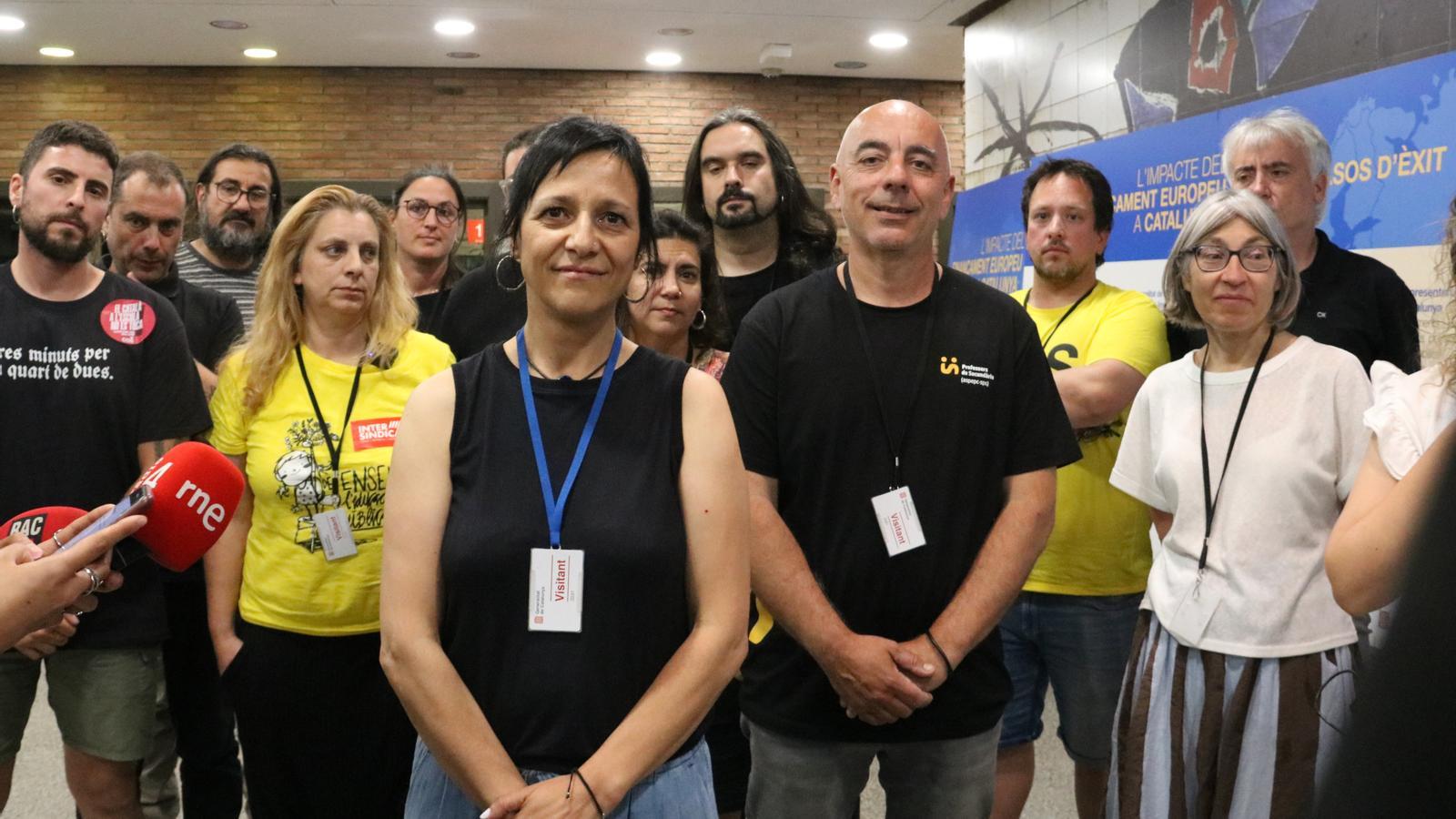
BarcelonaThe key day of the negotiations between Education and unions has ended in a complete breakdown. After a meeting –the seventh– that lasted more than six hours, the unions locked themselves inside the department and demanded that the Minister of Education, Esther Niubó, intervene in the negotiations. A few minutes later, at a quarter to ten at night, Niubó, who was already in the building, appeared and entered to speak with the union representatives, but only stayed for a few minutes. Union sources indicate that she asked them to "reflect" and urged them to talk on Friday at 10 a.m. In response, the unions calling the strike –USTEC, Professors of Secondary Education, CGT, and Intersindical– have assured that they will spend the night at the department. Furthermore, they have called for a demonstration in front of the ministry, where about ten people have gathered.
The breakdown in talks occurred after the Government brought a concrete proposal to the negotiation table regarding salary and resources to strengthen staffing and for inclusive education. "We have offered 400 euros more per month," argued the Secretary of Educational Improvement, Ignasi Giménez, after the meeting ended. Specifically, the Government has offered an increase of almost 400 euros more in salary over four years, as confirmed by sources from the Department of Education. The new proposal would consider two elements: finally, the increase in the specific complement agreed upon in March would be €267.33 for teachers and €273.36 for secondary school teachers, and on the other hand, the generalized complement for all teachers offered this week would be €124.99 in 2029. All in all, over four years, a Catalan teacher would earn €392 gross per month more and a secondary school teacher, €398 more.
On the other hand, the unions have criticized that the Government is "playing games" and have assured that what they are actually being offered would be 330 euros per month. They claim that no improvement is being put on the table compared to what they had already been offered and accuse the Government of "inflating" the numbers by using previously agreed upon increases at the national level.
The Government has also offered –in fact, it had already done so on Wednesday– to resolve a demand long requested by unions: compensation for cuts in seniority increments. The now famous "seniority debt" is a salary supplement for teaching seniority that was consolidated every six years of service. Until the 2012 cuts, teachers could access the first increment after six years, the second after twelve, and the third after eighteen. The Generalitat then postponed the first recognition from six to nine years, which also shifted the payment of subsequent increments. Now the Government commits to addressing the debt generated by these three years of accumulated delay from 2012 to 2024, when the six-year periods were reinstated. A move that, according to the Secretary of Educational Improvement, would represent an investment of approximately 300 million euros.
Beyond the remuneration aspect, the Government has also made an offer regarding staff reinforcements and inclusion. According to the Education document, in four years there would be approximately 7,000 new allocations. Specifically, for the next academic year, 1,787 allocations have already been announced; for the following two academic years, 1,631 would be added each year, and finally, for the 2029/2030 academic year, 1,983 would be added. The sum of all these allocations would be 7,032, a figure higher than the 6,400 requested by the unions. Nevertheless, the offer warns that the calculated amounts are "indicative." In any case, the vast majority of these positions would be destined for inclusive education with profiles such as counselors, educators, and teachers for support classrooms. In parallel, an increase of 5,000 teaching positions is also on the table between 2027 and 2028.
Education asks the unions to "reconsider it"
Just after the clash between unions and the Government, both sides have come out to give explanations. From USTEC, the spokesperson, Iolanda Segura, has criticized that the education offer "is not 400 euros". "Today was a key day for negotiation and we have not negotiated. They have presented us with the same proposal as yesterday and we have not been able to explore any room for maneuver. What the minister said is confirmed: that it was a final proposal," she criticized. Furthermore, she assured that the salary increase "is not 400 euros, but 120 euros over four years, plus the 200 euros from March". "The department has inflated the numbers," she insisted.
Laura Gené, from CGT, has also considered that the offer is not sufficient and has stated that the Government "is not understanding the message". "We will not settle for crumbs, 120 euros will not fix the educational emergency we have," she assured.
For their part, from the Department of Education, Giménez has insisted that the Government "has doubled the offer from March" and has asked the unions to reconsider. "I ask them to reconsider their situation," insisted the Secretary for Educational Improvement. At the moment, the unions remain locked in the department and about fifty teachers are demonstrating in front of the building.
