The DNA reveals the silenced chronicle of Pedralbes
The search for the seventh centenary of the monastery locates 25 individuals in eight tombs from the 14th century and extracts the genome of the founding queen
-
CAT -
CAST
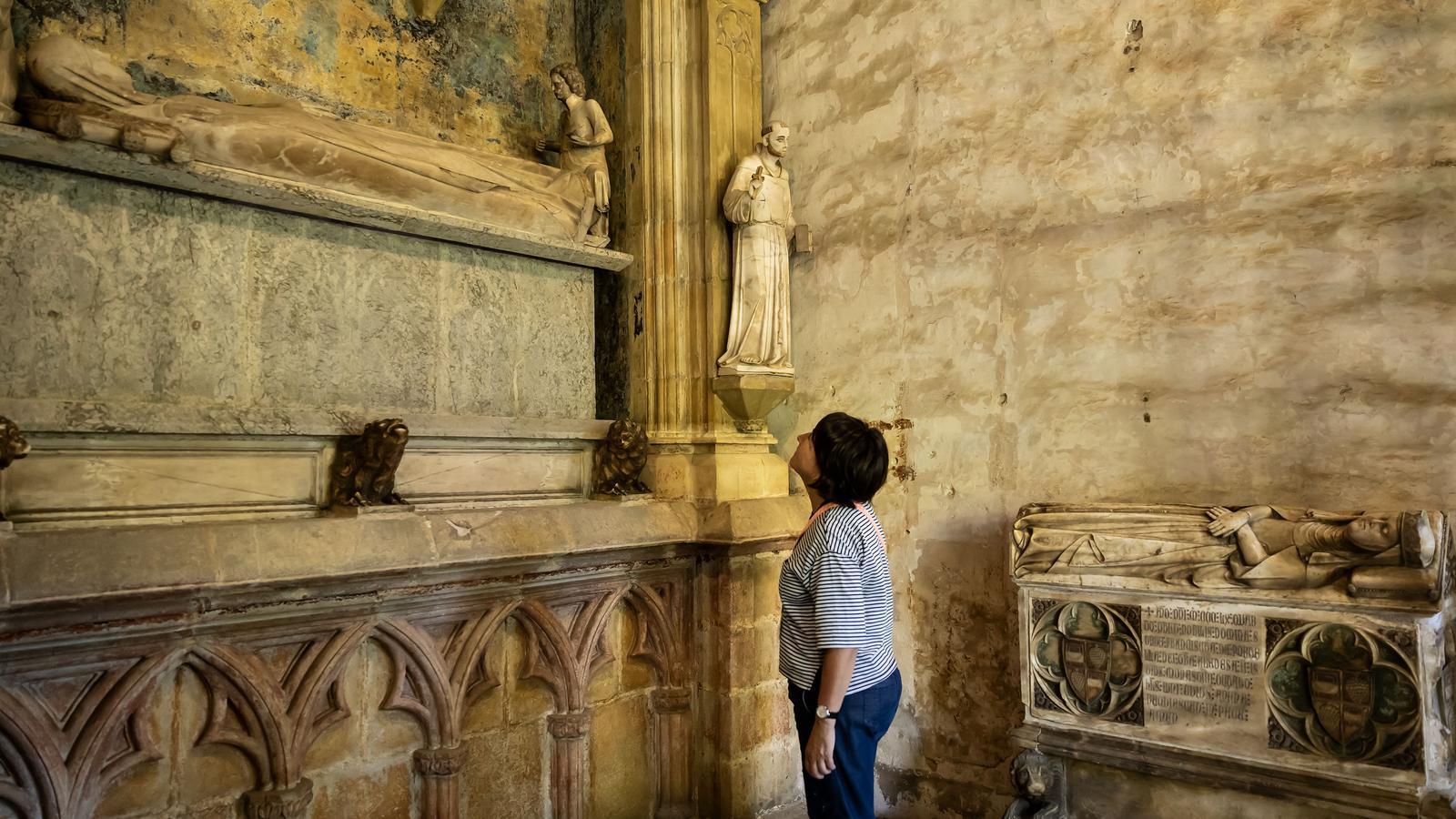
BarcelonaBehind the stone walls of the monastery of Pedralbes many generations of women have lived for seven centuries, and many stories have unfolded. We know many things about struggles, fights for survival, talent, and creativity, thanks to documents and stones, but now it is the turn of the dead. Through DNA, tissues, parchments, floral offerings and aromatic plants, and skeletal remains from the tombs, a new chapter is opening. What began as a conservation intervention to commemorate the seventh centenary of the convent (1326-2026) has become a fascinating archaeological and genetic research. A multidisciplinary team has opened eight tombs from the 14th century and found 25 individuals. And the surprises have only just begun.
The tomb of the founding queen, Elisenda de Montcada (Aitona, 1292 - Barcelona, 1364), is one of the most important pieces of the research. Until now, it was believed that her sarcophagus crossed the wall separating the church from the cloister. But archaeology has debunked the myth: they are two vessels separated by a small wall. An architectural solution that allowed the queen a double immortality: as a powerful sovereign facing the church and as a humble penitent facing the cloister.
Upon opening the tomb, researchers found a woman of robust constitution. She was tall for her time, over 1.60 meters tall, around 70 years old when she died – also an exceptional longevity – and the skeletal remains speak of the typical ailments of aging. She suffered a lot of pain due to different bone diseases. She also had a high glucose level, which is often linked to a very good diet or diabetes. She did not have hypoplasia of the teeth, which appears during periods of very high stress. Therefore, she must not have experienced great anxieties.

Unlike the other buried women, Elisenda de Montcada had no trace of pollen, a fact that tells us she did not tread the fields much. The queen rested in a medieval wooden box, wrapped in austere attire that evokes monastic habit, although there were also fragments of silk with gold thread. For now, science has already been able to extract part of her genome, which opens the door to knowing, within a year, from her eye color to the diseases that tormented her.
But if the queen is where she was expected, other tombs have revealed true surprises. In the tomb where the Aragonese knight Artau de Foces (1313-1374), who acted as counselor and steward to Queen Eleanor of Sicily, was theoretically to rest, no trace of any man was found; in his place, there were three infants and two young women, one with a long, still-preserved head of hair and evidence that an attempt was made to preserve her body, as she had herbs in her womb. "She was an extraordinarily beautiful woman," assures anthropologist Carme Rissech. We only know that none of these women were his two wives, who died older.
Deaths by stabbing in an abbess's tomb
More disturbing is the case of Francesca Saportella, the second abbess of Pedralbes. "She has been the most complicated," assures Rissech. Her tomb is a real puzzle of reopenings and alterations. "It's not even where it should be," points out archaeologist Josep Maria Vila. Nine individuals have been identified there, including four male skulls with stab wounds and, most striking, the mummified torso of a woman who still had a fetus of about 22 weeks in her birth canal. Among the skeletal remains, there were also papers, even a musical score in treble clef, fragments of parchment, devotional objects, textiles, and other non-medieval materials. In contrast, there is no trace of Saportella. "It was probably reopened during the Peninsular War, because the type of wounds on the skulls correspond to bladed weapons used in that conflict," assures Rissech.
In the tomb of Sobirana d'Olzet, remains compatible with the first abbess of the monastery have been found. She was no ordinary nun; she came from the community of Poor Clares of Sant Antoni i Santa Clara of Barcelona, and Elisenda de Montcada requested her transfer to set up the new monastery. In her tomb, there are also remains of candles and cords, likely intended for penance, which could reaffirm her commitment to the order's rule until death. In the tomb of the noble Romia de Sarrià, one of the first women to join the community of Poor Clares of Pedralbes, there were three women, an adolescent, and an infant, along with some partially mummified remains. And in that of Constança de Cardona, a nun who came from one of the most important lineages of medieval Catalonia, a woman and an infant were found, who were not mother and son. The child suffered a very severe contusion, from which it likely did not survive.

The research does not only speak to us of bones. Archaeobotany, with research led by Santiago Riera, can provide many clues about burial rituals. Each woman had her own flower. Thus, for example, dill abounds in Elisenda de Montcada's tomb. In the analyzed samples, offerings of rosemary, myrtle, and flowers such as broom have been detected, as well as plants like wormwood, which could have had medicinal or ritual uses in the preparation of bodies. Funeral practices such as the use of well-preserved textile bundles have also been documented – such as those that wrapped Elionor de Pinós or Beatriu de Fenollet–. "All the remains are very well placed. The head was placed in the bundles where it canonically belongs, to the west and facing east, and the long bones at the bottom," explains Vila. Testaments specified where they were to be buried and what rituals to perform. "One or two years always passed between the first burial and the final one," details Castellano. It was the necessary period for the bones to rest.
"For years we have been telling the story of these women through written testimonies, but we were missing an essential piece, which were the remains of the foundress and other women who shared her project," explains the director of the Pedralbes Monastery, Anna Castellano. "We had the precedent of the exhumations of Santes Creus and the opening of the tomb of Jaume II and his first wife, Blanca d'Anjou. With Elisenda de Montcada, Jaume II's second wife, we close the circle," she adds.
The project, which includes experts of the caliber of Carme Rissech in anthropology, archaeologist Josep Maria Vila, expert in conservation and restoration Javier Chillida, and paleogenomicist Carles Lalueza-Fox, will not stop here. The laboratory will continue working until May 2027 to answer the questions that still hang in the air: who were the people buried in the tombs, such as individuals who had died violently? What did they really die of? What kinship ties united them? What diseases did they suffer from? For now, we only know that the Black Death did not enter the monastery. What can the papers, parchments, textile and plant remains tell us about burial rituals? Why were the tombs reopened at later times and people buried in them who apparently had nothing to do with the monastery?
