Meloni fuels the migratory shock

-
CAT -
CAST
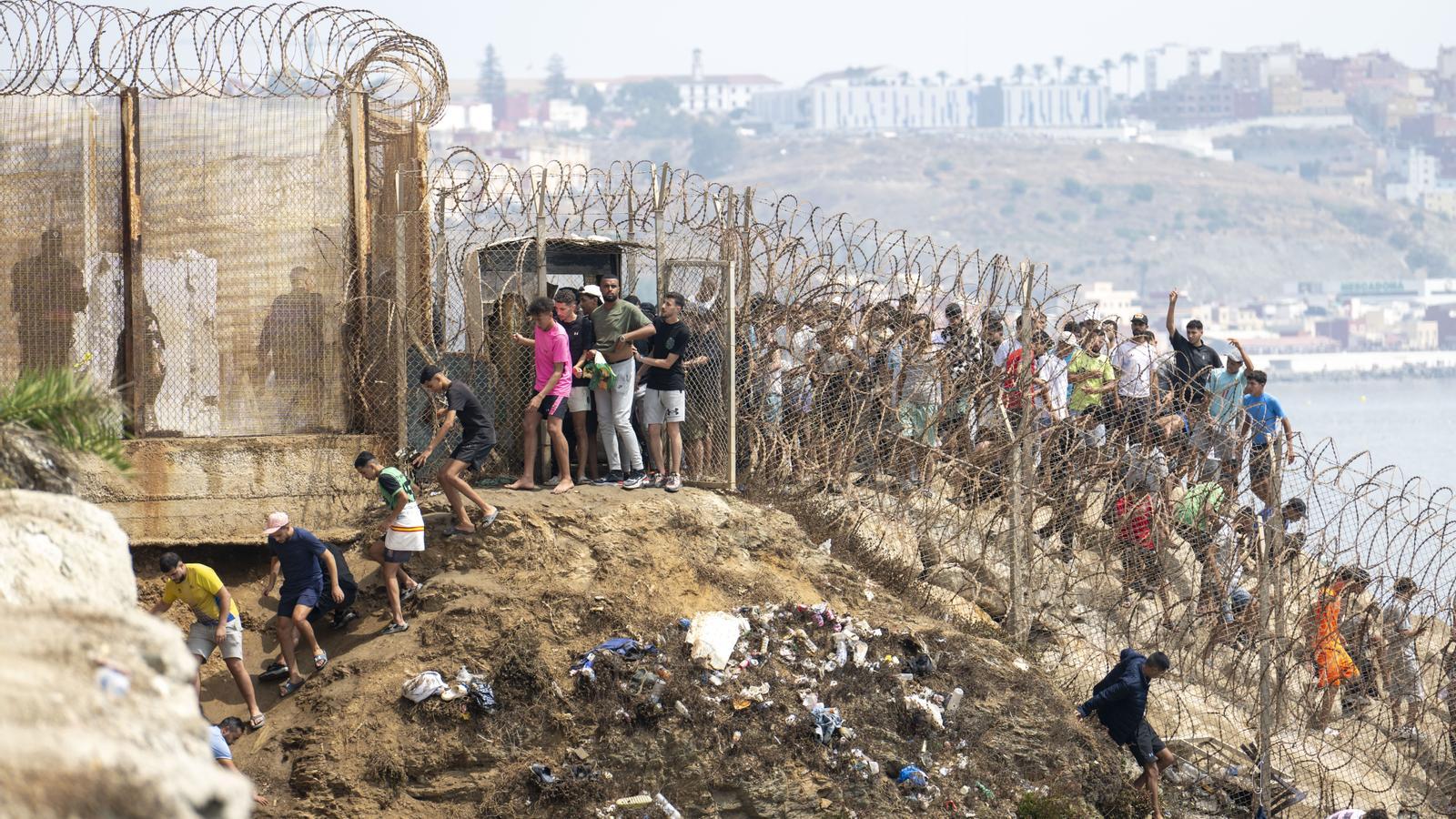
The European far-right, including the Spanish one, is being very quick and forceful in taking advantage of the propagandistic and dramatic gesture of Moroccan migratory pressure on Spain in Ceuta to distance itself from Pedro Sánchez's government, the government of regularization. It doesn't matter that what Meloni, Abascal, and co. call an "invasion" will ultimately have been a one-day episode: the massive arrival has been followed by a massive return. And it doesn't matter that more than fifty young people have died at sea: the far-right leaders have not spoken of this humanitarian drama. What Italy and Finland are concerned with is reinforcing the idea of the need to fortify Europe, an idea that does not fit with the demand for labor and which follows the xenophobic discourse of America first that the United States under Trump has also embraced.
The Italian Prime Minister, Giorgia Meloni, has been extremely quick to assert her profile by staging a supposed breach of the Schengen Treaty with Spain, which, however impossible, she has since had to qualify. The diplomatic crisis is served. But beyond the Meloni-Sánchez or Italy-Spain clash, such a gesture still opens a general crisis in the European Union, where the free movement of people has been a pillar of continental architecture since 1995, more than three decades ago, from political, social, and economic perspectives. It is true that the 2015 refugee crisis shook free movement without tolls or filters in the center of Europe, and that this past June the common migratory policy has been toughened. But Meloni's unilateral decision, despite the nuances, is a precedent and a further step in this direction.
One step, on the other hand, that does not correspond to the reality of numbers and facts. Regardless of whether the Ceuta crisis is being resolved with unusual speed, the data indicate that the most important irregular border crossings are located in the eastern Mediterranean (Greece-Turkey), in the Italian Mediterranean and the English Channel between France and England. The Iberian Peninsula is far below in this ranking, and the Canary Islands are even further behind. In fact, in 2025 Italy received 66,328 illegal immigrants compared to Spain's 36,775. Furthermore, overall, from June 2025 to June 2026, there has been a clear slowdown in arrivals. And, moreover, the data also contradict the idea, so discursively exploited by the loudspeakers of the European right, that Spanish regularizations – for example that of the Zapatero government in 2005 – led to a pull effect. It did not happen.
It is also debatable whether the sudden influx that has now occurred in Ceuta has a direct cause-and-effect relationship with the recent Spanish regularization: it should rather be attributed to a mixture of internal friction within Morocco and regional geopolitics, with the role of Algeria, the situation in the Sahara, and US pressure on Rabat regarding Israel. The analysis at this point is very open. And Morocco's silence leaves ample room for speculation.
In any case, the European far-right is winning the narrative battle and is succeeding in pushing the EU increasingly towards anti-immigration positions. Meloni wants to be at the forefront of this. It is the politics of fear that the traditional right is adopting, if only for another fear: that of losing electoral ground.
