The Catalan company Open Cosmos will deploy 192 satellites for its constellation
ConnectedCosmos seeks to present itself as a "reliable European alternative" in the satellite connectivity market

-
CAT -
CAST
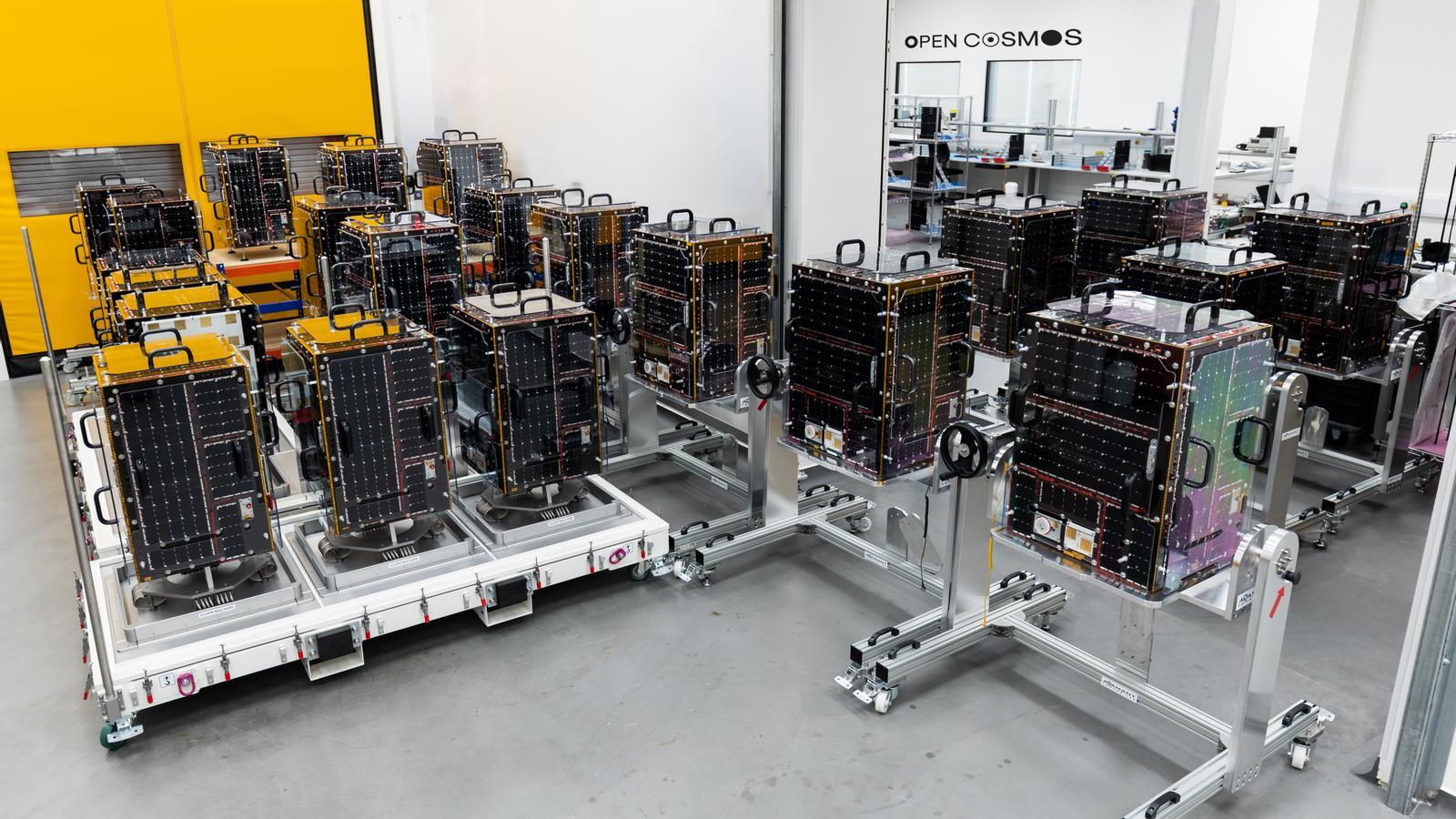
BarcelonaThe Catalan company Open Cosmos, one of the leaders in the satellite and space infrastructure sector, will deploy 192 satellites for its ConnectedCosmos connectivity constellation. The network will serve, as stated by the company in a press release, to "provide secure and resilient connectivity" while ensuring "sovereignty and control of critical data" at a time when satellite connections have become strategic infrastructures. These satellites will constitute the "core" of the constellation, although the company will be able to "rapidly expand the network's capacity" as demand increases.
As announced by Open Cosmos, they expect to have more than 96 satellites in orbit before the end of 2028. Full global coverage, meanwhile, would arrive before 2030. The next satellite launch for ConnectedCosmos will be executed before the end of this year, as indicated by the company.
The announcement comes only a few weeks after the Catalan firmraised a 300 million euro funding round, in which the Catalan Finance Institute (ICF) participated among other relevant financial actors. The investment serves to support the expansion of ConnectedCosmos, as well as to reinforce other projects, such as OpenConstellation and DataCosmos.
They will also use the investment to expand their industrial capacity. Currently, according to the company itself, its manufacturing capacity in Europe allows it to produce up to one satellite per day; with Barcelona as one of its main production centers.
Technological sovereignty
Open Cosmos positions its network as "a reliable European alternative to the solutions currently dominating the market". Among the constellation's capabilities, the company highlights the transmission of "large volumes of data"; such as images, videos, and databases. The satellite connection allows for avoiding "dependence on international ground stations and submarine cables" for this information traffic, as these are "especially vulnerable" infrastructures.
According to the CEO and founder of Open Cosmos, Rafel Jordà, ConnectedCosmos "represents a key milestone in the construction of a global, secure, and resilient network" in terms of satellite connection. As the executive highlights, the initiative combines space connectivity with real-time Earth observation capabilities, which ensures "an infrastructure that goes far beyond traditional telecommunications and provides new capabilities for decision-making and operational resilience".
With the objectives it sets for the deployment of the constellation in the coming years, Open Cosmos assures that it "will continue to incorporate new launches" in the short term. The Catalan company "is working with the goal of completing new missions between late 2026 and mid-2027", all in pursuit of the "construction of an increasingly robust, interoperable, and resilient European space infrastructure".
