Barcelona-Thailand: the unusual gas route that the war has drawn
Algeria and the United States continue to be the main gas suppliers to the State, but Russia is accelerating imports

-
CAT -
CAST
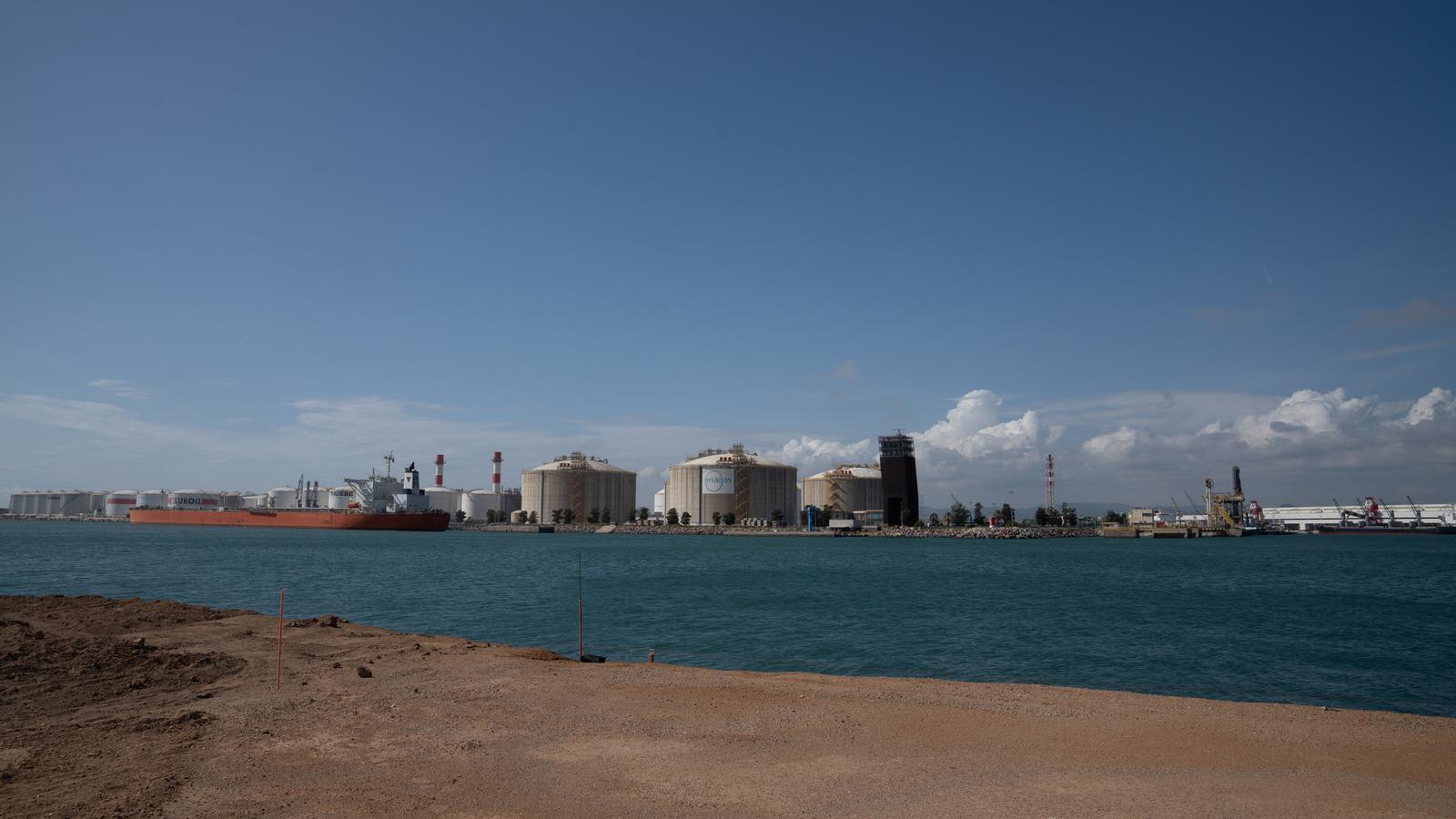
MadridThe global map of liquefied natural gas (LNG), as well as that of raw materials, has been upside down for some time. First due to the war in Ukraine and the fact that Europe turned off the tap for this fuel from Russia. Now, the war in Iran has been added to this following the attack by the United States and Israel and the subsequent blockade of the Strait of Hormuz –through which between a quarter and a fifth of the world's crude oil and natural gas circulated–, as well as an escalation of tension in the Red Sea. The context has forced many countries to look for gas under rocks –metaphorically and literally– and to chart unimaginable, or at least unusual, maritime routes, to the point that during the first eight months of 2026 (between January and August) the port of Barcelona has seen 7,439 tons of LNG loaded from the regasification plant tanks bound for Thailand. Specifically to the port of Bangkok, according to data on LNG shipments, to which ARA has had access.

- If you want to investigate the chart in more detail, open the high-resolution version in another tab.
LNG is natural gas that is cooled to extremely low temperatures until it turns into a liquid state so it can be transported and stored until its use. It is regasified (turned back into a gaseous state) through regasification plants to introduce it into the gas network so that companies, households, and gas-fired power plants can use it. The port of Barcelona has one of the seven regasification plants in the State, and it is the one with the most capacity in terms of tanks (where LNG is stored): six in total.

A Barcelona-Thailand maritime route involves very high time and costs. "When some countries run out of energy products, they buy wherever they can, at whatever price, and that leads to expensive routes," reflects Javier Blas, energy and commodities analyst at Bloomberg. "Necessity rules," he adds. If one looks at the history of LNG exports since 2010, only one shipment has been made from the State to Thailand: 55 GWh of liquefied gas in May 2025, as shown in the reports of the Corporation of Strategic Reserves of Petroleum Products (CORES), where the port of departure is not specified.
In general, the Asian market has never looked to Europe to supply itself with this fossil fuel, but rather to the countries of the Persian Gulf (80% of the crude and gas that fueled Asia passed through Hormuz). But with the conflict in the Middle East still latent and Hormuz closed, the Old Continent is assuming a new role. In fact, this spring, Thailand's state-owned oil conglomerate (PTT International Trading) announced its first long-term LNG agreement with the Norwegian multinational Equinor, as recently reported by Reuters.
Three routes
The cargo that was loaded in Barcelona and was destined for Bangkok could choose between three routes. The most reasonable one is the one that passes through the Suez Canal. That is, the navigation route under Egyptian control that connects the Mediterranean Sea with the Red Sea. But this is the route that precisely many commercial companies have had to avoid due to the attacks by the Houthis, the Yemeni group aligned with Iran, against international maritime transport, especially in the area near the Strait of Bab el-Mandeb, between the Arabian Peninsula and Africa.
A second commercial route, a direct result of this previous scenario of tension, is the one that passes through the Cape of Good Hope, in South Africa. More than an option, it has been an obligation for the main global shipping companies. Circling the African continent means an increase in travel time between Europe and Asia and, therefore, an increase in cost. Also in emissions and, therefore, in environmental impact.
Finally, sources from the energy sector suggest that one could also opt for the Panama Canal. That is, leaving Europe, crossing the Atlantic and the Pacific and arriving at the Indian Ocean.
ARA has tried to find the exact route by asking Enagás and the Port of Barcelona for the specific month in which the shipment took place, but no response has been obtained.
As a result of these circumstances, what is paid to transport energy products from a port of origin to a port of destination on board a ship – the so-called maritime freight – has skyrocketed: "We are talking about a cost of up to 1.2 million dollars a day," says Blas. Until recently, maritime freight accounted for 4% of the total energy shipment between the cost of the product, insurance, customs, etc. Today, on some routes, it accounts for 20%.
Italy, star destination
Between January and August, a total of 115,606 tons of LNG have been loaded at the port of Barcelona (an amount that, deep down, is very small). It must be taken into account that regasification plants act as intermediate points: Spain does not produce gas. This means that the LNG arrives from one country and is unloaded, but it never leaves the plant's tanks, rather another ship loads it. That is to say, it is re-exported. The case of Thailand is an example of this.
Bangkok, however, has been a rara avis among the LNG shipments that have taken place during the first eight months of the year from the plant at the Catalan port, which is owned by Enagás, the company that manages and operates the gas system, in which the State has a 5% stake, and which makes the infrastructure available to marketers.
The star final destination is Italy, with 103,520 tons of LNG loaded and sent to different ports in the country. In fact, this route accelerated in 2022, when, following the war in Ukraine and the decrease in the supply of Russian gas to Europe, Spain, due to its LNG storage capacity, assumed a role as a supplier for the rest of the countries. It was when the arrival of LNG from the United States soared, which was then re-exported.
The list of destinations includes Gibraltar (2,862 tons), Mauritania (853 tons), Senegal (853 tons), and a small shipment to Huelva (50 tons), where there is also an LNG unloading, storage, and regasification infrastructure, according to data accessed by ARA.
Seven origins of LNG
In this way, if Spain plays a role as a transit point for LNG that goes elsewhere, it means the origin stamp is different. Between January and August, 1,651,051 tons of liquefied natural gas (equivalent to about 23,853 GW/h) have been unloaded at the port of Barcelona. That is to say, many more than those that have been loaded. ARA has also had access to the data available so far, and the discharges at the Catalan port have reached 25,882 GW/h. The countries of origin for the LNG are seven: Algeria, Cameroon, the United States, Russia, Equatorial Guinea, Mauritania, and Nigeria.
Regarding the origin, by volume of discharges there is only data at a national scale (those made at the seven regasification plants). In the first eight months of this 2026, Spain has received gas from Algeria (34.8% of the total), the United States (28.7%), Russia (17%), Nigeria (8%), and in smaller quantities from other countries, as reflected in the latest Enagás gas bulletin.
What is happening with Russia?
Although Algeria and the USA continue to be the star suppliers, Russia is not falling behind. In fact, in the month of June –five years after the start of the war in Ukraine– more gas was imported from Russia (21.1%) than from the North American country (12%), according to data from the Enagás bulletin. "Spain has become a very important intermediate point for Russian gas," indicates Blas. If the data available at CORES (up to the month of July) are compared, imports of Russian gas this 2026 have grown by 39% compared to 2026.
One of the main reasons, the expert reflects, is that Russia is doing everything possible to keep its LNG carriers free for as long as possible, especially because some are essential for breaking through the ice layers encountered while heading to its deposits in the Arctic, from where it produces LNG. "If the ship goes from northern Russia to Europe, it can be sailing for two weeks. If it goes from northern Russia to Asia, it would be occupied for two months," the analyst explains. Also because once it leaves its gas in a port and another ship loads it, the Russian footprint is diluted.
At a time when the Russian economy is struggling, especially due to sanctions since the large-scale attack on Ukraine, speeding up this trade means income for the Kremlin. In fact, sources in the energy sector consulted by ARA point out that the gradual ban on Russian gas imports that Europe intends to implement from 2027 has also led traders of gas to increase purchases: they buy and sell in the short term, sometimes at very low prices that then skyrocket, and they end up making and breaking contracts in a matter of hours, even on the high seas. At the same time, it is becoming a key player in replacing that gas that came from places like Qatar or other suppliers affected by the conflict in the Middle East.
Own consumption
But if the volume of loads and unloads is compared, it becomes evident that much of the gas that has arrived at the port of Barcelona –this also happens in the rest of the cases– stays in the State. Here, different factors come into play.
First, the need to fill the own underground gas storage facilities to face the winter. In Spain they are at 73.49% and in Europe as a whole at 70.3%, according to data from this Friday from the GIE-AGSI registry. The goal set by the Old Continent was to reach 90% by November, although there is flexibility.
Also due to the fact that Europe learned the lesson of 2022 and some countries –Italy, France, and Germany– have rushed to install regasification plants, many of them floating. "Spain was an LNG hub, and now it no longer is," asserts a source from the energy sector. Furthermore, current prices do not help with gas exports either, and many retailers prefer to wait. Meanwhile, the gas is kept in the State and is used for its own use. More large ships in the port
The accumulation of circumstances over these five years in which the raw materials market, and in particular gas, has been altered is one of the reasons that explain why ports like Barcelona's have seen an increase in the number of ships, some of them very large, anchoring off their coast.But it is not just about ships loading LNG. Sources from the Port of Barcelona explain that it must be taken into account that unlike container cargo ships, where routes are much more defined, ships transporting liquid bulk (for example, varieties of energy products) can vary their routes more depending on supply and demand. Here, traders play a key role. Added to this is the fact that the Energy quay has a limited number of berthing points, which are expected to be expanded in the coming years.How it will all end is still uncertain and depends, first and foremost, on the evolution of the wars. "Until the [Strait of] Hormuz is fully opened, countries like Japan will continue to look to the other side of the map [to the United States] to obtain oil, for example. This makes no economic or geographic sense," concludes the Bloomberg analyst.
