The Strait of Hormuz, the decisive battle
Iran wants to maintain control of the strategic pass that has allowed it to compensate for its military inferiority
-
CAT -
CAST
London / BarcelonaThe dam of cross-attacks between the United States and Iran this week has left the ceasefire signed on June 15 not dead, but with assisted breathing. At the center of the resumption of hostilities is, once again, the strategic Strait of Hormuz, the key passage for gas and oil and other strategic goods that Iran has brought under its control. A weapon of mass economic destruction that has served it, so far, to survive an attack that surpassed it militarily.
Iran has controlled the strait with a military architecture of radars and missile launchers in various rings, fast boats, and submarine mines, and has begun to negotiate with Oman, with whom it shares the strait, a system to collect a kind of toll. In fact, this Saturday, Tehran's Foreign Minister, Abbas Araghchi, traveled to the sultanate to try to find a way out of the current waiting game between attacks. The key is that Tehran wants to decide which ships circulate through this passage, on which its neighbors depend in large part to supply half the planet with gas and oil. And neither the Gulf countries nor the United States are willing to allow it.
The latest escalation began when Iran fired on three ships it accused of crossing the strait without its permission. The United States they responded with a wave of bombings, first against coastal cities and Tuesday morning with attacks also on Tehran. Iran counterattacked with missiles and drones against several neighboring countries. All this while the funerals of the supreme leader, Ayatollah Ali Khamenei, were being held, died on February 28, on the first day of the joint United States and Israel war against the Persian empire. Trump has declared the truce over, but negotiations continue.
Little more than wet paper?
The text of the ceasefire, the 14-point memorandum of understanding, was drafted to satisfy both sides, giving them time to negotiate the thorniest issues: in principle, 60 days. And what is happening is that now each side interprets it according to its interests. For the United States, commercial ships must freely circulate through Hormuz again, as before the war. Iran, on the other hand, wants only ships that it permits to pass through. Tehran does not want to give up its most prized weapon, and as voices within the regime opposing any concessions to the United States grow, the strait has become a test of the ceasefire's credibility.
Before the joint attack by the United States and Israel against Iran, about 20 million barrels of gas and oil (20% of total global consumption) circulated through the strait daily, transported by just over a hundred and thirty ships. With a few attacks on some vessels, Iran managed to get most shipping companies to stop transit for fear of suffering damage that insurers would not cover. The United States and Israel could not destroy Iran's military capabilities to maintain control of the strait, Washington attempted a naval blockade of Iranian ships which also did not serve to bend Tehran, and global economic weariness finally forced Donald Trump to accept the truce.
How many ships have crossed Hormuz?
But the ceasefire did not lead, as Trump promised, to "oil flowing again on both sides of the region and the world." AIS data – automatic identification systems for ships – collected by firms likeLSEG Shipping andKpler show that, in the first 72 hours after the June 15 agreement, only one ship – the Indian gas carrier Disha, as confirmed by Reuters – dared to sail the waters of the strait. In the following days, the flow increased timidly, but always in volumes much lower than usual before the war. According to Kpler, between June 15 and 22, only a dozen or so movements were detected, mostly Iranian oil tankers attempting to resume sporadic exports after the end of the US blockade. The rest of the international traffic remained stopped in Gulf ports or anchored in waiting areas.

- If you want to investigate the graph in more detail, open the high-resolution version in another tab.
For the most recent data, there are variable estimates, depending on the sources. Kpler andOil Brokerage place the figure between 155 and 215 ships immobilized in the Gulf, and predict that there are between 2,500 and 4,000 sailors on board, waiting for instructions that do not arrive. The International Maritime Organization speaks of 6,000 sailors trapped. And on Friday, the number of ships that sailed through the strait was less than 20.
The new Iranian route
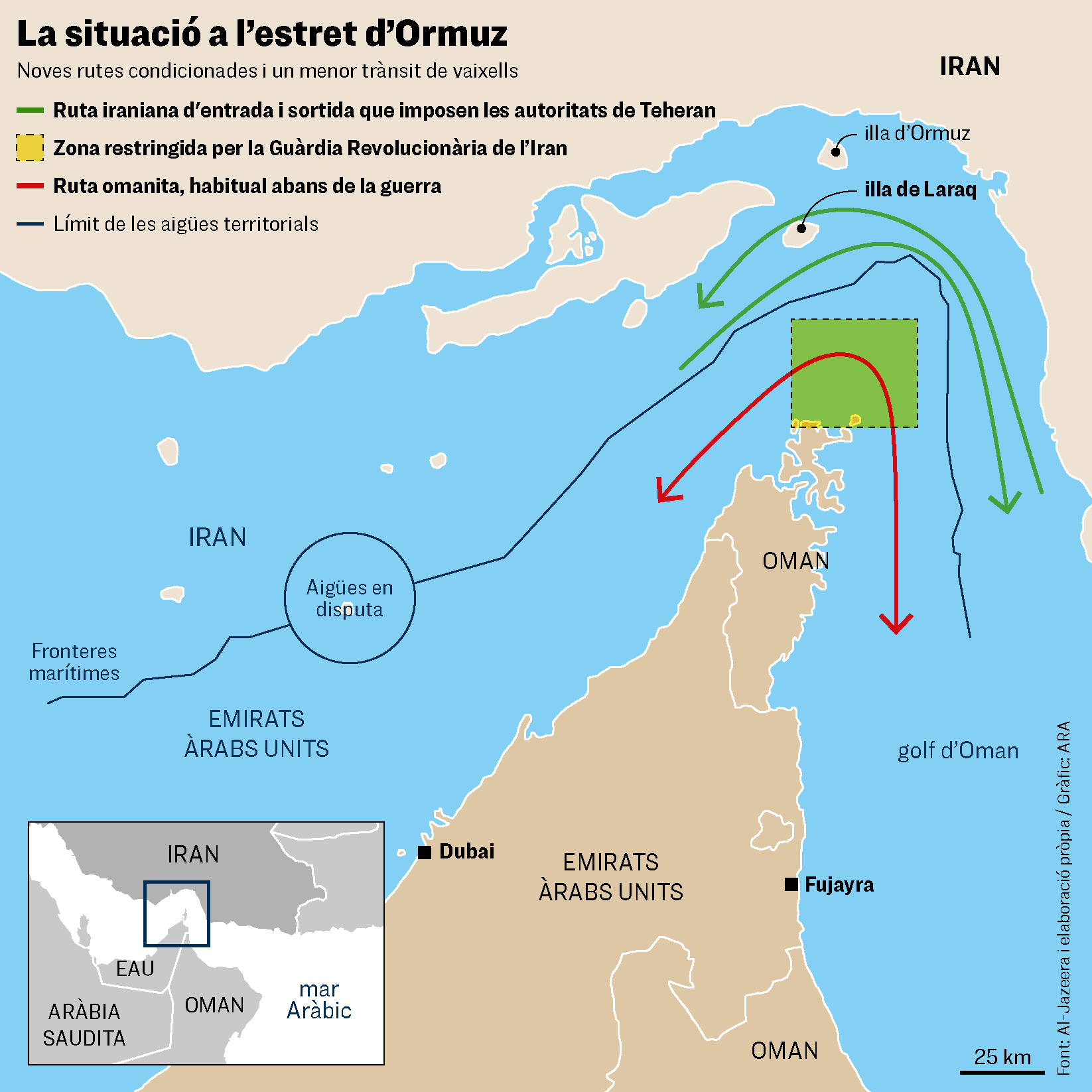
The few ships that travel through Hormuz avoid the traditional route, in the center of the strait, for fear of mines that Iran is believed to have laid. They pass through two corridors, one to the north, near the Iranian coast, and the other to the south, closer to Oman. Iran's Revolutionary Guard insists that ships must pass through the corridors designated by Tehran, and threatens ships that do not obey. After the latest attacks, traffic through the Omani route has stopped completely: no ship has used it.

- If you want to investigate the graph in more detail, open the high-resolution version in another tab.
All of this has direct consequences on the price of crude oil, as has been seen this very week. Oil and liquefied natural gas (LNG) flows have also fallen between 95% and 99% compared to pre-war levels. This is not only a direct impact of the maritime blockade, but also of the fact that many export facilities have been rendered partially unusable by bombings and sabotage.
An unprecedented crisis
Terminals such as Bandar Abbas (southern coast of Iran) or Ras al-Khair (Saudi Arabia) or some points on the Emirati coast have suffered structural damage that prevents normal operation. Even if the strait were completely safe, the export capacity of the Gulf would take weeks or months to recover. "The provisional peace agreement between the United States and Iran has opened the door to the resumption of oil and gas transit through the Strait of Hormuz. However, it is unknown at what point these flows will recover to pre-closure volumes and patterns, or even if they will recover them. Beyond the fragility of the ceasefire, there is no precedent that allows us to anticipate how an alteration of the market of this magnitude can be normalized: an interruption of supply exceeding 10 million barrels per day of oil and about 300 million cubic meters per day of liquefied natural gas (LNG) for more than a hundred days," states Clara Gillispie, an expert in energy security strategies at the Council on Foreign Relations.
A minefield
The strait, a true bottleneck of the world, is not at all safe for other reasons. According to sources consulted byAl-Monitor, a reference website for the geopolitics of the Middle East, andJane’s Defence Weekly, a British publication also a reference for military information, the area continues to be sown with naval mines of various types. During the conflict, both Iran and paramilitary actors linked to the Iranian Revolutionary Guard, Iraqi Shiite militias, and the Houthis would have contributed to the massive mining of Hormuz.
The devices deployed would be classic contact mines – similar to those used in the Iran-Iraq war of the eighties – and influence mines, which are activated by changes in the magnetic, acoustic, or pressure field. The latter are particularly problematic, as they can remain active for months and are difficult to detect with conventional sonar. Furthermore, there are indications that bottom mines have been used, designed to remain on the seabed and activate only in the presence of large ships, such as VLCCs (very large oil tankers). The combination of all these systems makes the strait a highly dangerous area, even in the absence of combat.
Demining Hormuz is not a quick operation. The navies that have participated in similar operations – those of the United States, the British Royal Navy, or the French Navy – recall that, in the 1991 Gulf War, these types of operations in Kuwaiti waters required weeks of continuous work, in an area much smaller and less frequented than Hormuz.
In the current case, experts estimate that it would take between four and eight weeks to guarantee a minimum safe corridor, provided there is international cooperation and the mines are not of a new generation. The process involves the use of underwater drones, high-resolution sonars, specialized ships, and neutralization teams that often have to work manually. In addition, each detected mine requires an individual deactivation or controlled detonation operation, which multiplies the time needed to get rid of them.