Judit Carrera: "It is not incompatible to work to attract local public and tourists"
Director of the Centre of Contemporary Culture of Barcelona (CCCB)
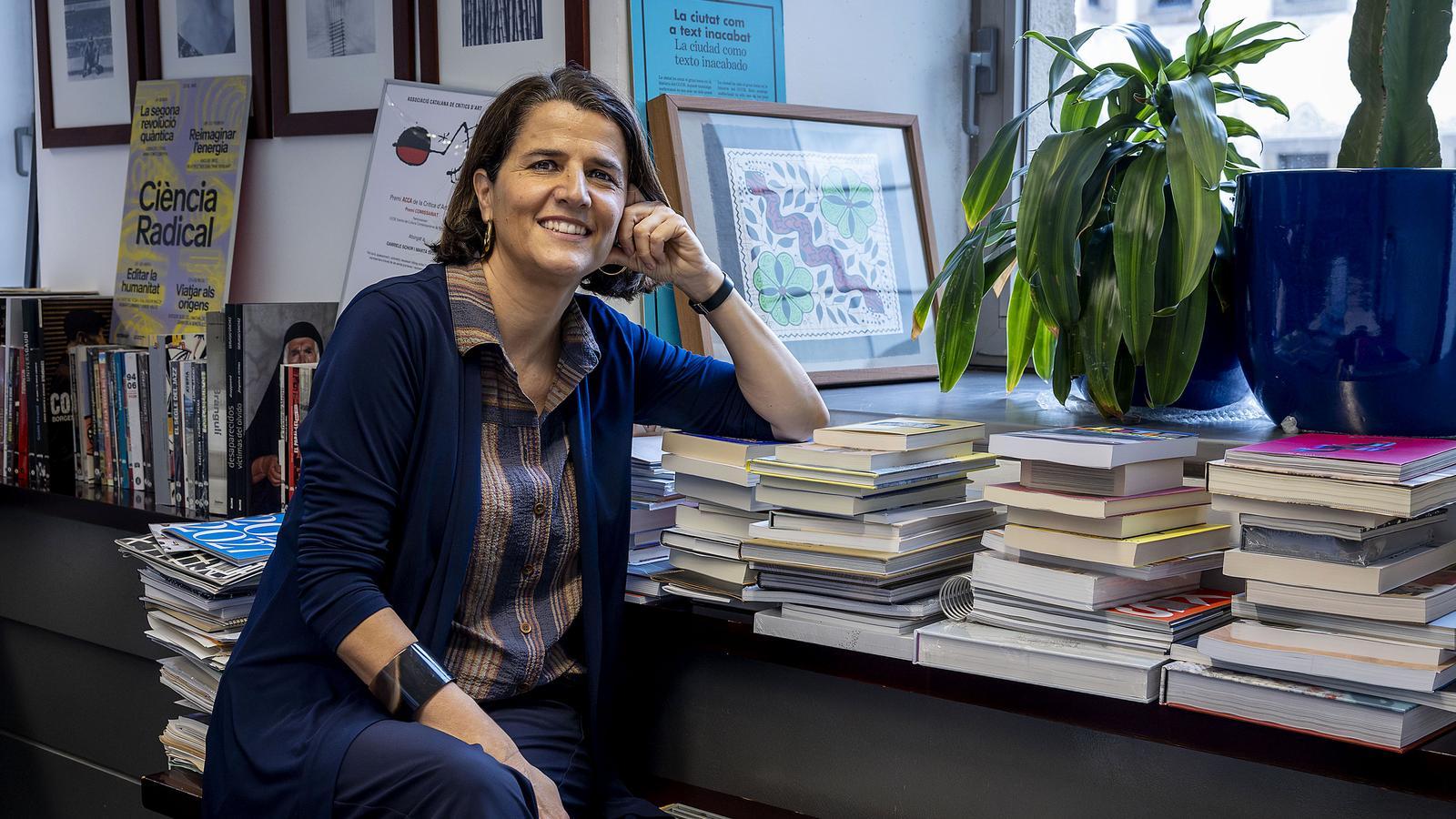

-
CAT -
CAST
BarcelonaIt is unusual for Judit Carrera, director of the Centre of Contemporary Culture of Barcelona (CCCB), to appear in the economics pages. Tourism governance and access to housing are two such huge and transversal challenges that they also impact the definition of Barcelona as a city and its cultural dynamics. From the CCCB, she has placed these issues at the center of many of its activities, from the Biennial of Thought being held these days to the Cities and tourism cycle, of which there are precisely two new activities this very week. The topic, however, also affects the very functioning of the center. Carrera, on one hand, argues that limits must be placed on tourism and, on the other, is committed to the CCCB reaching more foreign visitors. When the search for a new tourism model has become the Holy Grail, Carrera elevates culture as a vector for change.
While Catalonia receives more foreign tourists than ever, tourism by Catalans within the territory is at an all-time low, just as we published in ARA in mid-summer. Is avoiding this shift from happening also in the cultural sphere a challenge that is currently on the table, or is the possibility still light-years away?
— The CCCB has a certain singularity within the Barcelona and Catalan cultural ecosystem because almost 85% of our audience is local. We have a very loyal audience that returns to the CCCB often. At the same time, we see that we do not have enough international audience and that there is room for growth. We would very much like to attract more international visitors genuinely interested in the culture produced in Catalonia. We will never reject the international tourist because, the more people who come, the better.
Tourism puts local culture at risk –the brunch is the paradigmatic example– or is it internationalization?
— Tourism is one more factor of the globalizing forces that tend to harm minority cultures. Therefore, it is the task of cultural officials to ensure that our themes, language, and tradition are very actively part of our cultural programming. It is what we did with the Mercè Rodoreda exhibition, for example. I believe we are doing it.
Which is the model to avoid?
— In Barcelona we have a cultural singularity that makes us unique in the world. On the other side, there is the temptation of franchises, immersive models, and an entire cultural proposal that wants to jump on the bandwagon of a homogenizing globalization. This is the mistake, because you will never be able to compete with Instagram or with the immersive glasses you can see from home. What Barcelona must do in the cultural sphere is to aim to be a model, and not a copy of something else happening in the world.
Is it possible to work and program exhibitions with both the local public and the visitor in mind?
— Our main objective is to offer a good cultural program to the citizens of Catalonia, but we start from the hypothesis that it is not incompatible to do this while attracting an international audience. We can create a cultural program that is simultaneously interesting for both: a proposal that is deeply rooted in your context and, at the same time, has a vocation of a certain universality. We would also very much like to have more audience from other parts of Catalonia. Infrastructure difficulties in recent times make it hard to come to Barcelona for cultural tourism.
Beyond the approach of the CCCB, the museum is located in the heart of a city that is currently debating whether coexistence between local life and tourism is possible.
— I think there is a certain consensus that all limits have been crossed and that now the challenge is how to manage it. We are talking about 29 million tourists a year in a city of 1.8 million.
Does culture have any role in this discussion?
— Culture can contribute to better managing tourism in Barcelona, because it has the potential to define it internationally and change the tourism model. The tandem of culture, on one hand, and research centers, on the other, is extremely powerful for projecting a profile of Barcelona to the world that is not the Barcelona of sun and beach.

It talks about projecting Barcelona in a context where we are discussing a lot whether we have already reached the ceiling and whether we can continue receiving more tourists.
— When I speak about projecting ourselves to the world, I am referring to defining what kind of city we want to be. I do not mean this in terms of advertising ourselves to receive more public. Barcelona, like all post-industrial cities, has a certain identity crisis. The model for Barcelona that I would like is that of a city that bets on culture and knowledge.
The tourism model is at the heart of the discussion about the sector. There is an increase in higher-end hotels (four stars or more), to the detriment of one- and two-star hotels. Is trying to change the model with tools that go beyond the economic vector a pipe dream?
— Culture is an essential factor for rethinking Barcelona's tourism model. We want to try to have people travel to Barcelona to see our exhibitions, but this implies a change in budgetary scale. Right now, we have a much lower budget than Paris, Madrid, London, Berlin... Therefore, if we want to project ourselves to the world as a cultural capital, we must have the resources.
Did you hesitate when we proposed an interview about the impact of tourism on culture?
— No, the truth is that no. [Laughs]. For a year now, we have promoted a program about the effects of tourism with public talks, seminars, and podcasts, because we believe it is one of the big topics that Barcelona has on the table. Although they have quite high attendance, it is lower than in other proposals we put forward. This surprises us, because tourism generates a lot of social debate. Perhaps everyone already has a formed opinion, and is little willing to reflect and build new positions?
