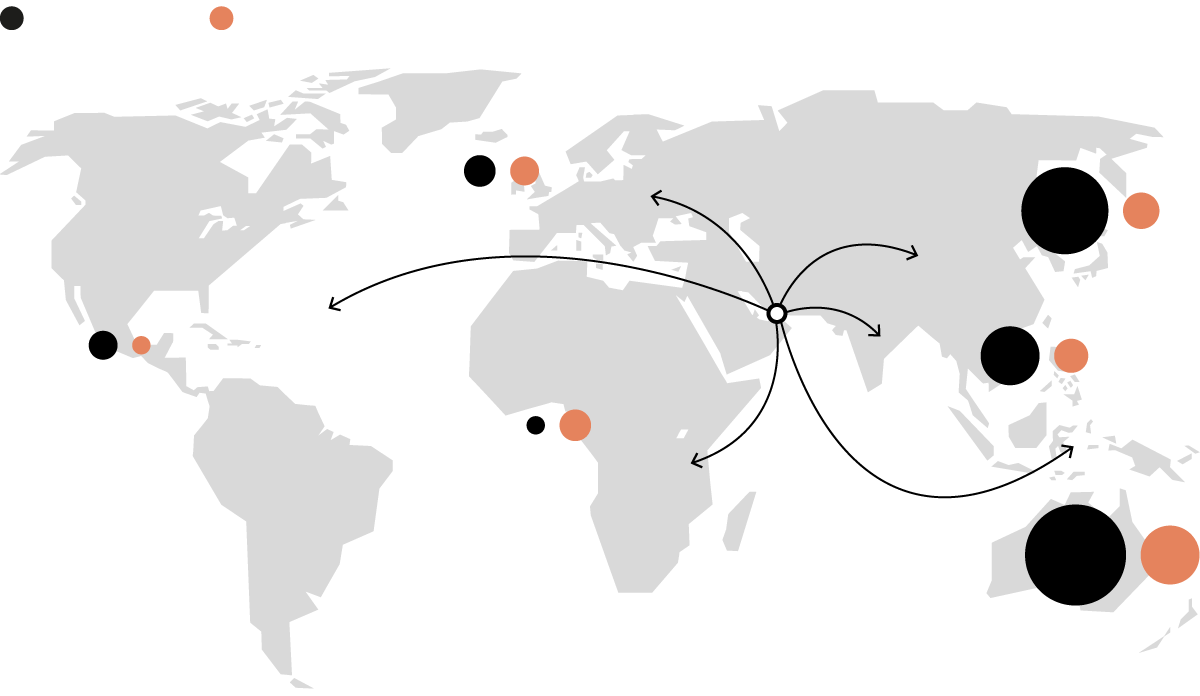
The war in the Middle East has rapidly driven up oil and natural gas prices, with one clear strategic geographic point becoming Iran's primary weapon: the Strait of Hormuz. This maritime passage carries approximately a quarter to a fifth of the world's crude oil and natural gas. Its closure by Iran, aside from disrupting global energy markets, directly impacts the region's economies, as they cannot sell the oil and gas they extract and, in some cases, have had to shut down their refineries and liquefaction plants. Furthermore, the closure of the Strait of Hormuz threatens shortages of crude oil, gas, and petroleum products in many countries, especially in the Asia-Pacific region, which are the largest buyers of products from producers on the Arabian Peninsula, as illustrated in the infographic.
Exportacions de petroli cru i derivats que transiten per l’estret d’Ormuz
Dades del 2025 per destinació en milions de barrils al dia
Agència Internacional de l’Energia / Eduard Forroll Isanda
As a result, this bottleneck to oil and gas raises the price of crude oil worldwide. In other words, the oil market is global, and if access to crude oil from the countries affected by the closure of the Strait of Hormuz—a fifth of the world's oil—is impossible, prices rise in all markets. This is due, on the one hand, to the decrease in supply, but also, on the other hand, to the fact that oil from other parts of the world, such as the United States, is...
To understand the problem, it is necessary to first situate ourselves geographically. The Strait of Hormuz is a maritime passage that separates the Arabian Peninsula from Iran and connects the Persian Gulf with the Gulf of Oman and the Arabian Sea. At its narrowest point, the strait is only 29 nautical miles (54 km) wide and has navigable channels 2 miles (3.7 km) wide for incoming and outgoing shipping, as well as a 2-mile-wide buffer zone. According to data from the International Energy Agency (IEA), an average of 20 million barrels per day (mb/d) of crude oil and petroleum products were transported through this point in 2025, making it "one of the world's most critical bottlenecks for oil shipping." Given that approximately 25% of global maritime oil trade passes through the strait and options for avoiding it are limited, any disruption to flows through the strait has serious consequences for global oil markets.
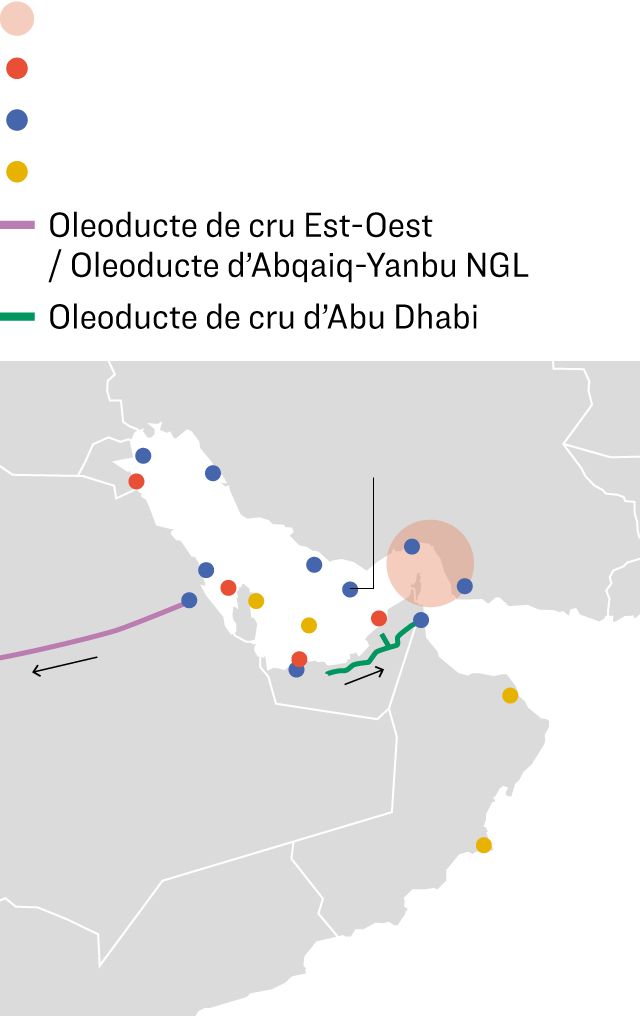
Rutes alternatives a l’estret d’ormuz
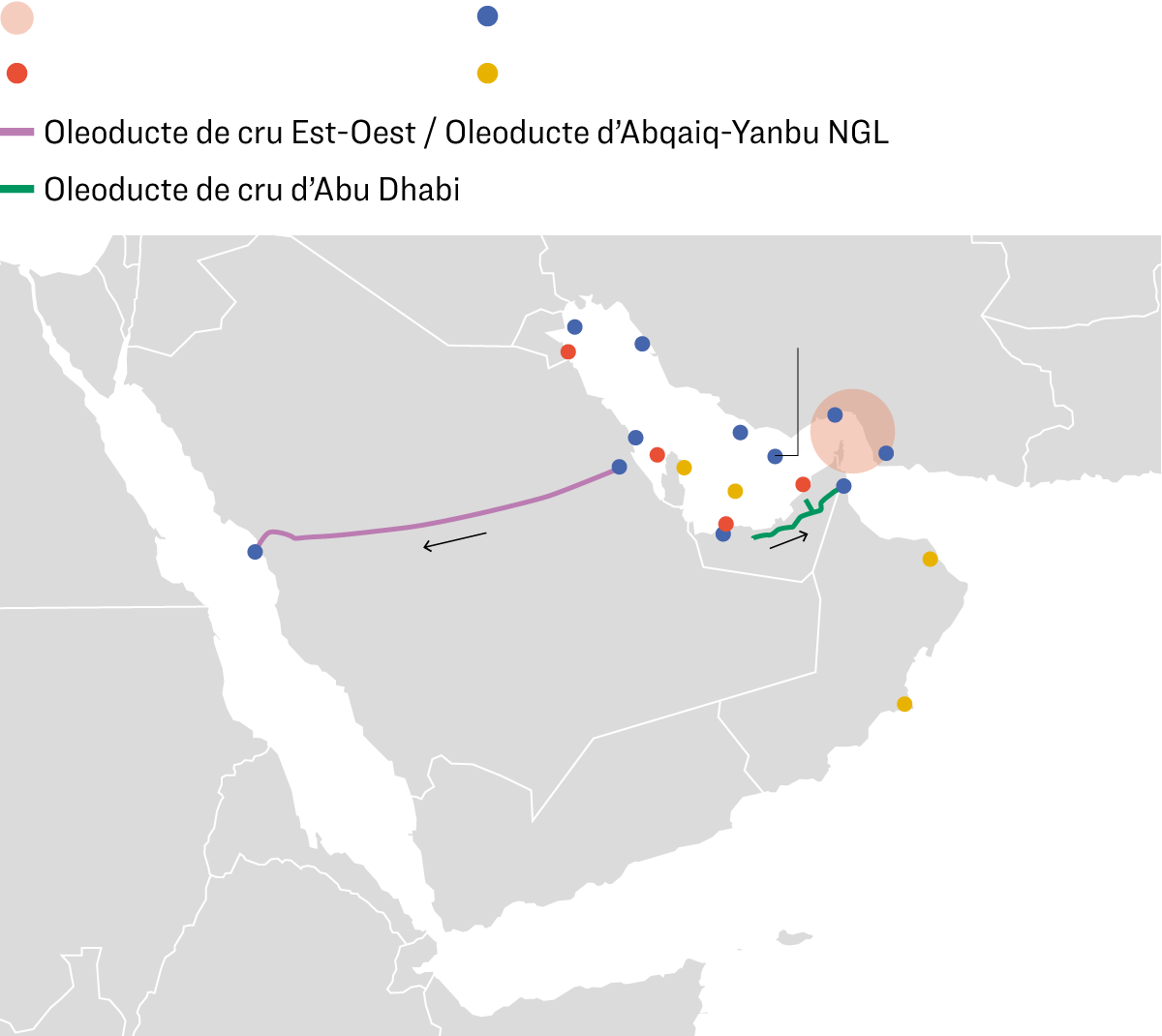
Instal·lacions petrolieres
Terminals de regasificació
Oleoducte de cru Est-Oest / Oleoducte d’Abqaiq-Yanbu NGL
Oleoducte de cru d’Abu Dhabi
Terminals de regasificació
Instal·lacions petrolieres
Oleoducte de cru Est-Oest
/ Oleoducte d’Abqaiq-Yanbu NGL
Oleoducte de cru d’Abu Dhabi
Terminals de regasificació
Instal·lacions petrolieres
Oleoducte de cru Est-Oest
/ Oleoducte d’Abqaiq-Yanbu NGL
Oleoducte de cru d’Abu Dhabi
Agència Internacional de l’Energia / Eduard Forroll Isanda
The IEA highlights that Saudi Arabia and the United Arab Emirates (UAE) have some oil export routes that do not transit the Strait of Hormuz, but the other countries in the region, including Iran, Iraq, Kuwait, Qatar, and Bahrain, depend on this strait. Furthermore, closing the strait would also have significant consequences for global gas trade, as it would strand LNG (liquefied natural gas) exports from Qatar and the UAE, which together account for almost 20% of global LNG exports.
Insufficient Alternatives
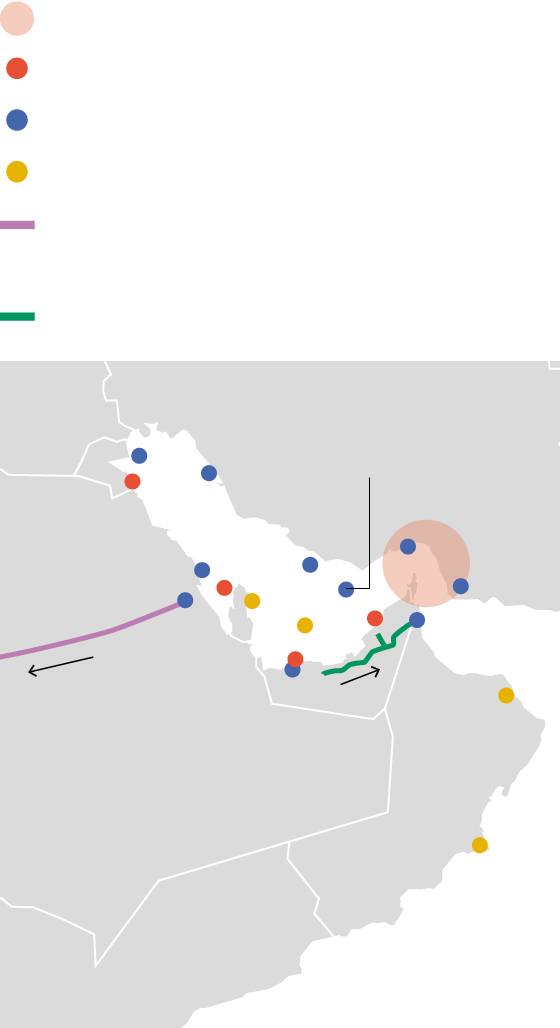
Most of the oil exports that passed through the Strait of Hormuz last year were destined for Asia. China and India, together, received 44% of these exports. Japan and South Korea are particularly dependent on these oil flows. Approximately 600 million barrels per day (mb/d) – or just 4% – of the region's crude oil flow is destined for Europe, according to the agency's data. In 2025, nearly 20 mb/d of oil was exported through the strait, but it is estimated that there is only 3.5 to 5.5 mb/d of available capacity to export crude oil from the Gulf via alternative routes, through the Arabian-Yabu pipeline., and the UAE pipeline at the port of Fujairah, the ADCOP, as can be seen on the map.
In the case of gas, there is also a natural gas liquids pipeline running parallel to the Saudi Arabian pipeline, the Abqaiq-Yanbu NGL, with a capacity of 300,000 barrels per day (kb/d), which is fully utilized.
Iran, which is now blockading the Strait of Hormuz, is well aware of its strategic value, even for exporting its own oil. In fact, the Tehran regime inaugurated the Jask oil terminal in 2021 to transport crude oil from the Goreh-Jask pipeline to Jask, in the Gulf of Oman. The pipeline has a reported capacity of 1,000 barrels per day (mb/d). However, both the pipeline and the port remain practically out of service. A test shipment was exported from Jask in late 2024, but no further oil has been exported since, and the terminal is not currently considered a viable option for exporting Iranian crude, according to the IEA. For gas, there are no alternative routes for transport from Qatar or the UAE to the global market, except for existing LNG liquefaction facilities. Qatar supplies pipeline gas to the UAE and Oman via the Dolphin pipeline (nearly 20.5 billion cubic meters in 2025). However, the pipeline has limited available capacity, and Oman's LNG export terminals reached a near 100% utilization rate in 2025. As with crude, Asian markets are the primary destination for LNG from Qatar and the UAE. In 2025, almost 90% of the total volume exported through the Strait of Hormuz was destined for the Asian market, while the proportion for Europe was just over 10%. Likewise, LNG transported through the strait represented around 27% of Asia's total LNG imports in 2025 and approximately 7% of total LNG imports into Europe during the same period, according to IEA data.
The most affected: Korea and Japan
Which countries in the world are most affected by the closure of the Strait of Hormuz? Analysts cited by Nomura warn: "In Asia, Thailand, India, South Korea, and the Philippines are the most vulnerable to an increase in oil prices due to their high dependence on imports, while Malaysia would benefit relatively because it is an energy exporter." In South Asia, the situation is critical for countries that depend almost exclusively on Qatar and the United Arab Emirates. According to Kpler, a consultancy specializing in the oil and energy sector, "Qatar and the UAE account for 99% of Pakistan's LNG imports, 72% of Bangladesh's, and 53% of India's." These nations lack storage capacity or the flexibility to seek short-term alternatives. In other words, Pakistan, Bangladesh, and, to a large extent, India could run out of gas.
Regarding oil, Japan and South Korea's dependence on the Gulf is pronounced: 75% and 70% of their imports, respectively, come from the Middle East, according to UBP (Union Bancaire Privée). In the case of LNG, the exposure is lower (14% in Korea and 6% in Japan), but scarcity is not the only risk; supply shortages could also pose a threat. Korea has stockpiled 3.5 million tons of LNG and Japan 4.4 million tons, figures that cover only two to four weeks of stable demand, according to Kpler. The direct economic impact is also reflected in external vulnerability: crude oil import costs in Korea represent 2.7% of GDP, and Nomura identified the country as among the most vulnerable in terms of current account.
China is hoarding, and India is looking to Russia
Two of the world's largest and most populous economies are among those most affected by the closure of the Strait of Hormuz: China and India. Like all economies, they are impacted by the war in the Middle East, with rising oil prices and concerns about supply security. But neither Beijing nor New Delhi has remained idle.
In the first two months of the year, before the outbreak of fighting in the Middle East crippled energy supply chains, China increased its oil purchases as part of an ongoing strategy to protect the country from escalating geopolitical tensions. China, the world's largest oil importer, imported 15.8% more oil in January and February compared to the same period last year, according to customs data released by China on Tuesday. Beijing has been building up strategic reserves over the past year, even as domestic oil consumption has continued to decline. All that stored oil is now expected to be put to use.
"Oil stockpiling has been happening for some time, and Chinese regulators were already preparing for the geopolitical tensions that could arise with the Trump administration," Cosimo Ries, an energy analyst at Trivium China, a consulting firm, told The New York Times. "It was a strategic move that, in hindsight, turned out to be quite astute."
The other Asian giant, India, has not followed the same path. It looked north and bought Russian oil, something that also did not bother the United States. The US ambassador to India, Sergio Gor, defended India's purchases of Russian oil, arguing that they maintain the stability of the global energy market. "India has been a key ally in maintaining the stability of oil prices around the world. The United States recognizes that its continued purchases of Russian oil are part of this effort," Gor wrote on social media. The diplomat insisted that it is "essential" for Washington and New Delhi to collaborate to ensure market access through the Strait of Hormuz, through which almost a quarter of the world's crude oil passes. White House spokeswoman Karoline Leavitt indicated that the temporary authorization to purchase Russian crude is a response to the current market situation. However, allowing India to buy Russian oil has its downside: the Indian private energy conglomerate Reliance Industries will build a new refinery in the port of Brownsville, Texas, designed to process US shale oil, Trump said on his Trufin Social network, with an investment of around 30 million dollars.
In fact, India—and indeed many other Asian states suffering from oil supply shortages—may now look more towards Russia, after President Donald Trump, through the US Treasury Department, announced a temporary authorization to purchase Russian oil currently in transit. In other words, Washington has issued a 30-day exemption from the sanctions that prohibit the purchase of Russian hydrocarbons as punishment for the war in Ukraine. This decision has been poorly received in Europe, where the US president's move is seen as a lifeline for Putin, as it could help stabilize Russian finances, which have been impacted by the war in Ukraine.