Marc Sarrats: Try not to be so miserable as to settle for the malice of pure survival
Comic
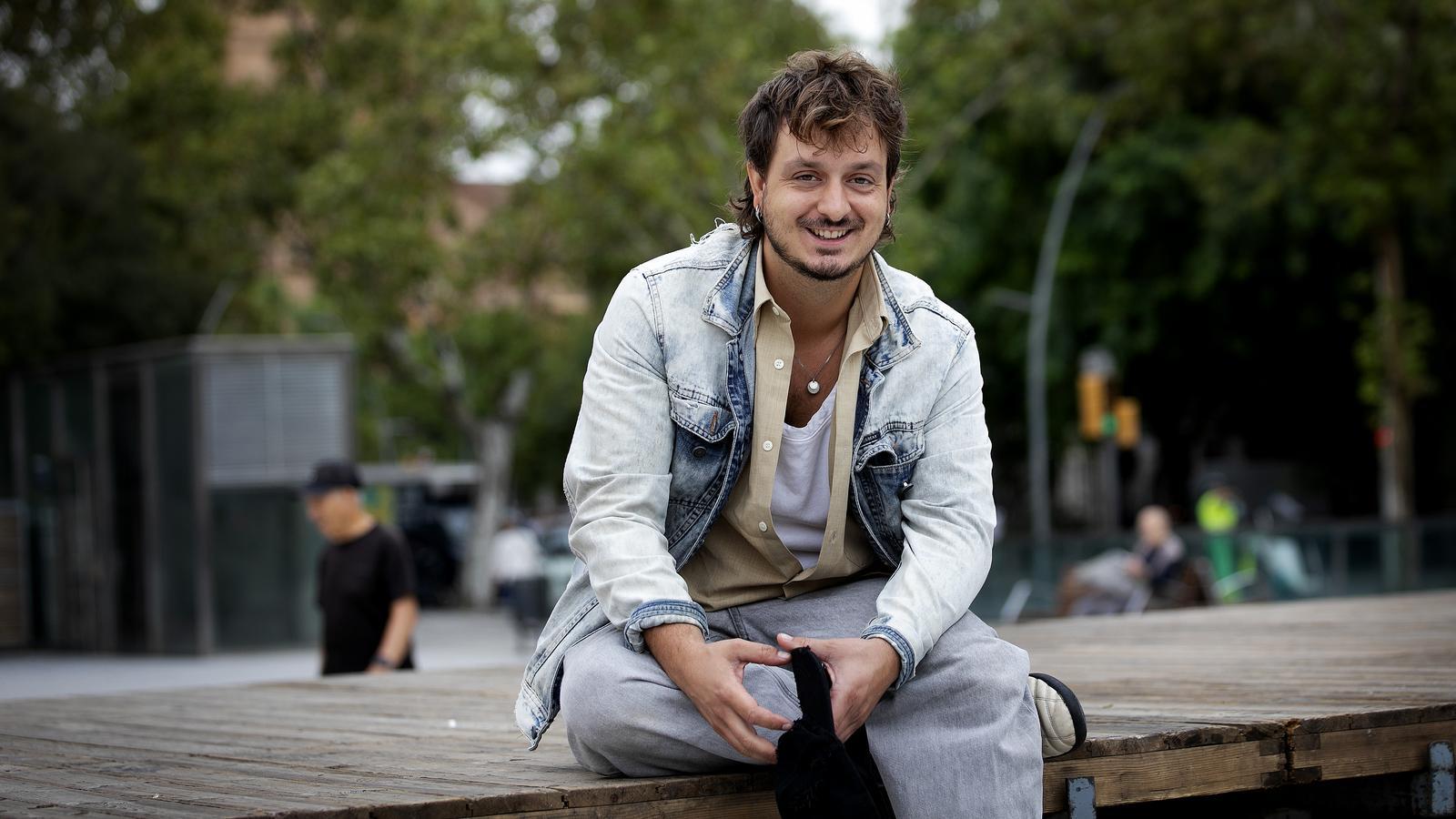

BarcelonaOn December 27th, Marc Sarrats will settle accounts with 2026 in the show El 2026, vist per sentència, at the Teatre Coliseum in Barcelona, with tickets already on sale. Taking advantage of the occasion, we talk unhurriedly about comedy, fatherhood, politics, and ghosts.
Coliseum. 1,500 seats. The curtain rises. Do you still suffer from any stage fright from time to time?
— No. Not even in some occasional gig that goes poorly: silence does not bother me.
Are you enjoying it? I imagine you savoring the discomfort...
— No, I don't enjoy it at all, but it doesn't show that I'm suffering or that I'm not enjoying it. On the few occasions where I haven't received silence but rather shouting and violence to force me off the stage... then perhaps I have looked more tense.
And when it happens, whose fault is it?
— It is usually a programming error. You are in a place, but people have not come to see you and you have to be eaten. Of course, then depending on which approaches... they don't buy them from you.
What are the topics that cause the most headaches?
— If people haven't come to see you, the worst thing you can do is mess with them... and that is what I have done a few times. [Smiles.] Even if it seems to you like an exercise in closeness or even affection towards them, they find it hard to understand that you see those slights as a gift. The gift, of course, is a piece of crap wrapped in a bow.
You have been in the Catalan comic scene for a few years now, having been present in the media, radios, televisions... Shouldn't the public already be spoiled?
— We move faster than these approaches can reach their destinations. That is why the one that continues to work best is the lighthearted observational comedy, which takes few risks. Most people still go to see a comedy show to have a good time without any pretension of reflection or challenging their principles.
Are you frustrated by seeing the dominance of those who say "Have you noticed that at airports..."?
— It is a frustration at the beginning, because you tend to feel like the center of the universe and you believe that everyone should understand you just because you exist. It is an arrogance that with time you abandon and you learn to find who your audience is. You want to reach as many people as possible... until you start to see what the maximum amount of people is like! Then you start leaving sectors of people behind: if you decide to make a living from it, go ahead. In the end, if to reach everyone I were to dilute the discourse I would be betraying myself. And that would indeed generate frustration for me.
Do you have a work discipline?
— With a two-year-old child, it is complicated to maintain discipline without leaving them in a daycare center, but I try to dedicate a few hours and spaces to it every day, as if it were what it is: a normal job. Of course, it doesn't always work out, because you have to have a very clear mind for a stream of thought to flow and take you where you want to go.
Where do you feel the greatest satisfaction as a comedian?
— Up on the stage. Before performing there are some nerves that never leave you. And listen, the day they are not there we quit, because it means you are not taking it seriously.
And when are you coming down?
— Since I am very energetic, I move a lot and I am aggressive on stage, then there is an energy crash that makes me even remember with nostalgia when I was up there, minutes ago. Until recently, I combined this work with consistent alcoholic consumption, to emphasize the sensations. Now I have really noticed the change from going up on stage with three beers in my system to going up with zero, because at the beginning you use it to get rid of your fear, but afterwards, for a chemical reason, the crash is much stronger. And it is much more satisfying to do it with full awareness and faculties.
Is it true or a cliché that a comedian feels the audience's energy?
— For me it is quite real, but I would not know how to elucidate which scientific principle it obeys or how it works. We end up becoming channels for an energy that is in the room: you notice it and you can decipher it as soon as the comic that goes before you comes out.
And when do you notice that it will be a difficult audience?
— Out of a touch of vanity and another of playfulness because I know I control the situation, I like to build tension and then shatter his expectations. Anthony Jeselnik used to say that the goal of a comedian is not to be able to say whatever they want to say, but to say it and get away with it. It is not enough to say it and then cry because people got angry: if that happens, it is because you did not do what you were supposed to do well.
Has fatherhood changed your comedy?
— I don't think so. Let's see, it must have changed me in some sense because it is the most transformative experience there can be. I haven't done ayahuasca and maybe one day I will and I'll say: “Oh, no, that thing about the kid was nonsense, this is what's important!” [Laughs.] Therefore, obviously my subjects have changed, but not the tone. One might think that having a child erases cynicism, but what I see, in fact, is that parenthood is a constant performativity and you have to supervise all the time whether you believe it or not. What trajectory of yours you sell to your child. Whether you should say swear words or not, which I think yes because they are part of the language and I love them...

Your comedy paints a bleak and almost nihilistic picture. Nevertheless, you decided to bring one child into the world and are expecting another in November.
— We humans function on different levels. Some would label it as a lack of consistency, but I don't think so: the reflections I make are one thing, and the commitment I, on a humanistic level, can have to the world and the future of things is another. And having a child opens a window of opportunity for there to be someone who can do them differently.
Is it a political gesture?
— Both on a human and political level, each of us is a person throwing branches into a bonfire. Perhaps we do not know what we are to use it for, perhaps it is not yet ready to burn everything. But I do know that giving up on throwing the branches is a surrender in which I do not want to participate. For me, having children is a political act. And it is transformative that there are people who can reach where you have not reached.
This might be a bit too directive...
— I am not talking about projecting onto them, nor forcing them to be or do anything, but rather collectively giving a window of opportunity to a new generation to reach places where we, due to material difficulties or time, have not been able to reach.
To you who are an anti-fascist, if your child ends up voting for Aliança Catalana...
— The photo in a boarding school! [Laughs.] No, of course: we would get very angry, you know. It's a bastard of a dilemma, huh? But look, we will have many arguments at home if he turns out to be from Aliança, but unfortunately love is stronger than all that.
Regrettably?
— Yes, of course. Sadly, I continue to love people with political opinions that are at the antipodes not just of mine, but at the antipodes of progress. But, sadly, love is a force that binds you to people. And hence also its good and transformative part. Perhaps with political arguments I cannot convince someone in my family to stop doing what they do. But with feelings and by influencing that bond, perhaps I am capable of transforming them.
The polls predict a wide victory for PP and Vox. Is this good for comedy?
— Everything is good for comedy. We could fall into the error of thinking that the worse things go, the better comedy goes. I do not believe that is the case. The worse things go... the worse things go! And comedy ends up making its way. And if PP and Vox win, there will be differences, of course. But it is also regrettable that the Spanish left is personified by the Socialist Party. Therefore, from my ideological position, whoever wins, we lose. I will always feel like a loser within the Spanish political ecosystem.
And in Catalonia?
— The only difference is that maybe they will kick me off TV, it depends on who wins. But we will do something else. And they will never be able to kick us out of the theater.
Oh, never say...
— And if they don't let us perform in the theater, we will perform in social leftist centers, whether they are pro-independence or not. We will find spaces because, I insist, we are throwing twigs into a bonfire. It also happens that many times economic interests come before whoever is governing. If a theater programmer is interested in having you because they know they can make money, they won't care who you are voting for. It has happened to me, working at Grup Godó, saying things that are at the other extreme of the ownership's ideology. But the thing is, when the real ideology is the corporate one, it's about money... you realize it doesn't matter what you say. We are all working to feed this wheel, all of us.
Meager comfort!
— In the end, capitalism is so powerful that politics has relative importance. What has Sílvia Oriols done in Ripoll and elsewhere? Shut down four social centers and fill her mouth with xenophobic discourse. But, for practical purposes, she hasn't done much either. And she has continued to take down the 'estelada' flag from the Town Hall and bow her head, because there are much more powerful forces. No matter who governs, comedy is a tool to combat the fear with which they hold us down. And the more fear they put upon us, the stronger the comedy must become.
Politics and fear go hand in hand, today.
— There is no party, not a single one, neither on the right nor on the left, that is making a speech against fear and in favor of construction or proposing a better horizon for the collective.
From zero to ten, how much fear do you have?
— No, I am not afraid. I am reckless, I always have been. And many people will think it is because I have a position of privilege. No: when I did not have it, I did not feel fear either. I gave up fear a long time ago.
Is there a specific moment when you shake off this structural fear?
— Look, I used to be very afraid of ghosts, death, and presences. My family has always been surrounded by esoteric themes, and once, in ninth grade, a girl brought a cassette of EVP recordings. I listened to it and said: "Okay, I will never sleep again." I was already quite old: fifteen years old. And it was a really shitty week without sleep until I said: "This cannot be." I asked the colleague for the cassette and I played it over and over again and a thousand more times until I managed to ridicule within myself that which was scaring me.
The ghosts that may come are now more corporeal.
— Obviously this is a one-off anecdote, but it was indeed the day I said: “That’s it, man. Let’s face it, and we might lose”. There is a high chance that those of us with a certain ideology will lose. But there is no shame in losing. Nor any honor, either? But fear is how they win against us. And it is what makes Europe and the whole world be the way they are right now, because they have managed to make people only care about the supermarket queue.
What do you mean?
— They have stripped civilization of any sense of belonging and community. When you eliminate the community and only the individual remains, it is a highly fertile breeding ground for fear to be instilled in you. And with this, they have us, both left and right, I insist.
The media is supposed to work in favor of articulating communities.
— Not only have they not succeeded, but I believe they also have a great responsibility in increasing this fear to achieve the necessary visits that allow them to thrive. Because the media also has fear, of course: fear of disappearing. That is when sensationalism grows, a certain way of explaining certain events... and when we start talking about Aliança Catalana long before it exists. It is not a unique responsibility, of course.
Social networks are in the equation, of course.
— The thing is that the far-right are machines at using social media, because they lack the moral conscience that certain things cannot be done. There was a very demagogic but illustrative photo. It showed a demonstration and it said: “This is what a left-wing struggle looks like”. Below it, there was a mobile phone farm and the text: “And this is what a right-wing struggle looks like”.
Should the left do the same, then?
— This is what I do not know how to answer. If the people who see a bright horizon for the collective in the future renounce certain moral precepts just to win the battle, they lose an important part of their identity. But if they do not do so, the situation is what it is. The left should find other ways to do it, but they are more difficult. And everyone is very tired.
When I interviewed you three years ago I asked you if you voted. You told me yes, but that you had imposed a discipline on yourself not to vote during five elections, as a purge. November 29th is the fifth since then. Will you continue not to vote, then?
— The thing is, I have a problem with democracy, and I will tell you that clearly. The emotional blackmail we have been subjected to our whole lives, saying that many people died so that we could vote... I no longer believe it. People did not die specifically to be able to vote, but to be able to draw an exciting horizon for the collective. If they voted for democracy, it was because it represented certain values, not for democracy per se, which is a tool. A tool, nowadays, absolutely corrupted and at the service of the interests of people who are not democratic.
Therefore, is it better to live on the margins?
— Regardless of whether one participates in it or not, one must be aware that democracy is a scam. My duty is not just to vote and that's it. It is to fight for the horizon. Voting is not about casting a ballot and then having three apartments on the seafront or destroying ecosystems, or complaining because a gender transition surgery is funded by Social Security but they don't trim the calluses on your feet, no.
In any case, will you vote?
— I don't know. I have no desire to, like many people. The thing is, I don't want to vote, I don't want to participate in this. But I also don't want to make a big deal out of not participating. Once, I was complaining to a colleague I care about very much that there wasn't any party that represented me, and he said to me: “But who do you think you are to have someone represent you?” And it's true, who am I for a party to fit me like a glove. Many doubts, Àlex, many doubts all the time. But this is the engine.
This vision of yours, some will call it utopian. Or naive.
— One thing that infuriates me is the very strong criticism of 'bonisme' (do-goodism). Listen, is 'bonisme' imposing upon myself a certain degree of naivety to think that a better future is possible? Because if 'bonisme' is that, what exactly is the problem? Wouldn't it be 'malisme', or 'dolentisme', or whatever the semantically opposite word should be called, which entails shrinking your world to the point where you have to be a cornered rat that sees everything as a threat and makes you react viscerally against others? Well, I'll stick with 'bonisme'!
The far-right has been very skillful with semantics and the appropriation of the concept of freedom.
— They manage to distort reality with a discourse of fear that ends up sinking in with many people who feel lonely and disconnected. That is why the left must bet on the communal, on the collective.
And why doesn't it do it?
— Because, knowing that it has the arguments, it is plagued by very large egos.
Oh, the famous moral superiority of the left, huh?
— Yes, of course. Obviously moral superiority. Life is shit. And it is for everyone, but for some more than others. I myself would prefer the shit of some others. But I do feel morally superior to someone who wants to lock up all migrants in those return centers. In the same way that someone who has decided not to feed themselves based on animal exploitation seems morally superior to me, because I don't do it. Of course, if that person then sets fire to an I4 classroom... the balance surely evens out! [Laughs.] Moral superiority? Try not to be so miserable as to settle for the malice of pure survival.
