The new global race to control maritime routes
80% of everything that surrounds us travels in some of the 112,500 merchant ships that underpin the world economy

-
CAT -
CAST
Barcelona / Badalona / El Garraf"If sea transport stopped, half the population would die of hunger and the other half of cold." This is stated by Germán de Melo, president of the Spanish Merchant Navy Officers' Association. If we look around us, more than 80% of the things that surround us have traveled by ship across the oceans that cover 70% of our planet. "In reality, we should call Earth planet Sea," states merchant captain Francesc Lleal. The sea is still largely unknown, indispensable for the global economy to function.
Worldwide, there are currently nearly 65,000 ships transporting goods. The rest of the fleet, to complete the total of 112,500 vessels, are in port loading and unloading or in a dock undergoing maintenance. If all the cargo of these ships were placed inside shipping containers and laid out end to end, they would occupy the area of Maresme, Barcelonès, Baix Llobregat, Garraf, Alt Penedès, and Vallès Occidental combined.
"It is the most efficient, safe, and environmentally friendly means of transport that exists for the volume of goods," concludes Víctor Jiménez, president of the council of the International Maritime Organization. Raw materials and manufactured products move across the oceans. The large volume is transported by sea – for now, by ships – while "higher value" and "luxury" goods are transported by air, clarifies UPC professor Francesc Xavier Martínez. This means that, while 80% of things travel by sea, when we talk about value, the percentage drops to 50%.

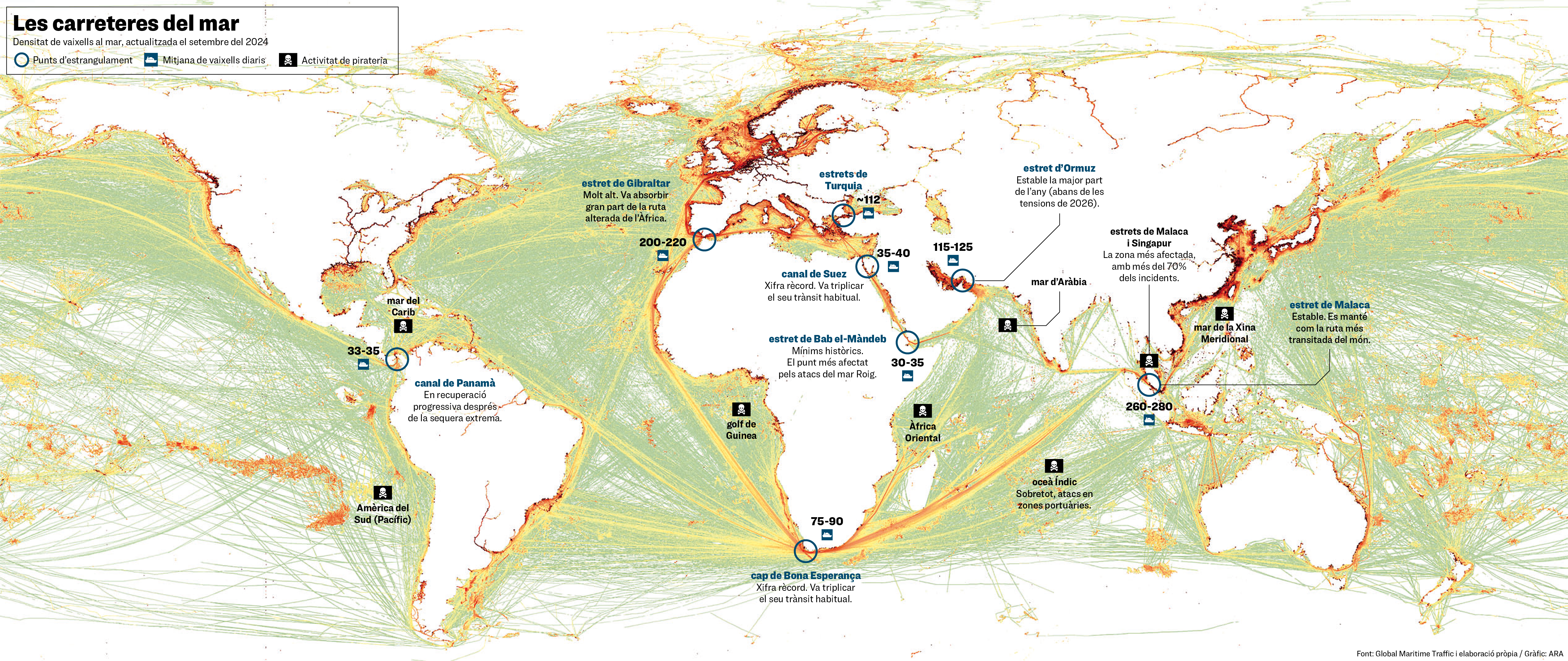
- If you want to investigate the chart in more detail, open the high-resolution version in another tab.
Oceans are an immense mantle with millions of moving points. There are three main types of cargo ships: container ships – especially for manufactured goods – bulk carriers or bulk carriers –dedicated to wholesale raw materials – and oil tankers and gas carriers – transport liquid energy and gas. Added to these are recreational private vessels (over 31 million), fishing vessels (over 4.7 million) and the other major transport: people. Every day, nearly 700,000 people travel on one of the 440 cruise ships worldwide – 40% in the Caribbean – and 15,400 ferries transport 2.1 billion passengers annually.
This enormous quantity of vessels generates large maritime corridors. Near the coasts, but also crossing the Atlantic from the east coast of the United States to Europe; or skirting all of Africa from the Strait of Gibraltar to Asia; or on the routes that connect the oil-producing countries of the Middle East to China. These large routes transit through what are called choke points, bottlenecks, key points in world geography through which thousands of ships pass each year.
The busiest route in the world is the Strait of Malacca, between Indonesia, Malaysia, and Singapore, through which between 260 and 280 large merchant ships pass every day – more than 100,000 a year. It concentrates 25% of world merchandise trade and connects the production centers of China, Japan, and South Korea with the markets of Europe and India. It is also vital because oil tankers pass through it to bring fuel to China: 16 million barrels of crude cross every day through the narrowest point of the Strait of Malacca, which is only 2.8 km wide.
Other strategic points are the Bab el-Mandeb Strait, the gateway to the Red Sea between Yemen and Djibouti; the Panama Canal, which connects the two coasts of the United States and allows transit between the Atlantic and the Pacific – 5-6% of world trade – or the Strait of Gibraltar itself.
Wars
Wars around the planet modify these routes, especially when wars happen near one of these choke points. This has happened in the Suez Canal and the Strait of Hormuz. Israel's attack on Palestine caused the Houthi militias in Yemen to attack merchant ships passing through the area with drones, ballistic missiles, and helicopters, ships that had ties with Israel's allies. Many companies decided to avoid the route through the Red Sea and divert around the Cape of Good Hope, going all the way around the African continent, which means an additional 6,000 to 9,000 kilometers, depending on the destination. This means many more days of travel (two weeks) and more consumption and emissions.
The war in Iran has also had an impact on the Strait of Hormuz, through which more than 30% of world oil and liquefied gas exports pass. Transit practically came to a standstill, and the daily 125 ships sailing there turned into a total blockade. The dual control exercised by both the Islamic Revolutionary Guard in the narrowest part of Hormuz and the United States at the passage from the Gulf of Oman to the Indian Ocean led some shipowners to mock the surveillance, under the threat of being attacked, and their ships turned off the Automatic Identification System (AIS) that allows their movements to be tracked. In addition, some tankers that had permits transferred their cargo to other ships and thus could export crude oil.
To control this route, the United States stationed a dozen aircraft carriers in the Gulf of Oman. The great powers use military force to ensure the transit of merchant ships and also to combat piracy. "It's a game of alliances. The United States has early warning ships in Malacca thanks to alliances with Singapore or Indonesia. China also monitors it. There are Chinese military vessels entering Taiwan's territorial waters. They show their strength, but they avoid provoking a conflict, they seek balance," de Melo recounts. But there are also other strategies.

The Chinese pearl necklace
The Asian giant had always feared a collapse in Malacca, and announced a "belt" to directly connect 18 countries and establish a network of ports and military bases in the Indian and Pacific oceans under Chinese influence. The "jewel in the crown" of this initiative is the port of Gwadar, in Pakistan, although it does not have the "activity" that was presumed, explains geopolitical analyst Miguel Gómez Catalán. But there are others in Sri Lanka, Bangladesh or Myanmar, reaching Djibouti, in Africa, or the Persian Gulf, which configure what is called for its shape the Chinese "string of pearls". The objective is twofold: an economic one to secure the routes to the Middle East and Africa, and a military one to encircle India.
In 2013, President Xi Jinping renewed his commitment to this project by presenting the 21st Century Maritime Silk Road. A commitment that also includes the construction of land infrastructure, from gas and oil pipelines to connections between ports via railways. However, some of these projects have not prospered, such as the Kra Canal that China wanted to promote in Thailand: to connect the Indian Ocean with the Gulf of Thailand at its narrowest point, building an artificial canal of just over 100 kilometers that would prevent ships from having to go to Malacca. In this way, China would ensure control of the route – Thailand is an ally – but the initiative has always been stalled because it would mean breaking the country in two and increasing Chinese dependence. Gómez Catalán points out that this is one of the Asian giant's strategies: "Establishing economic dependencies." That is, Beijing builds the infrastructure, and the countries that benefit from it end up contracting a "trap" debt that subordinates them to Chinese interests.
No one can compete with China in terms of volume. They are the kings of the sea and also of the coast: they have 7 of the 10 busiest ports in the world and, together with South Korea, they are the manufacturers of large vessels. However, there are other ways to control maritime traffic. This is the case of the United States, which does so through its aircraft carriers deployed around the planet and its political influence in many governments. And also through flags of convenience. "They are the owners of Liberia, Panama, and the Marshall Islands," says de Melo.
These three countries host more than 40% of the world's merchant ships. Vessels are obliged to sail under a flag, and this means they are subject to the laws, taxes, and inspections of that state. Any shipowner can register their ships wherever they wish. Liberia, Panama, and the Marshall Islands offer tax benefits, more lenient labor laws, and less bureaucracy and transparency, conditions that have made ships under their flag more common in cases of mariner abandonment or their working conditions. However, Jiménez, from the IMO, assures that these three countries have a degree of "compliance" with regulations similar to the rest and are no longer on blacklists.
The situation for fishermen is the same or even worse. It is estimated that there are around 40 million worldwide and, according to a study by the FISH Safety Foundation, 300 die every day. Fishing vessels sailing around the world caught nearly 80 million tons of fish in 2024 – 12 more in inland basins – and the most critical areas are the Mediterranean and the Black Sea.
Climate change
The punts clau have remained quite stable for decades, although in recent years climate change has opened the door to a new route through the Arctic due to melting. There are two itineraries: one through the North Sea, which skirts the coast of Russia from the Bering Strait to Northern Europe and has more traffic; and one that skirts Canada and Alaska, passing near Greenland, which is less navigable. In both cases, Asian ports, such as Shanghai or Yokohama, are connected with ports above the English Channel, such as Rotterdam or Antwerp, and allow for a reduction of between 3,000 and 7,000 kilometers, which means saving almost two weeks of travel. Mediterranean ports hardly benefit at all, as the best option remains Suez.
This Arctic route avoids historically conflictive areas such as Malacca or Bab el-Mandeb, but gives great importance to Russia, which controls a large part of these itineraries and is responsible for guaranteeing passage – only a few months a year – with its icebreaker ships. For the moment, however, the inaccessibility of the area, which makes rescues difficult in the event of an accident or breakdown, deters many European companies from choosing this route.
To combat this Russian influence, and also Chinese hegemony, Donald Trump's United States has tried to annex Greenland. Not only to guarantee trade routes and increase military control of the Arctic, but also because of the large amount of natural resources on the island. "The thawing brings to the surface lands that can provide natural resources. If it cannot have political control, the United States will do so through companies that exploit these resources," points out Martínez.
Climate change also affects, for example, another bottleneck like the Panama Canal, crucial for the US economy. This centuries-old, complex engineering work is not at the level of the oceans it connects: the Atlantic and the Pacific. Ships enter a lock that is filled with fresh water from Gatun Lake. They do this three times, in three locks, which allows them to overcome the 26-meter difference in elevation to the lake. And when they reach the opposite end, they do the same process in reverse. The drought, however, has had an impact on the canal and has reduced its activity.
The same ports can also suffer from rising sea levels due to melting. Large hubs around the world are making improvements to their facilities to raise containment dikes and combat global warming.
Europe's mistake
The actors who dominate the maritime board are also private. "There are a series of international companies that are everywhere, they have port terminals or container transport. They are large global logistics operators that control the flow of goods, divert it to their terminals and can have influence on traffic volume," relates Martínez. They are the Italian MSC, which has a fleet of a thousand ships; the Danish giant Maersk, with more than 730 ships in 67 terminals; the French CMA CGM, with more than 650 vessels; the United Arab Emirates multinational Dubai Ports; Hutchinson Ports, based in Hong Kong and which manages the Best terminal in Barcelona; the state-owned company China Merchants Port Holdings; or Singapore's PSA International.Although some of the main companies are European, de Melo considers that Europe is making a "strategic" mistake by not pooling all its fleet under the same flag. Despite this, Greece is the country with the most ships in the world, as shipowners took risks to create "good shipping companies." The complete opposite of Spain, which has fewer than 100 large ships registered. A fleet now "rickety" that collapsed in the mid-70s when it was "one of the most important" on the planet with "routes all over the world," recalls Lleal. The international oil crisis of 1973 caught Spanish shipowners up to their necks in debt. Business declined, companies went bankrupt, and banks became owners of a ghost fleet that was in ports without crew or activity. To manage the rescue, the Sociedad de Gestión de Buques (SGB) was founded, which operated until 1990. The vessels were absorbed by other countries at bargain prices, while some ships ended up scrapped in shipyards. Spain has been left out of the global board where it is decided who dominates the oceans.