"The Vatican Museums do not make restitutions but rather donations"
The director of the sixth largest museum in the world claims the diversity of the collections and warns of tourist overcrowding
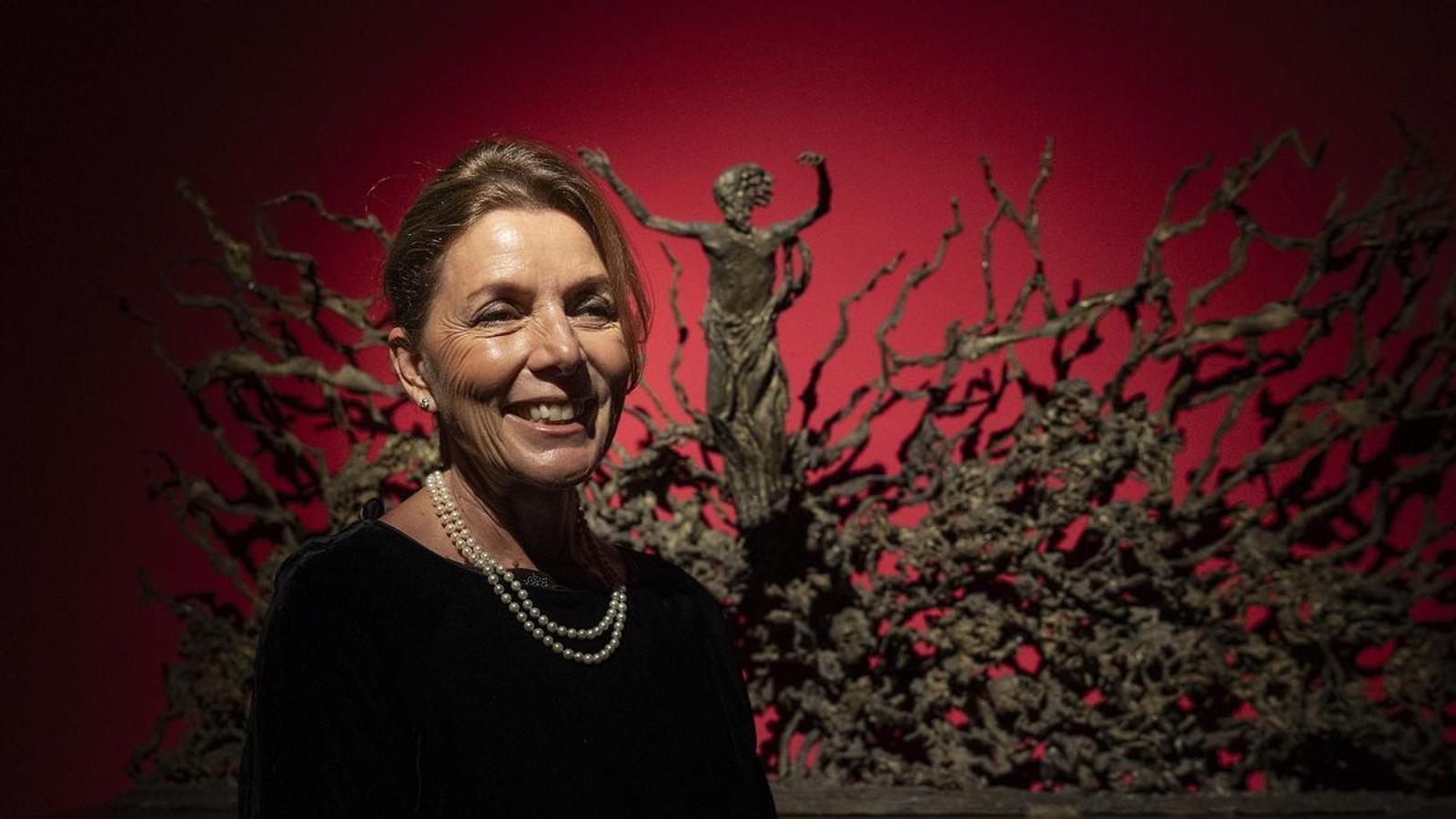

- Barcelona Diocesan Museum. Until December 8th.
The Italian art historian Barbara Jatta has been directing the Vatican Museums for ten years. With 43,000 square meters of exhibition space and seven kilometers in length, it is the sixth largest museum facility in the world, behind giants such as the Louvre, the British Museum, and the Hermitage. Jatta was in Barcelona this Monday for a monographic exhibition at the Diocesan Museum of their collection of 20th-century Italian sacred art. "The Vatican Museums are not just the Sistine Chapel," explains Jatta. "I have been fighting this battle for many years: the Sistine Chapel is an attraction, but the Vatican Museums are made up of about twenty museums that are just as attractive and incredible. We have collections of Greco-Roman antiquities in centers such as the Gregorian Profane Museum, the Pio-Clementine Museum, the Chiaramonti Gallery, or the Braccio Nuovo. But we don't just have antiquities, there are also the Raphael Rooms and the works of the Vatican Pinacoteca, all of them have truly fascinating works!".
The rooms from which some of the works exhibited in Barcelona were taken are located at the end of the Vatican Museums route, near the Sistine Chapel. The collection of sacred art has its origin in the 1963 meeting between Paul VI and hundreds of artists in the Sistine Chapel, to whom the Pope apologized if the Church had ever censored them and said that he needed them to make beauty an antidote to hopelessness. The call worked. Among the 22 works exhibited at the Diocesan Museum under the title of "Sacred art of the 20th century from the Vatican Museums draws attention The crucified man. It is a self-portrait by the artist Ottone Rosai, who was a communist, but found in the image of Christ on the cross a motive to express the labor conflicts of his time. Another highlight is the model of the monumental sculpture Resurrection, by Pericle Fazzini, exhibited in the Paul VI Audience Hall.

For Jatta, religious confession is no obstacle to feeling engaged by sacred art. "We are not only visited by Catholics or Christians; people come from all over the world. We speak a universal language, that of art and spirituality. And some of our works are universal: in the Vatican Museums, you don't just find religious art," he explains. The largest center in the Vatican complex is the Anima Mundi ethnological museum, with some 100,000 pieces from all over the world. This museum has not been immune to the demands for the restitution of pieces that major international encyclopedic museums have received in recent years.
In this sense, in November of last year, Pope Francis transferred 62 objects from the indigenous peoples of Canada to the Canadian Conference of Catholic Bishops, which announced that it would return them to the indigenous communities as soon as possible. Before that, in November 2023, Pope Francis gave three fragments of the Parthenon sculptures to the Greek Orthodox Church, and that same year Francis expressed his willingness to return other controversial pieces from the Vatican collections. "We, the Vatican Museums, make donations, not restitutions, because there was no colonial context [in the acquisition of the works]," Jatta stresses. "Pope Francis gave a kayak to the Canadian communities, for which we have documentation showing that it was originally acquired by a priest to send to the Pope"..
The Vatican Museums are part of the Bizot Group, which brings together some of the most important art museums in the world and where the debate on heritage restitution is a recurring theme. "We are part of the group, but our history is not that of a colonial empire, unlike England, France, Belgium, and the Netherlands," insists Jatta. "The Pope, as the person ultimately responsible for the museums, has every right to decide to donate them," the director explains. "When I went on a delegation to Athens, I understood the importance that the small fragments of the Parthenon have for that people. They even awarded me a decoration, so now I am a sort of star in Greece! But I have done nothing; it is the Pope who has done it for me. We are an open museum, we are the museum of peace. Therefore, this must be our way of doing things.".
The problem of overcrowding
Last year, the Vatican Museums were the second most-visited museum institution in the world, with 6.9 million visitors, only behind the Louvre. "The main problem with the Vatican Museums is tourist saturation," warns Jatta. The year 2025 was exceptional because it was a jubilee year. Back then, and especially this year, Jatta took measures to maintain the quality of the visits. "We have increased the hours by two hours, from eight in the morning to eight in the evening, every day. And we have limited the number of daily visitors to 20,000. In addition, we are fighting against reselling by introducing nominal tickets," says the director. "One of the goals is to make the visit more pleasant. Public numbers dropped significantly during the COVID pandemic, but shortly after we saw that we could not return to the nearly 32,000 people a day we had before," admits Jatta.
After ten years, which works in the museum continue to move Barbara Jatta? "I am very moved walking through the museum, but more than the works, what moves me are the spaces. For example, a high terrace designed by Bramante and finished by another architect named Pirro Ligorio," explains the art historian. "I like to go there very early in the morning, or at night, when there is no one around. From this terrace you see the seven kilometers that the museum covers, and the whole of the Vatican. And I also see my city, Rome. And beyond that, all the fields that surround it."
