Lluís Nacenta: "We cannot make a hodgepodge without criteria of the Design Museum's collections"
Director of the Design Museum of Barcelona and head of programs and contents of the Disseny Hub Barcelona (Dhub)

-
CAT -
CAST
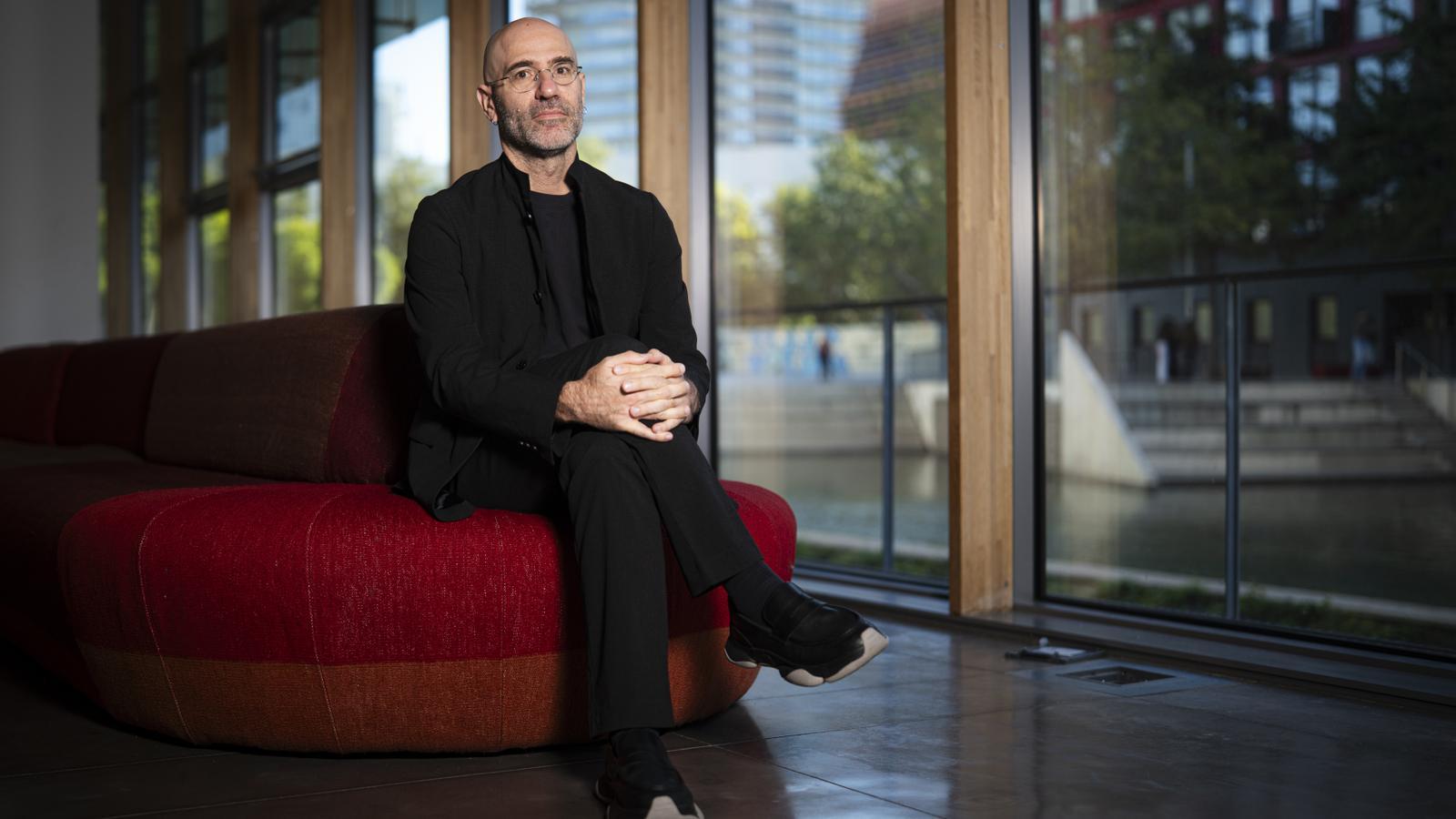
BarcelonaThe curator, writer, musician and researcher Lluís Nacenta (1976) assumed the directorship of the Design Museum in March, after José Luis de Vicente left the position prematurely. Nacenta was the director of Hangar, collaborated with the Mies van der Rohe Foundation since 2012 and is a trustee of the COAC Foundation. In the field of teaching, he has been a professor at various design and architecture schools in Barcelona, including Eina and Bau. Before arriving at the Design Museum, he was head of events and exhibition experiences at the production company La Manchester. And among the exhibitions he has curated, AI: artificial intelligence, at the CCCB stand out.
José Luis de Vicente left two years after assuming the position of director because he was unable to carry out his project. The more conservative sector attacked him very harshly, especially for the exhibition Matter matters, by architect Olga Subirós, which made objects from the collection of different eras enter into dialogue. During the presentation of the season, he questioned the personal stamp on projects. But you were chosen for a specific project. What did you mean by that?
— I understand that it makes sense that it was interpreted that way, but I was not thinking about José Luis's case, but rather the fact that many times an identification is made between the curatorial task and the management task. That is to say, we have all seen many cases, for example, in which the director of a museum is the curator of some projects at the same museum. That is not my approach and it is not the model that I like the most. I will not curate any program at the Dhub in the next five years. It seems to me, and even more so with a facility as multifaceted as the Dhub, that your task should be that of a director, a little more meta, with a bit more abstraction. My concern must be to make it possible for curators with very different expertise to contribute each season to creating a program that is coherent and balanced. On the contrary, what happens, is the exhibition curated by the management more important than the others?
What did you think of Matter matters?
— I liked it a lot. Obviously, it is a complex exhibition, because there are still many difficult topics. But to me it seems like a very good project, which gives us a great opportunity to work, to establish conversations. We will work on it a lot, I already have the conversation open with Olga Subirós to carry out an ambitious program of conversations around the exhibition.
Should the collection's narratives be focused on design, or can the objects be used to address contemporary world issues?
— No cultural project is truly relevant in its environment if it does not contribute to the debate on contemporary crises. It seems to me that any historian would tell you that. Within our heritage, the case of clothing is very clear; that is, our fashion collection takes on a most interesting meaning when we look at it to gain knowledge about current fashion.
Does the disciplinary division of collections into decorative arts, clothing, and industrial design make sense today?
— What happens is that it is an inherited distinction. The Dhub collection was built by incorporating collections that had different origins. There are technical reasons; the conditions required for the preservation of a historical garment are not the same as those for graphic material or a contemporary design object. In the storage area, we must maintain subdivisions that are technical, for reasons of material preservation. And then there are areas of expertise that are very important to maintain, embodied by historians who are experts in the different cultural traditions that are consigned to the different collections. We have experts in ceramics, fashion, graphic design, decorative arts... and we cannot lose all this expertise. In other words, we cannot create a jumble without criteria. Now, this does not mean that later, when we do research work, outreach, and present the collection in exhibitions, we have to strictly adhere to these disciplinary divisions of the collection, because then we would be telling partial stories. For example, the first project we have already started working on, which is the new exhibition of our fashion collection, in which we are working with Sílvia Rosés as curator. It will not only have garments, but will also have graphic material and furniture.
During the presentation he pointed out that his job is for the museum to run "like lightning". Five years from now, with which milestones will he be satisfied?
— The challenges I set for myself for this term can be summarized in three main lines. The first is for the Dhub program to be more ambitious, that is, of even higher quality, and more coherent overall. The second is for more people to come, but this is necessarily linked to broadening the spectrum of the people who come, that is, not only having the professional public, which I believe we have, but also a more civic public, a public more, shall we say, of culture. And the last is to reinforce our role on the European and international scene. A design museum in Barcelona, which is a city that has such a powerful history and such a powerful present in the discipline of design, seems to me to have the potential to play a more relevant role on the international scene.
So, for you, does Barcelona continue to be a design capital?
— If we hold on to the image of the design city of the 80s or 90s, we are wrong. But if we look at the current professional context of design, it seems to me that it remains a design capital.
What does Barcelona currently stand out for?
— Clearly, in the dimension most related to the digital industry, such as the case of video games, and in the context of digital arts; this year we are celebrating the first edition of the Digital Arts Biennial. The effervescence of creators in the digital field in Barcelona and Catalonia is very important. And I see totally cutting-edge proposals in the fields of graphic and industrial design, architecture, and interior design.
What is the European role of the Design Museum?
— We are already working on our exhibition projects for the coming seasons in coordination with various European museums. We are doing what I believe an ambitious Barcelona museum must do, which is to contribute to the European conversation. And this can be done in several ways: through co-productions, that is, projects that we work on from the beginning with a museum in Germany or Belgium, and which is an exhibition that will already have an itinerary conceived from its first edition, or by receiving projects from other museums as traveling exhibitions.
And does the museum have enough muscle to do it? José Luis de Vicente asked that the museum not be only municipal.
— We are fine. I found the Dhub up and running, with an ambitious program, but it is an institution that has room to increase its program, its team, and to gradually increase its budget collaterally [this year's budget is 6.18 million euros]. That is to say, the budget in itself means nothing; the budget must be accompanied by your capacity to execute it, to be more ambitious with the program. You can only ask for more budget if you can say that you can create better exhibitions, programs for debate, dialogue, training, and mediation.
