Joan Vilamala: "TV3 underestimated us, for fear of being seen as folkloric"
Member of the Esquirols group

-
CAT -
CAST

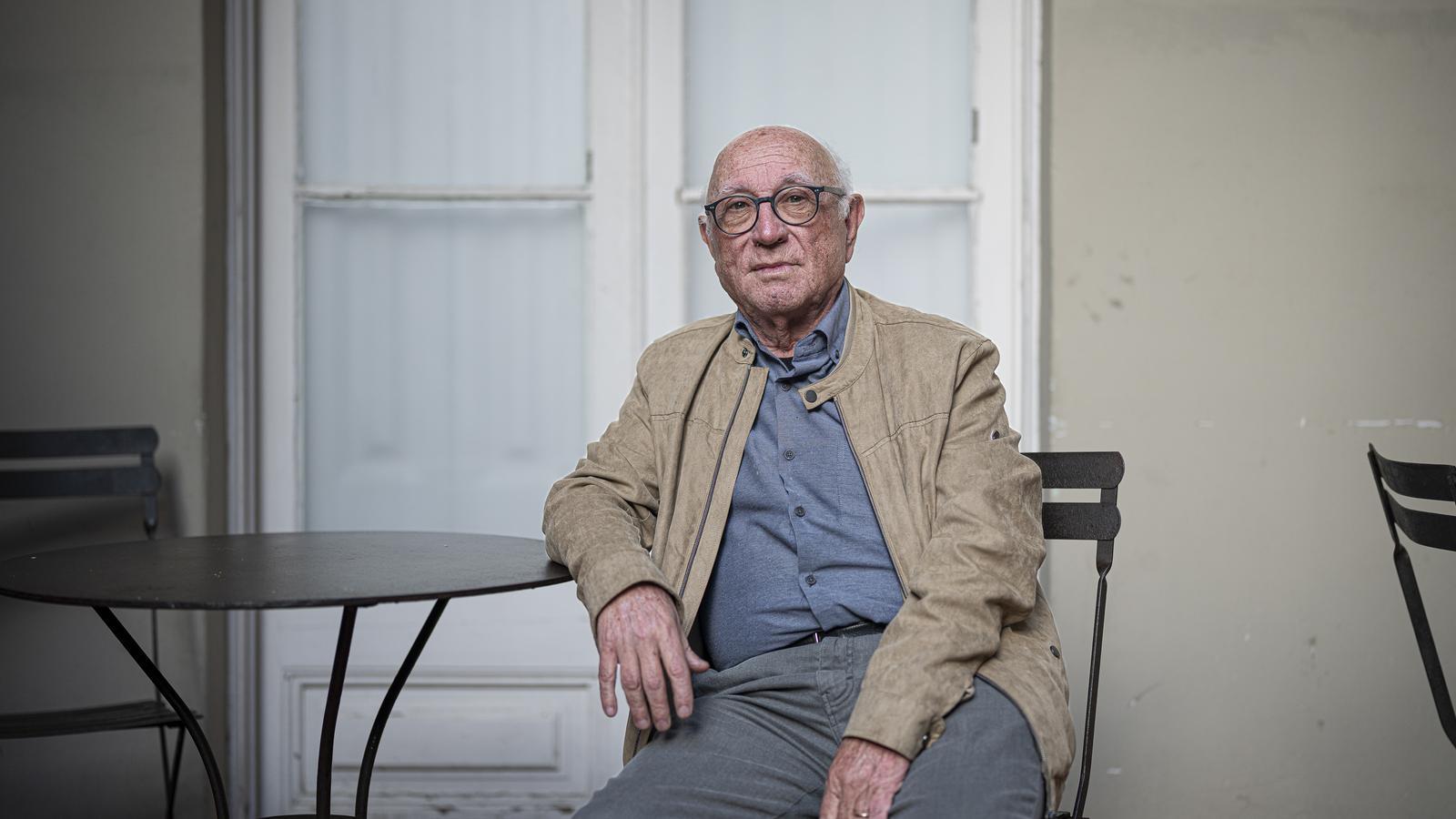
"It is normal that people can say what they think." This is read on the mural that is seen behind his photo, on his WhatsApp profile. But just because it is normal does not mean it is common. Member of the group Esquirols, a priest who stopped being one for love, author of more than 350 'auques' and scholar of Verdaguer, Joan Vilamala lives up to the motto and Enderrock Llibres publishes a volume where he narrates his life, with an accent on his musical facet.
Esquirols folded more than 40 years ago. Why have you told the story in a book now?
— Because the public deserves it. We wanted to leave a mark of our work.
And settling scores with the critics!
— Ah, but I am playing it safe, so that it is seen that these are not my prejudices: I am posting the texts that they dedicated to us.
Did you feel belittled?
— The record label had us debut with the album Cants al vent, which were mountain songs. We were labeled as hikers and they never let us shake it off, even though we were doing Song. Àngel Casas, for example, came to see us at the Romea and his review the next day was titled “Canciones des de la rectoria”. They clung to the fact that I was a priest, but we were singing about freedom, about sexual liberation... I suppose it was immaturity. And that we were singing about national liberation, of course.
Did you pay a toll for not being from Barcelona?
— Of course. The region visits us! We had played some concerts in Barcelona, but above all many small ones throughout Catalonia that whoever was writing from the capital did not take into consideration. Time has put things in their place.
For those who watched TV3, it might have seemed that Catalan rock had been born with Sau, Sopa de Cabra and Sangtraït.
— TV3 did us a lot of harm. They belittled us, for fear of being seen as a folkloric, anthropological television station. From the Cançó, they only played the two or three inevitable names, but as for the rest, nothing. Furthermore, there were many soloists, but very few groups: Coses and Esquirols, practically.
You popularized the Volem pa amb oli. Do we still want it?
— Of course! They are not at all generous, those who have it...
And then?
— We'll have to take it, right? [smiles]. That's what we're missing.
When you see that, forty years later, some of the songs are still relevant, what do you feel?
— That there is much to do, to achieve. Not with weapons, not with terrorism, but with utopia. Like Xirinacs, or like the Somniem by Lluís Llach. This is not finished...!
But these are bad times for lyrics.
— We are humans and man has this dream, this ideal. To be human is to trust in the other: not to see them as an enemy. Catalonia deserves to be respected and we must try to be alive.
If you hadn't been forced to choose between marriage and priesthood, would you still be a priest?
— Yes, but it would be a somewhat progressive priest, one of those who make people a bit uncomfortable, of which there are still a few left. I go to mass often, to some premises that the parish will convert into three apartments for people in need: that is the grassroots Church. We are not among those who worship the temple and its four walls, but rather we focus on the human vision.
You would have continued, but you ran into the dogma of celibacy.
— The bishop told me: "Either you were wrong because you had no vocation or you are wrong now by getting married". Of course: for them, the Church is never wrong! But what were they supposed to do? Take me to the next parish and act as if nothing happened, until I met another lady? One must be consistent. And, in any case, I find it unbelievable that even today the Second Vatican Council has not been properly applied.
Should celibacy be optional?
— What I defend is the end of this way of understanding the Church, not of Christianity. Because one can live Christianity without religion, as Bruno Mori defends, for example.
“As I make my way through life, I will have to eat dust, get into the mud”. What has been the worst mud, the worst dust?
— I am a lucky man, I am. I wouldn't know how to tell you, beyond the moments of pain because you lose someone close. When a friend died, or when my mother-in-law died, in a car accident. I am not resentful at all nor do I have enemies. And I sing to myself: “I have three daughters like three suns, a wife like the moon, when I look at them one by one, I ask myself «What more do you want?»” And, look, I was going to be a priest and I ended up being a dad.
Don't let Leo XIV find out, or he might excommunicate you!
— I just don't need this whole setup. It is the last remaining absolute monarchy. I am a child of the Second Vatican Council and it pains me to see that the Church has become so cowardly.
In the book you link national and class liberation. But nowadays a part of the left sees independence as essentially bourgeois.
— I believe there are people who have worked a lot on this double line, like Casaldàliga. Independence should not be either right-wing or left-wing: it must belong to the people, and among the people there is everything. Because it is when we go together that we are unstoppable.
Another facet of yours: scholar of Verdaguer, as a good native of Folgueroles. Do we hold him in high regard?
— More and more. We should value him as an undisputed classic. And take off his cassock. People see the cassock and get scared. It's curious, isn't it? Lope de Vega was also a priest and he is not reminded of it every other minute. Yes, Verdaguer wrote poetry on commission, and prayer cards, and mediocre verses. But if you go to Flors del Calvari or the Canigó... sublime. Furthermore, Verdaguer was like King Midas, everything he touched he turned into gold: the rafters, Montserrat, the Canigó, the Pine of the Three Branches. He was truly a father of the homeland.
Living up to your name, Esquirols, you were elusive with censorship.
— I remember that you had to ask for authorization before recording a song, sending the lyrics translated into Spanish... And they rejected some of ours. Back then you tried to bypass censorship with wit. In Goig de Sant Democraç we spoke of “tastalunglans”. Tasta in Spanish is cata (taste). And ungla, uña (nail). The tastalunglans were the Catalans. And if later we sang “Four hundred grams!” it was because four hundred grams was a pound. That is to say, free.
And were the concerts also monitored by the competent authority?
— Yes, of course, and then you would try to take the social workers out for a drink, to be able to touch upon the most delicate topics.
In the Joy of Saint Democracy you also sang: “If forty years were a long time for the forced quarantine, one must be vigilant, to immunize, against a new virus of that kind”. Seeing the electoral polls, it does not seem that the vaccine has worked.
— Indeed. But I am optimistic and I hope that the far-right does not succeed.
