The monstrosity that lies behind the search for the ideal of beauty
From the Greeks to AI-created models, the artistic exhibition 'The Cult of Beauty' shows at the CCCB the origin and effect of the pressure of the canon

-
CAT -
CAST
- CCCB. From May 21 to November 8, 2026
The Naked Maja, by Francisco de Goya, was a groundbreaking painting from the late 18th century, both for the sensual attitude of the model depicted and because the artist dared to paint a female pubis. But behind this apparently naturalistic and brave image also lies a whole cultural and social framework that led Goya to portray a woman of canonical beauty, sufficiently exuberant yet also sufficiently domesticated, with that white, smooth skin, free of misplaced hairs. Ester Conesa, from the feminist collective Peliagudas, has drawn the missing hairs on an almost exact copy that can be seen in the new CCCB exhibition. Through time and multidisciplinary works of art —painting, photography, cinema, installation—, "The Cult of Beauty", which can be visited until November 8, explores precisely all the ugliness hidden in the pursuit of this ideal. Beauty is intangible and mutable depending on the era, morality, status, race, agenda, industry, etcetera, and it undoubtedly provokes as much pleasure, admiration, and desire as, by opposition, shame, pain, and marginalization for those who are left out.
From Ancient Greece, the images of women reproduced in statues were already conditioned by an idea of artificial beauty, based on olive skin tone and a lot of makeup. Later, Greco-Roman sculptures would establish the foundations of beauty canons that have endured to this day, an ideal that is reproduced faster and more globally than ever through social networks and selfie culture. As Aitana, an AI-created model with a face of ultranormative and mesmerizing perfection, says at the beginning of the exhibition, today the mantra prevails that "beauty is something you can achieve if you try hard enough." The cosmetics and aesthetics industry is exploiting this: just look at the fever for Ozempic and new disorders like cosmetorexia.
The exhibition aims to dynamite this impossible ideal and seeks to distort its contours to make it more diverse and inclusive. One of the initial videos shows a performance by trans artist Lorenza Böttner, painted white, embodying a Venus de Milo that looks very much like a marble sculpture. "Böttner lost both arms as a child, climbing an electric pole to look at a bird's nest. This can already make us think that the pursuit of beauty involves sacrifices or losses —says the exhibition's curator, blanca arias—. But beyond that, it also raises the question of why bodies that we would consider beautiful within a museum do not seem so to us when we go out on the street. The exhibition's basement aims to broaden the silhouettes of the bodies we desire, that we want to care for, and that we want to accompany throughout life".

What did Napoleon smell like?
The exhibition was born at the Wellcome Collection in London in 2023, curated by Janice Li. In Barcelona, it expands with local works and readings, through curators blanca arias and Júlia Llull. For example, when it shows how religion has used beauty to symbolize the purity that connects with divinity, it relates a Virgin Mary from the MNAC, a bust of Nefertiti, and a painting of Krixna. Or when observing the contrast between the Orientalist paintings of Tapiró, Fortuny, or Fabrés, which exoticized the racial difference that was bearable at the time, and the intense and agitated portraits by Colita in the gypsy settlements of Montjuïc and Somorrostro. Ismael Smith's drawings are contrasted with the men from the Essence colony. A special work for the CCCB is Perfums masculins, by the Ernesto Ventós Foundation, which has recreated what the perfumes of Tutankhamun, Nero, and Napoleon would be like as archetypes of masculinity, to remind us that beauty is synesthetic, and is perceived with all the senses. "Perfume is a matter very linked to desire and social, economic, political power," says arias, especially when it was influenced by the spice trade.
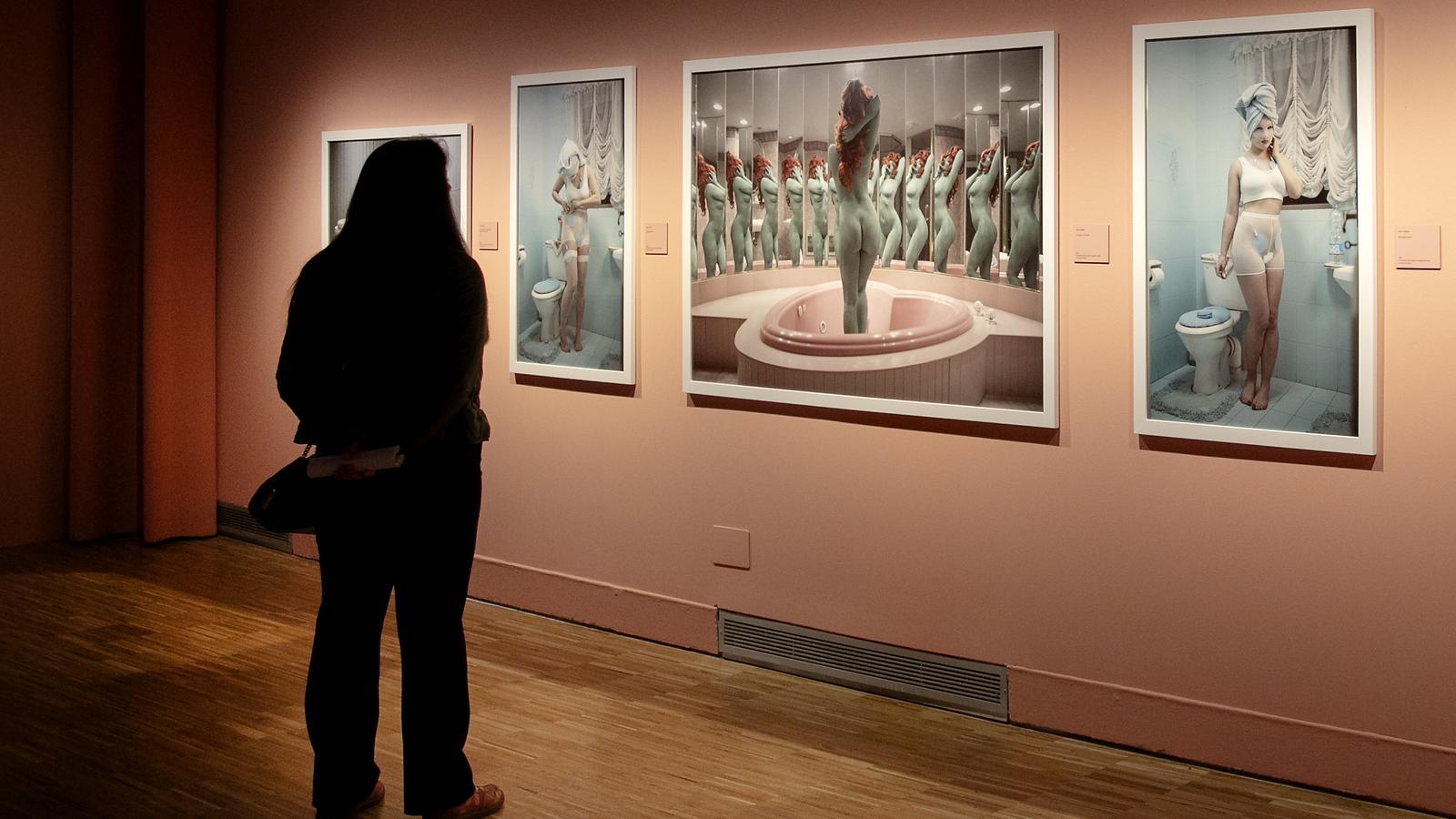
Each work in the exhibition poses particular reflections on beauty, all centered on human beauty and, in particular, on female pressure and against dissident bodies. Juno Calypso's pop photographs, which show the modification processes that women undergo until they resemble aliens, demonstrate how "a lot of ugliness and sacrifice has been produced under the banner of beauty," says Llull. There are also newly created works like that of Xcessive Aesthetics, which reproduces women's restrooms in a nightclub as a space of sorority and at the same time of aesthetic pressure through mirrors that are TikTok videos. It is a paradox that is repeated several times in the exhibition: the same channels that serve to reproduce the canon of beauty and enslave us can also be subversive channels or be phagocytized by capitalism if it sees potential market. Examples of this are Barbies of all colors and with functional diversity.
From mothers to daughters
Part of the exhibition analyzes how norms are already imposed from childhood, often from mothers to daughters; an extreme case is girls and young women victims of beauty pageants. It also delves specifically into skin, hair, and contours, as elements to overcome the predefined silhouette of beauty. Shirin Fathi explores plastic surgery in Iran with The Disobedient Nose. Angélica Dass dismantles racism through a Pantone of portrait colors. And various works expose extreme carnality, from humor or the plasticity of the skin. A very striking and emotional installation is by Narcissister, an artist who performs masked, and who at the CCCB exhibits her most personal work: she takes all the concrete objects that connect her with her deceased mother and places them together to heal the pain of being a racialized daughter with untamable hair who will never resemble her beautiful, Jewish, white mother with straight hair.
"I've been asked many times if there is a universal beauty. If someone is looking for a yes or a no, there is no answer in the exhibition. There is no single ideal, what is fascinating is the search, the cult," states Janice Li. The exhibition aims to be a space for debate on a very delicate and complex issue. For this reason, the public program has invited names such as writers Zadie Smith (author of On Beauty) and Irene Pujadas, artist Nora Ancarola, scientist Remedios Zafra, philosopher Eloy Fernández Porta, and film critic Desirée de Fez, who will curate a special Gandules cycle on the obsession with aesthetics.
