Reread Samuel Beckett in full housing crisis
Club Editor begins to publish the stories and novels of the Irish author with 'Narrations and Texts for Nothing', translated by Joaquim Sala-Sanahuja

-
CAT -
CAST
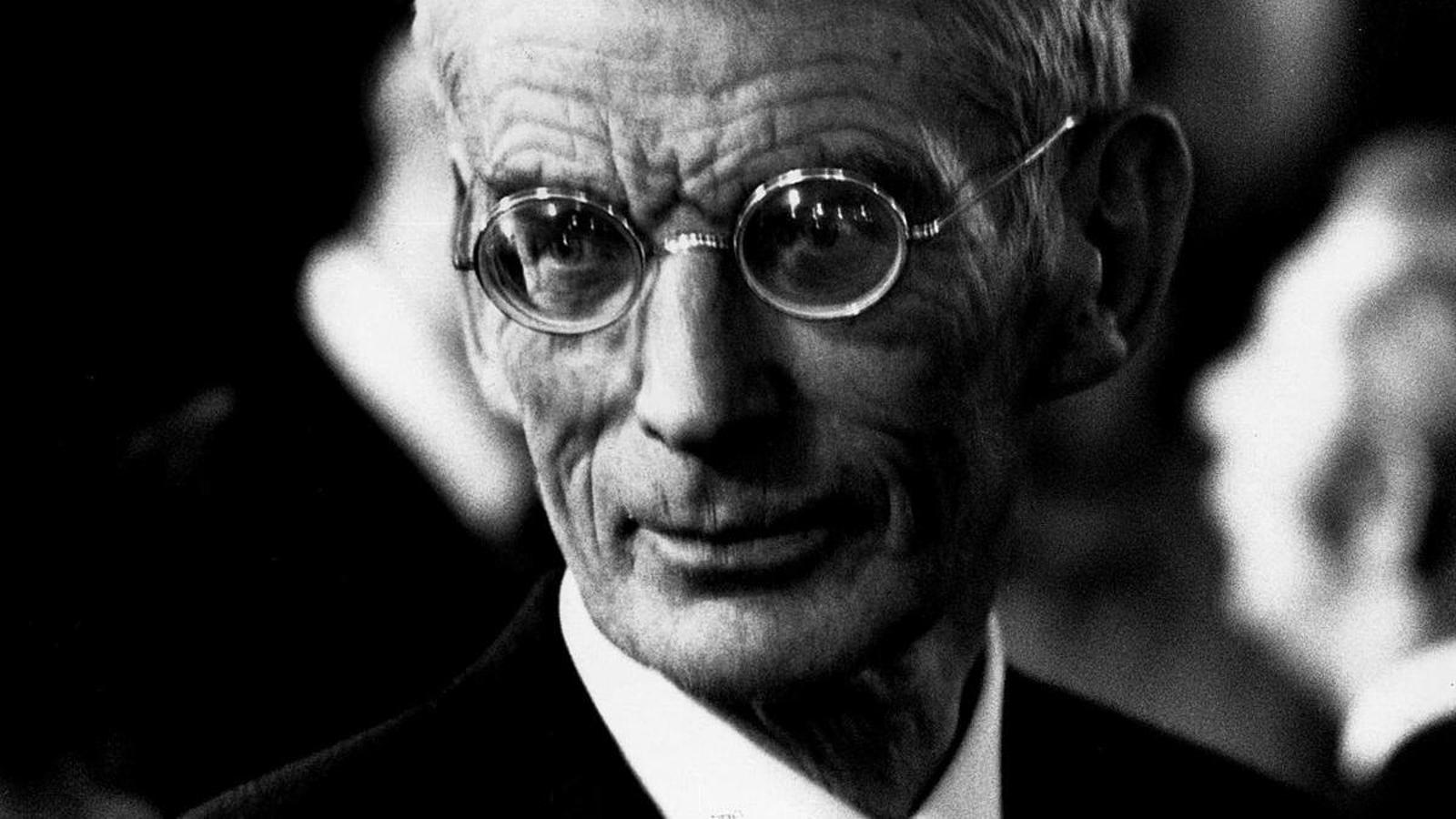
BarcelonaOn October 23, 1969, the telephone rang in the room of the Tunisian hotel where Samuel Beckett and his partner, Suzanne Déchevaux-Dumesnil, were on vacation. She answered, and a spokesperson for the Swedish Academy informed her that her husband, the author of such acclaimed plays as Waiting for Godot (1952) and Endgame (1955), had just won the Nobel Prize in Literature. "What a catastrophe!" he exclaimed. With these two words, he summarized the discomfort with which Beckett lived the award: he did not go to Stockholm to collect it, he did not keep the financial compensation, nor did he allow himself to write anything for a good while, until the world had managed to forget that his work had deserved such a prestigious distinction.
Beckett won the Nobel at the age of 63, when the bulk of his work had already been published, although the Irish author would continue to write and disseminate increasingly hermetic texts until almost the end of his life. The last one, the prose Stirrings still, arrived in 1988, months before his death. "He is one of the essential authors of the 20th century, one of those great creators of forms who respond to philosophical visions of the world and who reform literature to express what an era conveys," explains Maria Bohigas from Club Editor, which has just added Beckett to its catalog with the volume Narracions i Textos per no res (Stories and Texts for Nothing), written in 1946 and 1950, respectively. "His success as a playwright overshadowed the prose writer Beckett also was, but I'm having a wonderful time translating him: otherwise, I wouldn't be dedicating myself to it at this stage," argues the translator Joaquim Sala-Sanahuja, who is currently working on the first Catalan versions of two of the author's most emblematic novels, Malone Dies (1951) and The Unnamable (1953). "The latter stops having distinct paragraphs from a certain point onwards and requires a lot of concentration, but it's an impressive reading experience," he admits.
Resisting the elements
It will be at the end of 2027 when Club Editor releases Malone meurt and L'innommable, preceded by Molloy (1951). "There was indeed a translation of this in 1991, by Ramon Lladó, who is currently revising it, and which we will publish with the rest of the triptych in a single volume," advances Bohigas. It was through the commissioning of an early play by Beckett, Eleutheria (1947), that the publisher delved into the author's novels and stories. "They stay with you for a long time, unlike many other books – she comments–. It is worth trying to make him known as a prose writer in Catalan. To welcome his work, full of characters who live without homes, immersed in a great housing crisis like the current one, is not without impact. Beckett gave a voice to those who have the least of all, the people who live on the street. His protagonists resist with their integrity despite all sorts of hardships they suffer." During his early years in Paris, Beckett was very close to the city's homeless, the well-known clochards, until one of them stabbed him in 1938 and nearly ended his life.
The reading journey proposed by Narracions
and Textos per no res is very suitable for discovering the author. "The three Narracions have a narrative thread – comments Sala-Sanahuja, who has previously translated authors such as Fernando Pessoa, André Breton, Raymond Roussel, and Francis Ponge into Catalan–. In the thirteen Textos per no res, the narrator weaves a story without a plot. They are a kind of meta-narrations in which we follow the philosophical and often tragic discourse of a voice." The first begins like this: "Suddenly, no, after all, after all, I couldn't take it anymore, I couldn't go on. Someone says: 'You can't stay here.' I couldn't stay and I couldn't go on." Bohigas refers to the story that opens the volume, L'expulsat: "It begins with someone being thrown out of their home. When they are already on the street, they throw their only remaining possession, their hat, after them. From here, they set off and wander through a city that could be Dublin. Beckett's characters have the peculiarity of comforting the child they once were and the dead person they will one day be."
So far, Samuel Beckett's extensive narrative work has not fared very well in Catalan: apart from Molloy (1951), one can only read Primer amor
(Lleonard Muntaner, 2010; translated by Anna Soler-Horta) and Mercier i Camier (Quid Pro Quo, 2020; translated by Marta Marfany).
