The erotic painting of Joan Miró that you cannot miss
The new deposit of the Katsuta Collection incorporates 37 works by the artist in Barcelona

-
CAT -
CAST
BarcelonaParis was decisive for Joan Miró to become one of the most important artists of the 20th century. But he did not have things easy at all. In a letter dated September 1923, he explains to his friend Josep Francesc Ràfols that he was working "a lot, with absolute regularity and method". "I have managed to free myself completely from nature, and the landscapes have nothing more to do with the external reality," he told Ràfols. All this, Miró did in complete poverty; sometimes he could only afford a handful of dried figs to get through the whole day. "During that period, hunger caused me hallucinations, and the hallucinations gave me ideas for painting," Miró later explained in an interview.
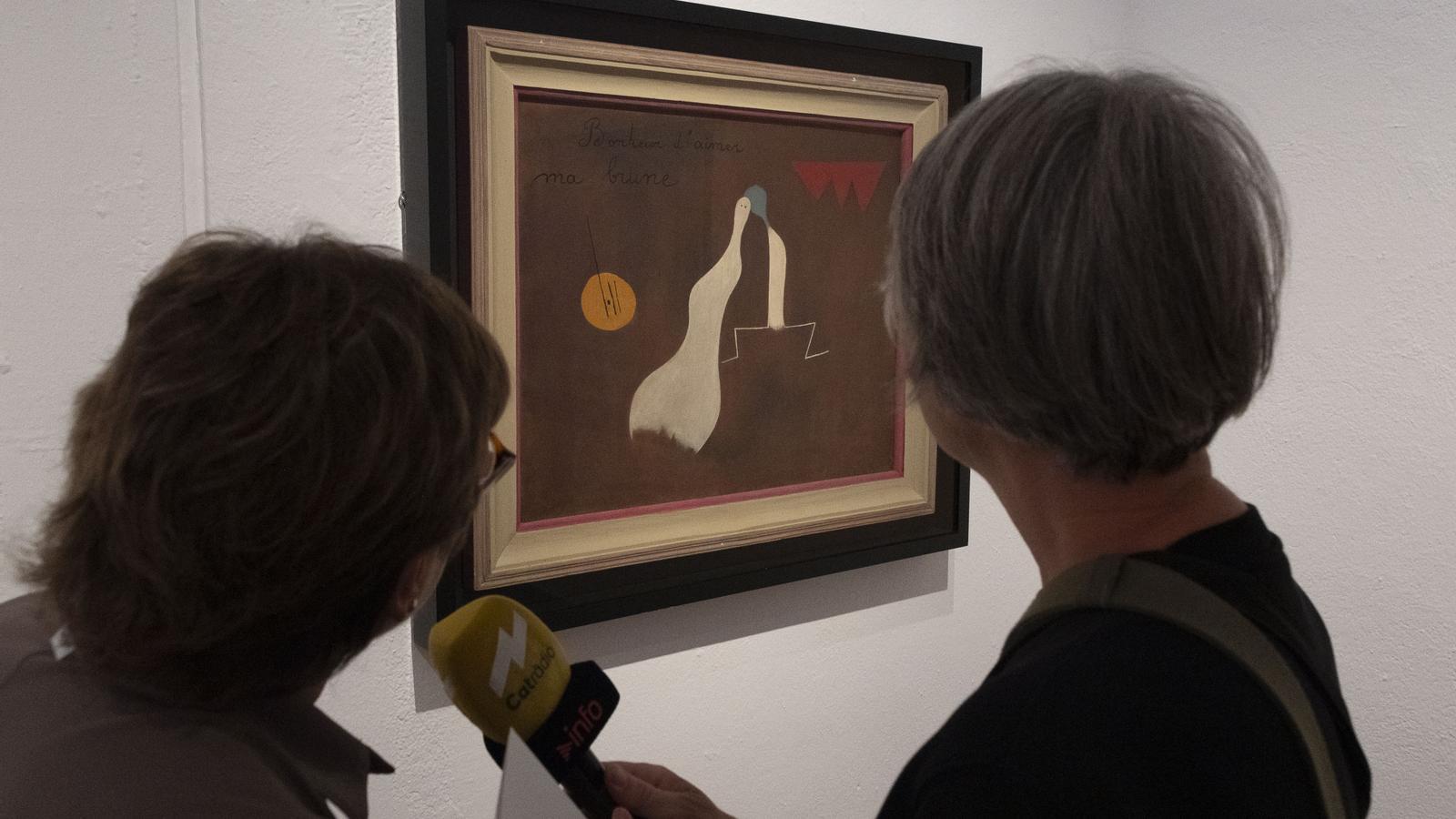
The suffering bore fruit: in the summer of 1925, he painted some of his first "oneiric" canvases in Mont-roig del Camp, one of which, Peinture-poème (Bonheur d’aimer ma brune) [The joy of loving my brunette], can be seen at the Joan Miró Foundation starting this Thursday, as part of the new deposit from the Katsuta Collection, with which the foundation has a relationship that dates back to the celebration of the Joan Miró centenary in 1993. Peinture-poème (Bonheur d’aimer ma brune) is a rather recent acquisition by collector Kazumasa Katsuta; he bought it for about 4.8 million euros at a Christie's auction in New York in 2019.
The "oneiric" paintings were the first major extensive pictorial cycle and are the works in which Miró represented one of the first sexual scenes of a couple of lovers. In the painting, there are joined red triangular shapes that could evoke the peaks of Montserrat or a female pubis. Furthermore, this canvas could be the first composition in which Miró wrote a verse about the feeling of exaltation of being in love: "The joy of loving my brunette". The first owner of the work was the writer Raymond Queneau, with whom Miró collaborated in the 60s on the portfolio of lithographs with a poem by the Frenchman titled Àlbum 19.
The new deposit of the Katsuta Collection includes 37 works by Joan Miró and will last ten years. Peinture-poème (Bonheur d’aimer ma brune) is one of the six that had not been part of any previous deposit. According to the foundation's new director, Maribel López, the relationship between the works in the permanent collection and those in the deposit is a way to "continue discovering Miró's thought". And Kazumasa Katsuta's daughter, Akiko Katsuta, says that, although it "breaks her father's heart" to be far from these paintings and sculptures, she believes that "having them at the Foundation is what Miró would have wanted".
The experimentations of Joan Miró
"A particularity of the Katsuta collection, which is in addition to the works that the family deposited at the Foundation, is that it shows a Miró who is in constant experimentation," explains the head of the collections of the Joan Miró Foundation, Teresa Montaner, to ARA, which are especially rich from the 60s onwards. Now, in addition to Peinture-poème (Bonheur d’aimer ma brune) it receives another important earlier work –Pintura, from 1936–, which is part of the artist's masonite series. "The incorporation of this work will allow us to carry out research that will end in an exhibition focused on paintings on masonite in 2028," says Montaner. It is planned that the curator of this exhibition will be Robert Lubar, the North American art historian who resigned from the Foundation's board of trustees following the appointment of Maribel López.
Starting this Thursday, 29 of the 37 works will be exhibited, while the rest of the pieces that make up the deposit will be incorporated gradually, according to the rotation of the pieces in the permanent collection, renewed in March by Montaner herself and the artist and researcher Marta Ricart, with Miró's work processes as a common thread. Among other additions, Pintura (1927), The open sky gives us hope (1954), Landscape at night (1966-1974) and Song on white background (1966) stand out –the Joan Miró Foundation does not have any similar work–, and two paintings from 1960, Pintura V/V and Pintura IV/V, which emphasize how Miró renounced his sign language to produce more cosmic works. "With the incorporation of the new works we can complement series of which we already have some work and delve deeper into them. One of the main characteristics of the Katsuta collection is that it reflects how Miró constantly interrogated matter, and how he went from the most material to the sense of spirituality by insisting on material work," says Montaner.
The link between heaven and earth
Six of the works are sculptures, two of which are ceramics from 1962. "In our collection, we have few ceramics. One of those in the new deposit is circular, and it relates to Miró's idea of recovering the ancestral dialogue between heaven and earth. And, furthermore, it is also like a nod to a project Miró had to create a ceramic circle in the sculpture room that was ultimately never made," says Montaner.
The collection of Kazumasa Katsuta, who has been a patron of the Joan Miró Foundation since 1999, consists mainly of works by Joan Miró from the collection of Pierre Matisse, who was his art dealer in the United States from 1932. After the death of Matisse, and coinciding with the centenary of Miró's birth, the Yokohama Museum of Art hosted the Joan Miró Centenary Exhibition: the Pierre Matisse Collection. A prominent part of the exhibited works, which since 1990 were owned by Acquavella Galleries, was acquired by Kazumasa Katsuta. The Katsuta Collection includes representative works from all of Miró's creative stages. In addition to the core originating from the Pierre Matisse Collection, the Katsuta Collection has been expanded with works from other prominent collections, such as that of Raymond Queneau and that of René Gaffé.
