"The 17-A was not just about catching some terrorists, there was a communicative war at stake"
The thriller 'Cronos', with Enric Auquer, Mónica López and Sandra Gómez, relives the 2017 attacks in Barcelona and Cambrils
-
CAT -
CAST
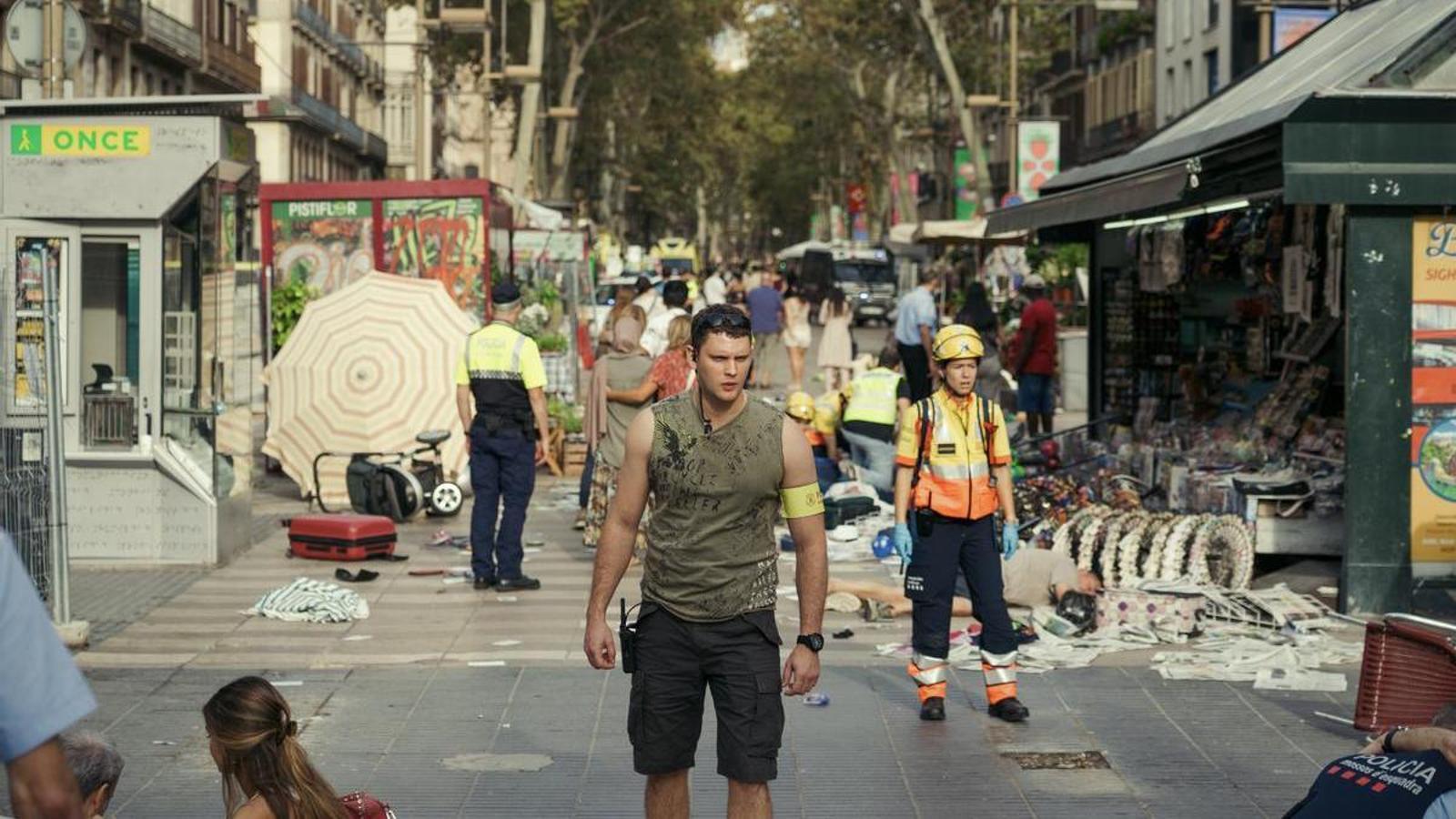
BarcelonaSixteen deaths and more than a hundred injuries make the attacks of August 17, 2017, in Barcelona and Cambrils the bloodiest terrorist massacre of recent decades. A trauma in the collective memory of the country that, according to screenwriter Alberto Marini (Turin, 1973), a Barcelonan by adoption, was forgotten too quickly: “The memorial for the attacks is on the ground of La Rambla; many people don't even know it. Immediately, the shops reopened, the Barça match was played, and there was a desire to turn the page. Possibly, there was no desire to probe deeper into the wound, but to heal a wound, one must scratch the flesh and clean it, not just forget about it.” Marini signs the script for Cronos, the thriller about the 17-A that premieres this Friday in its original Catalan version and that relives those days of anguish and confusion through the work of the Mossos d'Esquadra to control the initial situation and arrest those responsible for the attack.
The decision to address the events solely from the police perspective was made by Marini and the case investigators who advised him, Nacho Carretero and Arturo Lezcano González, but it is also fully assumed by the film's director, Fernando González Molina (Pamplona, 1975). “With another approach, I would not have been part of the project, because it would not have worked,” asserts the director of box-office hits like Palmeras en la nieve and El guardián invisible–. “I find no sense in focusing on the horror of the victims, which is already in the account of the events. And it also makes no sense to explain the story of the terrorists, with all the questions that are still on the table. We base ourselves on an architecture of real facts and a very powerful investigation: it was the way to flee from easy sensationalism.” Marini points out that the film wants to go beyond the chronicle of a terrorist manhunt and “pose the dilemmas and conflicts that the attacks generated in society”.
The narrative threads that Cronos pulls to recount the sequence of events of August 17th are three, each with a reference character: the head of the Mossos (Enric Auquer) who organizes the police operation on La Rambla during the minutes following the attack; the force's head of communication (Diana Gómez), who coordinates the information made public, a character very much inspired by Patrícia Plaja, and the Mossos d’Esquadra officer from Ripoll (Mónica López) who discovers with horror that the perpetrators of the attacks are kids she knew and loved. “It is inspired by a police officer, but above all by a social worker who continued working in Ripoll, Núria Perpinyà, and she helped us a lot to understand how your head explodes when you are told that some children you take to the youth center and who were born there and speak Catalan are terrorists,” explains López, who through her role illustrates the fracture in coexistence that opened up on August 17th in the capital of the Ripollès region. Auquer also points this out: "The country was left very shaken after the attacks, from where the Catalan nationalist far-right that we have now emerges. The film attempts to open a space for reflection on this".
The actor admits that it was not easy for him to step into the shoes of a police officer. “There was no way, I didn't know how to approach it –he admits–. I would say I am closer to the drug dealer from Quien a hierro mata than to this Mossos officer, and it was very hard for me to find the voice of authority and feel legitimized”. He was helped a lot by meeting the Mossos inspector on whom the character is partially based, Jordi Rodón. “He is the person who set up the command center and the field hospital, and brought order to the chaos of ground zero. A super-cop, let's say, with a nervous system prepared to handle a situation like that. For him and for all the Mossos, those days were the most important of their professional lives”.
An emotional reconstruction
In the portrait that Cronos paints of the Mossos, emotion is a major protagonist. Throughout the film, the characters played by Auquer, López, and Gómez cry, but so does the plainclothes officer who crosses paths with Younes Abouyaaqoub, those who witness the massacre on the Rambla, the one who shoots and kills four terrorists in Cambrils, and the two who take down Abouyaaqoub in Subirats. “It wasn't a conscious decision to humanize or justify the Mossos, but rather what we discovered during the preparation of the film,” explains González Molina. “In fact, the testimonies of the people we spoke with were much more emotional, and we had to perform an exercise in restraint.” Marini adds that, due to the conventions of thrillers, "we are used to police officers who shoot, holster their weapon, and check if the suspect is dead, but reality doesn't work that way. The two Mossos who shot Younes were devastated and lost, because they didn't know if they had shot a terrorist or an innocent person.”
Auquer himself admits that he had reservations about embracing the film's emotional exaltation. “What are we going to do, a movie about crybaby cops?” he once snapped at González Molina. “I resisted crying, but when I spoke with Rodón, he explained to me that when he finally went down the Rambla and saw the dead and the phones ringing, he completely fell apart and cried. And while he was telling me this, he was crying.” The actor defends the film's decision to offer a “more homely and Mediterranean vision of the Mossos” and to move away “from that very American, Hollywood-style vision,” adding that, although he himself started with a “stigmatized” view of the Mossos, he has discovered many people within the force who believe in “a democratic police force and in purging responsibilities, people who see it as disproportionate to evict people from their homes.”
For those who already know the ins and outs of the case –for example, thanks to the excellent documentary series 800 metros–, the most interesting plot in Cronos will perhaps be the one starring Diana Gómez as head of communications for the Mossos, which portrays the struggle between the Catalan police and other security forces and government bodies to control the narrative of 17-A. “We didn't look for this storyline, we found it –explains Marini–. We spoke with Patrícia Plaja to find out what had happened in the command room with Trapero and company, but she also told us about the battle for the narrative in which she became involved. 17-A was not just about catching some terrorists, there was a communicative war at play. And Diana's character not only has to deal with the central government, but also with the Generalitat, a very interesting triangulation that served to explain the social and political context”.

