The most transversal general strike makes a cry for housing
The central mobilization of the strike will be at 17:30 hours at Jardinets de Gràcia, in Barcelona
-
CAT -
CAST
- The call is also for an improvement in wages and to stop the loss of purchasing power
- The strike has been labeled as political by some sectors
- The strike is the first major general strike in 14 years in the State
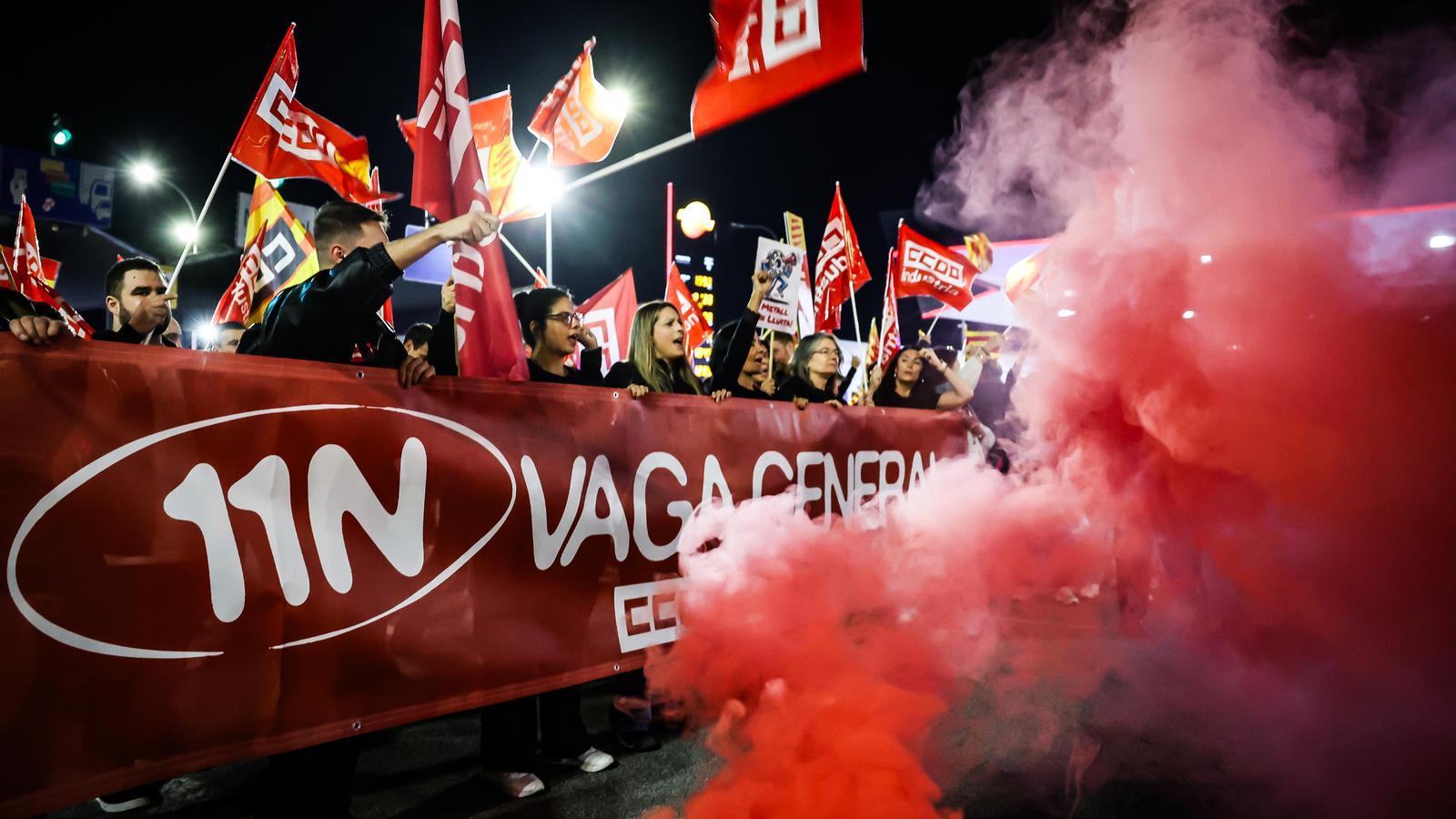
This Wednesday, the most transversal general strike since the Transition is being held. Major trade unions –CCOO and UGT–, the organizations of the Trade Union Table –CGT, IAC, Co.bas, CNT, COS, SO– and housing entities –such as the Tenants' Union– have called for mobilization to stop workplaces across the State. The day, which aims to "stop everything," demands strictly labor-related proposals, such as wage increases and halting the loss of workers' purchasing power. And, for the first time, a general strike on a Spanish scale also asks to intervene in the housing market. It has been 14 years since a 24-hour general strike has taken place with the consensus of the major trade unions.
The call, which arose a few weeks ago following the Congress of Deputies' rejection of what are known asMaricarmen decrees, is an offensive strike: it does not complain about a loss of workers' rights, but rather aims to put on the table different situations that, according to the unions, currently strangle the working class. An offensive strike is no anomaly. Examples of this have been the March 8th strikes, or those carried out in companies or sectors to unblock collective bargaining, although the last major strictly labor-related general strikes in the State were defensive in the face of labor reforms pushed forward following the great crisis of 2008.

Regarding the specific proposals of the organizers, the various unions are demanding salary improvements and access to housing, which they consider has become a “factor of impoverishment and labor precarization.” The trade union organizations believe that the measures taken so far – such as rent control – are “insufficient” and point out that housing is added to the rising costs of other basic necessities and essential services. Thus, although they all agree on the need to urgently approve theMaricarmen decrees, they also consider it to be a "band-aid" for a much larger problem. Furthermore, they also urge unblocking measures such as the law on occupational risk prevention and the reduction of the working day to 37.5 hours – or 35 hours.
That the electoral calendar has impacted the calling of the general strike – which was announced before the elections – has led some to accuse the mobilization of being political. And that different parties have wanted to capitalize on the demands. The organizers, however, have distanced themselves from the parties and, although the Maricarmen decrees fell due to the opposition's votes, they have also pointed out that the Spanish and Catalan governments have not done enough for housing in recent years.
Mobilizations and roadblocks
During the day, unions and organizations plan to carry out mobility disruptions and information pickets throughout the country. In fact, the first actions will begin this Tuesday: it is expected that the entry of night shift workers will be stopped at centers such as Seat or Mercabarna. Throughout the morning, information columns are also expected to be distributed across the different Catalan regions.
The main demonstration, however, will take place in the afternoon in Barcelona. Specifically, at 5:30 p.m. at Jardinets de Gràcia. It is worth remembering that the Socialist Housing Union of Catalonia (SHSC) and the Solidaritat Obrera (SO) union have called an alternative demonstration at 5:00 p.m. at Plaça Jacint Verdaguer. In Tarragona, the protest will be at 6:00 p.m. at Plaça Imperial Tàrraco. In Girona, at 5:30 p.m., at Plaça de l’1 d’Octubre and in Lleida the mobilization will depart from Plaça de Ricard Vinyes at 5:30 p.m.
An unprecedented strike
This is a general strike different from the rest of the strikes that have taken place in the State in the sense that it does not arise for a purely labor-related motive, but rather focuses on a set of socioeconomic issues surrounding housing that are at the same time linked to the population's income and, therefore, to wages. Furthermore, it does not arise from traditional class unions, but has been promoted by the housing movement. Specifically, the Confederation of Tenants' Unions. The Tenants' Union is an alternative union that was born in the face of the housing problem and in particular that of rents in the State. Much earlier, in 2009, the Platform for People Affected by Mortgages (PAH) was born in Barcelona, which also supports the strike, as a response to the real estate bubble and the 2008 financial crisis in Spain.
In a political context marked by the imminent electoral campaign –which will begin this Friday–, the unions anticipate massive demonstrations and seek to halt activity, but they foresee that there will be a different level of participation depending on the territory and the impact of the housing crisis in each part of Spanish territory. In Madrid, the main event of the day is also in the afternoon, at 6:00 p.m., when a demonstration is called at Atocha that has the support of the Tenants' Union of Madrid and the majority unions, CCOO and UGT, but also of the CGT and the CNT. The demonstration will end at Plaza España and by midday there will already have been a gathering at Plaza de la Cibeles.
